

October 10 2025
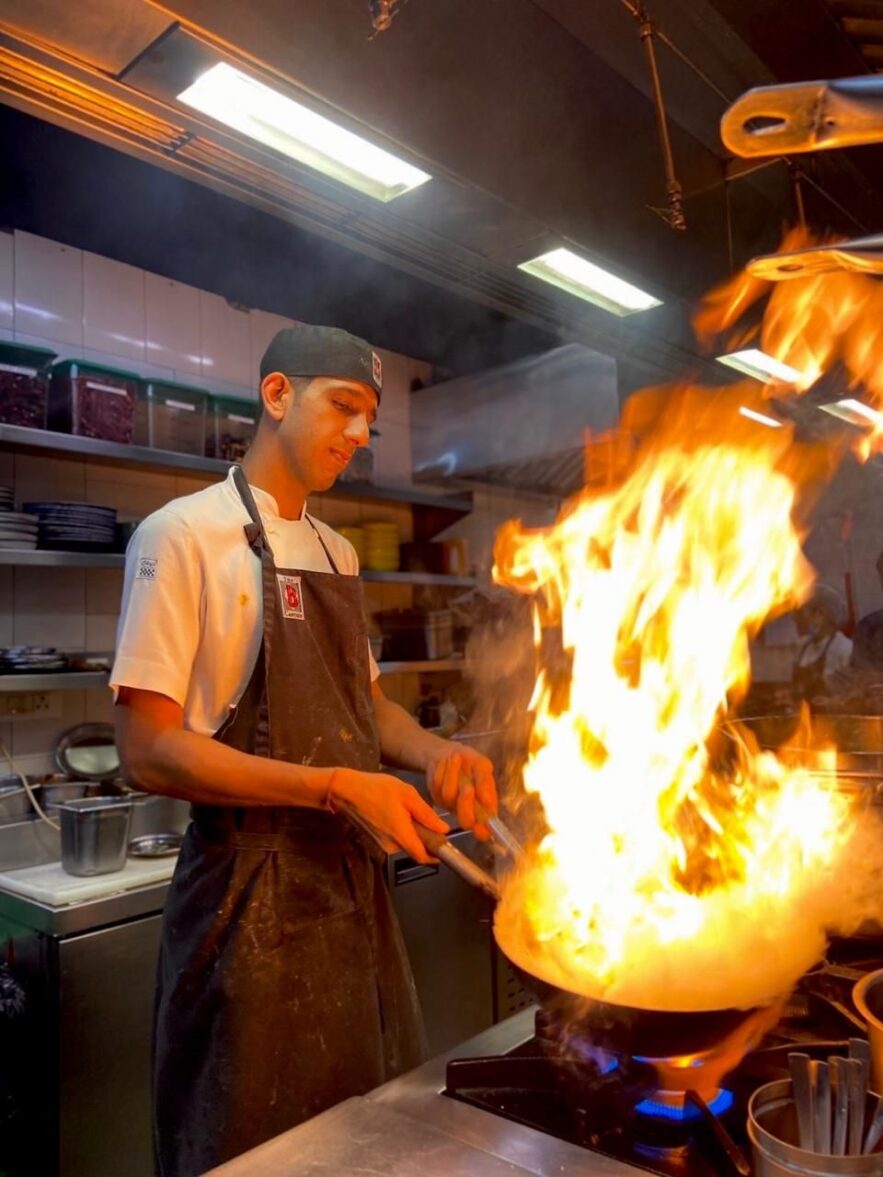
In the open kitchen at Adda in New York’s East Village, the air shimmers with heat and
focus. Orders move in quiet rhythm. Flames from the tandoor lick the edge of copper
pots while servers weave between tables carrying Le Creuset biryanis and bheja fry still
hissing in butter. To the untrained eye it looks like chaos, but to those who know the
structure of a fine dining kitchen, the choreography is unmistakable. Every hand has its
role, every motion a purpose. At the center of it all is Sous-Chef Shubham Sharma,
whose path from Mumbai’s most experimental restaurants to one of Manhattan’s most
demanding kitchens has shaped Adda’s balance of precision and exuberance.
Shubham’s early formation as a chef took place across two of India’s most forward-
thinking kitchens, The Bombay Canteen and Masque. At The Bombay Canteen, under
Executive Chef Hussain Shahzad, he learned to ground his technique in narrative and
cultural memory. The kitchen celebrated regional food with the same rigor that French
fine dining applied to its sauces. Shubham moved through stations that tested his
endurance and timing, from tandoor to garde manger, mastering the nuance of open-fire
cooking and the speed of high-volume service. It was there that he began to understand
how a plate could hold both nostalgia and innovation.
His work at Masque, however, pushed him into a new realm entirely. Masque’s
philosophy of collaboration defined a crucial chapter in his evolution. Among his most
formative experiences was the Masque x Toyo dinner, a two-day exchange between
Indian and Filipino cuisines led by chefs Varun Totlani and Jordy Navarra. The menu
used familiar ingredients in unexpected ways: kinilaw made with Bombay tadgola,
siomai filled with fermented black rice, and Kashmiri chili oil as a bridge between the
two cultures. For Shubham, the event revealed how collaboration could stretch the limits
of technique and cultural expression without losing authenticity.
Another milestone came with the Indian Cheese Six Hands Dinner, hosted by Masque
Lab. Working alongside Thomas Zacharias and dairy expert Aditya Raghavan,
Shubham helped construct a tasting menu that reframed paneer and dahi as the
protagonists of modern Indian cuisine. Aged curds were treated like European cheese,
while fresh cheese was paired with mango and herbs to highlight its versatility. The
dinner was both a technical challenge and a statement of identity, showing how India’s
own ingredients could anchor a fine dining narrative.
The Bombay Chop Suey dinner, another Masque Lab experiment, turned nostalgia into
performance. Collaborating with chefs Lakhan Jethani and Harsh Dixit, Shubham
helped design dishes that transformed India’s Indo-Chinese street food into artful
compositions. Fried noodles were lacquered in Manchurian sauce and layered with kala
khatta syrup. Parottas arrived with bright acidity and crunch, each bite echoing
childhood comfort foods dressed for the modern table. Through these experiences,
Shubham learned that fine dining could be humorous, emotional, and deeply personal.
By the time he arrived at Eleven Madison Park, he carried with him the flexibility of
those Indian kitchens but faced a new kind of rigor. EMP’s transition to a fully plant-
based tasting menu posed a challenge that stripped cooking down to its essence.
Without the familiar foundation of meat, butter, or cream, every element depended on
texture, form, and timing. “When you cook without animal products, you start to see
technique differently,” Shubham says. “There is nowhere to hide.” On the garde manger
station, he executed compositions of vegetables and grains with the same precision
expected of caviar or foie gras, often plating for more than 100 guests a night.

His involvement in EMP’s most ambitious collaborations became another defining
chapter. During the Daniel Humm and Alain Ducasse dinner series, which brought
together two of the world’s most revered chefs, Shubham was part of the core team
executing a multi-course plant-based menu that demanded both artistic control and
conceptual clarity. The service drew international attention for its meticulousness and
creativity. Each plate was treated like a sculpture, and every vegetable, from the knife
cuts to the garnish, was a study in balance. Working within that environment sharpened
his instincts for discipline and structure.
Those collaborations, both in India and New York, shaped him into a chef fluent in two
distinct languages of fine dining. From Masque, he took experimentation, curiosity, and
a love of cross-cultural storytelling. From EMP, he absorbed precision, form, and the
calm confidence of a Michelin kitchen. Together, these influences form the backbone of
Adda’s identity today.
At Adda, Shubham now works alongside Chef de Cuisine Neel Kajale, another Eleven
Madison Park alumnus. Together they have brought fine dining’s methodical discipline
to a space defined by warmth and energy. The butter chicken experience unfolds with
theatrical flair but rests on finely calibrated technique. The goat biryani layers aromatics
with the care of a tasting menu. Even the bheja fry, as bold as any street-side delicacy,
is executed with exacting control. The kitchen feels like a continuation of both Masque’s
creative laboratory and EMP’s quiet precision, translated into a language that speaks
louder and smiles more.
For Shubham Sharma, this is not fusion but evolution. The discipline of EMP and the
daring of India’s most innovative restaurants have met in one kitchen. The result is food
that feels global yet unmistakably personal, fine dining that has traded its silence for
sound.