

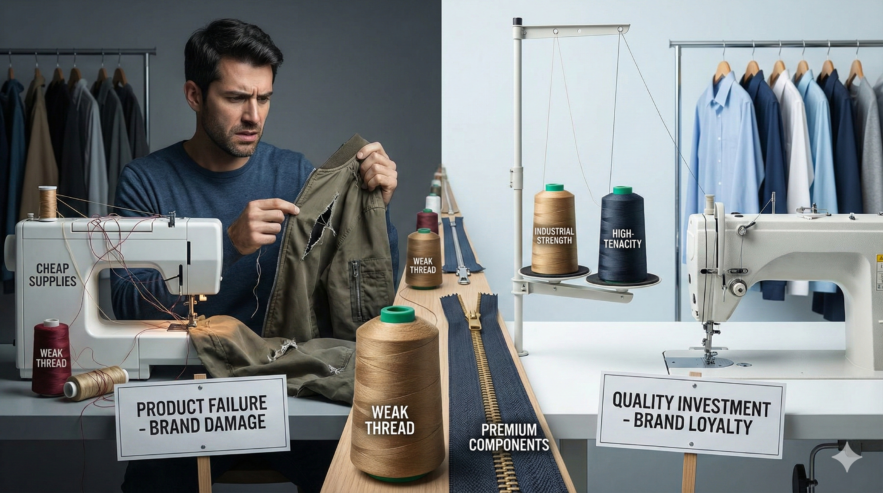
We have all had that moment of disappointment. You buy a new piece of clothing that looks great in the store, but after two cycles in the washing machine, the hem starts to unravel. A button pops off. The side seam begins to twist. As a consumer, you look at that frayed thread and decide, “I’m never buying from this brand again.”
For apparel manufacturers, this scenario is the ultimate nightmare. In a market saturated with options, brand loyalty is incredibly fragile. While designers obsess over fabric swatches, color palettes, and silhouettes, the structural integrity of the garment often gets relegated to a line item on a spreadsheet. Trim and notions are seen as places to cut costs. This is a strategic error.
The reality is that the quality of your industrial sewing supplies—the threads, zippers, needles, and elastics—dictates the lifespan of your product. Whether you are running a boutique fashion house or a high-volume uniform factory, the inputs determine the output. Partnering with a dedicated supplier isn’t just about keeping the stockroom full; it is about ensuring your brand against failure.
Here is why upgrading your “ingredients” is the smartest investment an apparel company can make.
1. The High Cost of Machine Downtime
Let’s look at this from a production floor perspective. Time is money. Industrial sewing machines are beasts. They run at speeds of 5,000 to 9,000 stitches per minute. They generate heat and friction that would melt standard polyester thread found at a hobby store.
If a manufacturer buys cheap, low-grade thread to save a few cents per cone, they pay for it in labor. Low-quality thread has low tensile strength and inconsistent thickness. It snaps under high tension. It shreds in the needle eye.
Every time a thread breaks, the operator has to stop. They have to re-thread the machine. They have to back-tack to fix the gap in the seam. If that happens ten times an hour across fifty machines, you are losing massive amounts of productivity. Investing in premium industrial thread means your machines keep running, your operators stay in their rhythm, and your daily quotas are actually met. The expensive thread is actually cheaper because it keeps the factory moving.
2. Returns and Reputation Management
In the age of e-commerce, the return rate is the metric that keeps CFOs up at night. If a customer returns a shirt because it didn’t fit, that is a sizing issue. If they return it because the seam ripped when they put it on, that is a quality issue. The latter is far more damaging.
When a garment fails physically, the customer perceives the brand as “cheap.” It doesn’t matter if you used expensive Italian silk; if you stitched it together with weak cotton thread that disintegrates, the garment is garbage.
Using industrial-grade supplies ensures that the construction matches the material. High-tenacity threads, bonded nylon for leather goods, and reinforced zippers ensure that the product survives the dressing room and daily life. You are essentially paying for the assurance that your product will continue to sell.
3. Safety and Compliance
For many sectors of the apparel industry, a seam failure isn’t just an annoyance—it’s a liability. Consider manufacturers who make turnout gear for firefighters, tactical vests for law enforcement, or safety harnesses for construction workers. In these industries, industrial sewing supplies take on a literal life-or-death meaning.
You cannot use a standard thread for these applications. You need specialized inputs:
- Kevlar and Nomex Threads: These are fire-retardant and heat-resistant.
- Bonded Nylon: For heavy-duty load-bearing strength.
- UV-Resistant Thread: For outdoor gear (like awnings or marine canvas) that sits in the sun all day.
If an apparel company tries to source these generic components from a non-specialized vendor, they risk non-compliance with safety standards. Investing in the right supply chain partner ensures you have the certifications and the specs to bid on those high-stakes government and industrial contracts.
4. Aesthetics Matter
Have you ever seen a dress shirt where the seam looks wavy or wrinkled, even after you iron it? That is called seam puckering, and it screams low quality.

Puckering often happens when the wrong thread is paired with the wrong fabric, or when the thread shrinks differently from the fabric during the wash.
Industrial suppliers do more than sell spools; they offer technical expertise. They know that if you are sewing a lightweight knit, you need a specific textured thread to stretch with the fabric. They know that if you are sewing denim, you need a core-spun thread that looks like cotton but has the strength of polyester.
By investing in the correct, high-quality supplies, the finish of the garment improves. The seams lay flat. The top-stitching looks crisp and professional. The perceived value of the item goes up, allowing the brand to charge a premium price point.
5. Sustainability and the Slow Fashion Movement
There is a massive cultural shift happening right now. Consumers are becoming tired of fast fashion—clothes that are meant to be thrown away after one season. They are looking for durability. Sustainability isn’t just about using organic cotton; it is about longevity. The most eco-friendly garment is the one you don’t have to throw away.
If an apparel company wants to market itself as sustainable, its products have to last for years, not months. This is impossible without industrial-grade construction. A heavy-duty zipper that doesn’t jam and buttons that are shanked properly to stay on are key components of a sustainable wardrobe. When you invest in supplies that extend the lifecycle of the garment, you align your brand with the values of the modern, eco-conscious shopper.
In apparel manufacturing, the glory usually goes to the designer who sketched the coat or the textile mill that wove the wool. But the unsung heroes are the thread, the tape, the elastic, and the zippers.
These components are the glue that holds the vision together. By treating sewing supplies as a strategic investment rather than a commodity to be bargained down, apparel companies protect their margins, their workers’ time, and their brand’s good name. It is a simple equation: better inputs equal a better product.