

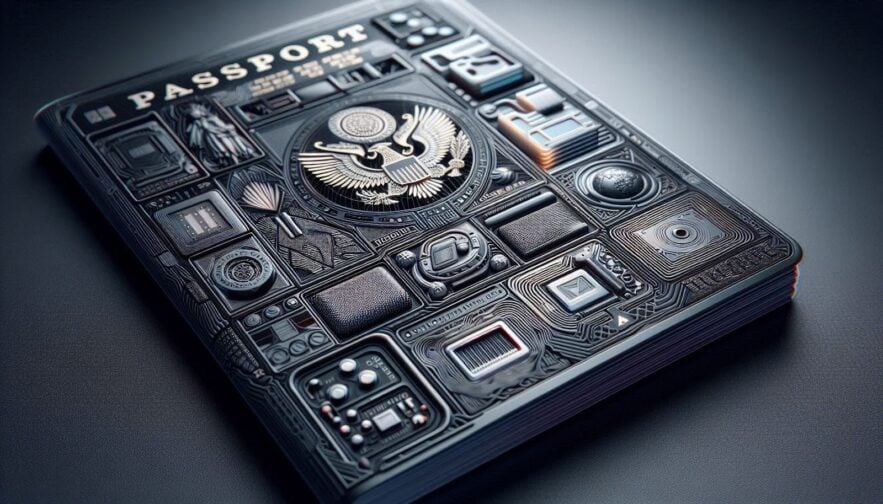
Today’s passports use a mix of overt and covert features to strengthen border checks and reduce the risk of document fraud.
WASHINGTON, DC,
A modern passport is designed to do much more than hold a name, a photo, and a page count. It is built to survive suspicion. Every serious travel document is expected to prove itself not once, but repeatedly, under light, movement, touch, magnification, machine reading, and increasingly, biometric comparison. That is why passport protection today relies on a mix of overt and covert defenses, with hologram security, invisible ink, and intaglio printing sitting near the center of the system. The U.S. State Department’s overview of the Next Generation Passport reflects that broader shift, describing a modern passport book with a polycarbonate data page, laser engraving, and upgraded physical protections intended to make both tampering and counterfeiting harder.
The reason these features matter is simple. Counterfeiters can sometimes imitate the general look of a passport. They can copy a color scheme, reproduce a page layout, and even build a document that appears convincing in a flat image or at a quick glance. What they struggle to reproduce is performance. A genuine passport is supposed to react correctly when tilted, examined under ultraviolet light, touched by an officer, and checked against known security expectations. A fake often looks plausible until it is forced to behave like the real thing.
Holograms turned the passport page into a behavior test.
Hologram security matters because it forces the document to do something that ordinary copying methods handle poorly. It must change under movement and light. Instead of being judged only as a still image, the passport becomes an active object. Tilt it, and the security feature should shift, deepen, brighten, move, or reveal another controlled effect. If the page stays visually flat, the response is muddy, or the effect appears wrong for the issuing country, suspicion rises quickly. That is why holograms remain one of the most practical frontline checks in document inspection. They let officers test authenticity in seconds without needing a full forensic setup.
This is also why holograms are more important than they appear to the public. To travelers, they often look like a decorative sign of officiality. To inspectors, they are a rapid challenge-response tool. Canada’s current passport design, for example, uses a Kinegram that changes color and appears to move depending on viewing angle, along with lens-based features that cause a photo and date of birth to appear and disappear. That kind of angle-sensitive behavior is difficult for counterfeiters to clone convincingly because it depends on controlled optical design, not just print appearance.
Invisible ink gives the passport a second face.
If holograms test the passport under movement, invisible ink tests it under ultraviolet light. In normal light, the page may look complete and ordinary. Under UV inspection, a second layer appears. Hidden symbols, page graphics, design structures, or secondary portrait elements can glow or emerge in tightly controlled ways. That creates an immediate problem for counterfeiters, who now have to build two believable documents at once, one for daylight and one for trained inspection.
That second layer matters because many fraudulent passports are built for casual handling, not serious examination. The page may look acceptable at check-in, then fail once the officer switches on a UV lamp. The fluorescence may be too bright, too weak, the wrong color, or missing altogether. In secure document design, those are not small mistakes. They are often the difference between a document that moves forward and one that gets pulled aside. As Amicus International Consulting explains in its backgrounder on the high-tech features that make passports secure, visible, and covert elements work best when they reinforce one another, forcing the passport to authenticate itself across more than one inspection environment.
Intaglio printing makes touch part of the security system.
Intaglio printing may be less publicly discussed than holograms or chips, but it remains one of the strongest classic passport protections because it turns touch into a test. The process uses high pressure and specialized inks to create a raised image with a tactile feel on the surface of the document. That tactile quality matters because it is difficult to imitate with standard commercial printing tools. A counterfeit page might look convincing from a short distance, yet feel flat, soft or mechanically wrong in the hand.
That matters a great deal at real borders. Officers do not always begin with elaborate equipment. They often start with fast, practical checks. They hold the booklet, tilt the page, inspect the photo area, look for optical response, and feel whether the printing behaves the way a secure document should. Intaglio gives them another low-tech but high-value way to challenge the passport. It is one thing to reproduce color and shape. It is much harder to reproduce the depth, edge sharpness, and relief created by true security printing.
Modern passport security works because no single feature stands alone.
The strength of today’s passport protection is not holograms alone, invisible ink alone, or intaglio alone. It is the overlap between them. The hologram challenges the page at an angle with light. Invisible ink challenges it under ultraviolet examination. Intaglio challenges it through touch and fine printing quality. The polycarbonate data page and laser engraving challenge alteration. Machine-readable elements challenge formatting and data integrity. The chip, when present, challenges whether the digital record matches the printed one. Each layer covers weaknesses that the others might leave exposed.
This layered logic is what makes modern passports difficult to fake well. A criminal might reproduce one feature with moderate success. They might even reproduce two. But the more layers the document contains, the more likely the forgery is to fail somewhere along the inspection chain. The passport does not need to expose fraud with one dramatic reveal. It only needs to keep asking questions until the fake runs out of good answers.

The document is now checked inside a broader biometric system.
Physical security features still matter because they remain the opening line of trust, but they now sit inside a wider identity-verification environment. A recent Reuters report on expanded facial recognition at U.S. borders reported that the United States was expanding facial recognition at borders to track non-citizens, reduce visa overstays, and help detect passport fraud. That means a questionable passport may now face deeper scrutiny not only for its physical features, but also for whether the person presenting it matches the identity attached to it.
This broader enforcement setting does not reduce the importance of classic passport features. It raises it. Before a biometric system compares a face or a chip is read, the booklet still lands in a human hand. If the hologram does not react properly, if the UV layer fails, or if the printing lacks the expected tactile quality, the document may never receive the benefit of the doubt needed to move smoothly into the next stage. The physical passport remains the first gate.
Why these three features still define modern protection.
Hologram security, invisible ink, and intaglio printing continue to define modern passport protection because together they capture the central philosophy of document security in 2026. A secure passport must not only look official. It must behave officially under movement, under ultraviolet light, and under physical handling. It must make copying harder, alteration riskier, and counterfeit performance less convincing.
That is why these features remain standard in serious travel documents around the world. They are fast to inspect, difficult to reproduce well, and effective precisely because they force the document to prove itself in more than one way.
In practical terms, that is what modern passport protection has become. Not one trick. Not one shiny patch. Not one hidden mark. It is a layered system in which overt and covert features work together so that the moment inspection becomes real, the genuine document keeps performing, and the fake usually starts to fall apart.