

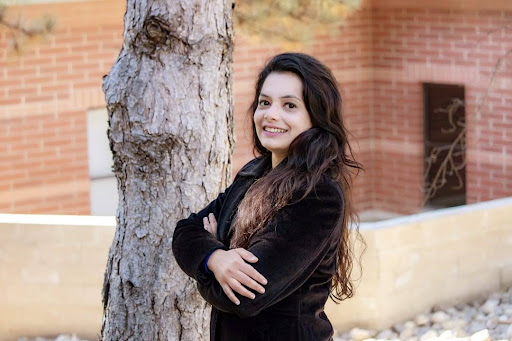
By Fred Artemis, September 2024
Monika Bharti first arrived at the University of Nevada, Reno, as a driven international student. In India, where she was born and raised, she had excelled in education. Since then, she has cultivated a multidimensional career intersecting educational research, early childhood education, higher education instruction, and international leadership and educational advocacy.
She currently serves as a Senior Research Analyst at the Nevada Institute for Children’s Research & Policy, University of Nevada, Las Vegas. Bharti also holds a senior international leadership role as the senior director of education and STEAM project leader at the International Teachers Association (ITA), where she works to develop cross-national STEM literacy programs and collaborate with global educators to develop inclusive educational frameworks.
Bharti’s academic path has remained as diverse as her professional roles. She earned a Master of Education in Elementary Education from the University of Nevada, Reno, and is completing a Ph.D. in Literacy Studies with a focus on multilingual learners’ writing development. She is also planning on embarking a master’s of business administration degree to complement her educational leadership with strategic management skills. “Each academic milestone has built my interdisciplinary lens,” she says, “merging science, literacy, pedagogy, and leadership.” We recently sat down with Bharti to talk about her experiences in education.
Can you tell me how your career began? How did it start? What brought you to Nevada?
My journey began in a modest classroom in India, teaching science to primary-grade students. That experience opened my eyes to the transformative potential of education. After moving to the US, I encountered both immense opportunities and profound challenges. I found myself navigating a new culture, a new education system, and a new identity as a scholar-practitioner. Nevada became both my academic home and the place where my vision for equity-driven education took root.
It was in those early years, juggling work, study, and adaptation, that I realized I didn’t just want to teach; I wanted to redefine what education could be. That realization continues to guide my work today.
You already have quite a diverse education. What do you focus on as a researcher?
My academic research has focused on writing instruction for multilingual learners and the training of pre-service teachers. I focus on how multimodal and technology-integrated strategies can be used to make writing more accessible and meaningful, particularly for students who are learning English as an additional language. Over the past several years, I’ve also taught undergraduate and graduate-level courses in literacy instruction and diagnostic assessment. My work bridges practice and policy, with direct influence on teaching methods, student support systems, and educational equity frameworks. From early STEM camps to doctoral-level research mentoring, my career spans education at all levels and across continents.
You’re right that I have learned a lot in all of my degree programs. I would say that my core competencies include literacy development. This involves expertise in writing instruction for multilingual learners using multimodal and technology-integrated strategies. I am also knowledgeable in teacher training, research design and dissemination, and early childhood education. This, in particular, inspires me. I also have classroom experience supporting the developmental and academic growth of young children through culturally responsive teaching.
What has challenged you most in your career?
My journey has been shaped by the unique challenges of being a first-generation international student, navigating a foreign education system with limited support structures. Balancing multiple degrees while working to fund my education taught me time management, persistence, and resilience. And, as a woman of color in academia, I have encountered systemic barriers, but those experiences have sharpened my ability to create inclusive spaces.
These challenges have become fuel for my advocacy. They inspired my leadership within the Graduate Student Association at the University of Nevada, where I led initiatives that addressed student housing, mental health, and equity. Every hurdle strengthened my voice, refined my mission, and positioned me not just as a participant in education but as a changemaker.

What are your long-term goals?
I envision founding a cross-national institute focused on multilingual education, literacy equity, and teacher training. The goal is to create a collaborative hub that brings together researchers, educators, and policymakers to innovate equitable teaching practices for linguistically diverse populations.
I also aim to continue publishing cutting-edge research, expanding global teacher mentorship programs, and influencing education policy both in the United States and internationally. My ultimate mission is to bridge gaps between communities, languages, and learning systems, ensuring every child, regardless of background, can thrive through education.
Who has inspired you in your career?
I live by Maya Angelou’s words: “Do the best you can until you know better. Then, when you know better, do better.” That quote defines how I move through the world. I am driven by a responsibility to “do better” every day, for students, for teachers, and for communities who have long been unheard. What sets me apart is not just my research or accolades, but my unshakable commitment to advocacy, mentorship, and impact.
At the core of my work is a deep belief in the power of education to liberate, connect, and empower. My hallmark project, examining how pre-service teachers use multimodal strategies to teach writing to multilingual learners, demonstrates my commitment to innovation grounded in equity. At the heart of it all is a conviction that education can liberate, empower, and connect. And that’s the work I intend to keep doing.