

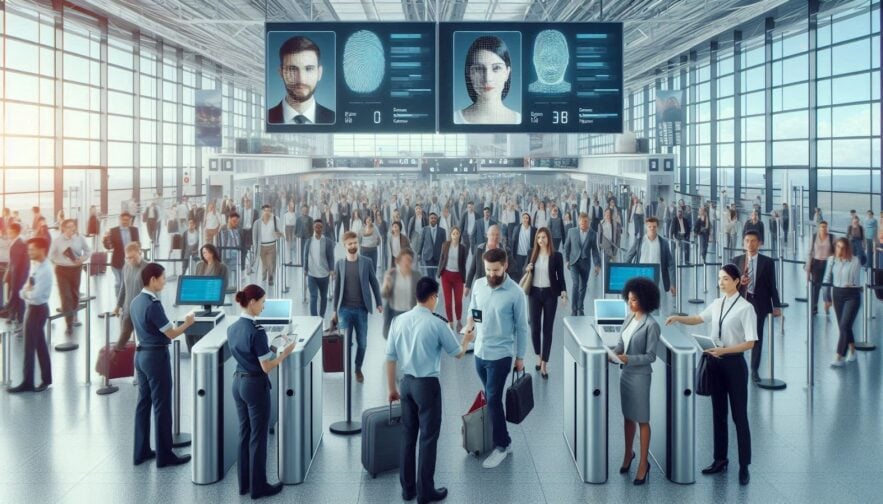
With AI-generated identities on the rise, 2026 travelers are leaning on device biometrics to keep their most sensitive identifiers from leaving their hardware.
WASHINGTON, DC.
The modern traveler is carrying a new kind of luggage in 2026: their face, their fingerprint, their voice, and the growing realization that these identifiers are now assets.
That sounds dramatic until you watch how travel has changed. Your biometric traits increasingly unlock your phone, sign you into banking apps, approve purchases, open hotel doors, and, in some airports, help move you from curb to gate with fewer manual checks. At the same time, the quality of synthetic media has leapt forward. Deepfake video, voice cloning, and AI-generated portraits have moved from novelty to tool. The result is a new category of anxiety that shows up in boarding lines and hotel lobbies, not just in cybersecurity conferences.
People are not only worried about being watched. They are worried about being copied.
“Biometric assets” is the phrase privacy-minded travelers are using because a biometric is not like a password. You can change a password. You can replace a credit card. You cannot replace your face in any meaningful sense. If a biometric is misused or becomes too widely distributed among third parties, the risk can persist for years.
That is why on-device biometrics are having a moment. Travelers are increasingly choosing security flows that keep biometric templates inside hardware-backed enclaves and use them only to unlock local credentials, rather than handing facial images and voice samples to a long chain of vendors. The goal is not to defeat identity checks or bypass lawful screening. The goal is to reduce unnecessary replication of the most permanent data a person has.
Key takeaways
• Deepfakes do not need to fool everyone; they only need to fool one automated gatekeeper once.
• The safest biometric strategy is often indirect, using biometrics to unlock device stored keys, not to provide fresh biometric data to third parties.
• “Privacy by design” in travel is increasingly measured by where biometric data lives, and whether it ever leaves the device.
Why deepfake anxiety is hitting travelers now
For most people, the deepfake threat becomes real when it touches money or movement.
Movement is travel. Money is everything around it.
A flight disruption forces you into a call center or chat. A hotel identity check forces you into a verification portal. A lost phone forces you to do account recovery. These are the moments when institutions ask you to prove you are you, quickly, often through photos, videos, or voice interactions.
That is where AI-generated identities are changing the game. A traveler might never be targeted directly, but the same tools that enable deepfake scams against executives are now affordable enough to be used against ordinary people. The weak point is not always a border checkpoint. The weak point is often a support channel, an account recovery flow, or a third-party verification vendor that treats a selfie video as a reliable truth.
Travel adds another layer. Your itinerary creates a script. A scammer can convincingly reference your hotel brand, your flight number, or your destination. A synthetic voice can sound like you to a hurried agent. A synthetic face can pass a low-quality selfie check. And because travel is time-sensitive, victims are more likely to act quickly and verify later.
This is why travelers have started treating biometrics like the keys to a vault. If those keys can be forged, the vault needs a different lock.
The quiet shift: from “biometrics as identity” to “biometrics as a local unlock.”
Here is the most important change in how sophisticated travelers think about biometrics in 2026.
They are moving away from using biometrics as the sole means of proving identity to a remote system.
They are moving toward using biometrics to unlock a locally stored credential that proves identity.
This is a subtle distinction with big consequences.
When you upload a selfie, or a short video, to a third-party verification service, you are giving fresh biometric material to a remote system. Even if the provider promises restraint, the traveler has to trust storage, retention, breach prevention, employee access controls, vendor subcontractors, and future policy changes. The traveler also has to trust that the liveness check is strong enough to resist sophisticated spoofing.
When you use on-device biometrics, the biometric is not transmitted as data. It is used to unlock a cryptographic key stored on the device. That key can then authenticate you to services without revealing your face or fingerprint in raw form.
This is the logic behind the broader movement toward passkeys and hardware-backed authentication. It is also why on-device biometrics are being framed as a privacy tool, not just a convenience feature.
In travel terms, it means this: the “proof” can be a signed credential rather than a new image of your face.
Why on-device biometrics are winning trust
Travelers are adopting on-device biometric strategies for three reasons that are practical, not philosophical.
First, it reduces the number of places a face scan can live.
Every new vendor that stores biometric material becomes a new breach risk and a new governance risk. If a hotel uses a third-party check-in platform that stores ID images, that is one risk. If the platform also stores a selfie video for verification, that is a larger risk. Travelers have learned to ask, “Where does my face go, and who can access it?”
Second, it reduces what a scammer can steal.
A deepfake scam is harder when the system does not accept a selfie as the primary proof. If authentication depends on a hardware-backed key on a device you control, a scammer cannot simply generate a convincing face and pass.
Third, it keeps identity proof “boring.”
Boring is good. Boring means a traveler can explain the system to a bank or a carrier without sounding like they are trying to evade anything. “I use a device-locked credential” is a normal posture. “I refuse all identity checks” is a posture that creates friction.
How travelers are changing behavior in the real world
The most telling aspect of the deepfake defense trend is that it is not a single product. It is a stack of habits.
Travelers who care about biometric safety are doing five things more consistently now.
They avoid unnecessary selfie-based KYC during travel
If a service demands a selfie video for a simple booking or a routine change, travelers are increasingly skeptical. They ask whether an alternative exists, or they defer the transaction until they are on a trusted network and can verify the vendor.
They prefer authentication methods that do not require new biometric capture
Instead of re-uploading selfies, they use device-based authentication that relies on locally stored credentials.
They reduce the exposure of high-quality facial media
This is where “social silence” becomes a deepfake defense. Real-time posting creates both timing risk and media risk. High-resolution video is useful for legitimate memories and also useful to adversaries training a model.
They tighten the recovery pathways
Account recovery is where deepfake attacks thrive. Travelers are moving away from recovery methods that depend solely on voice calls or selfie videos. They are choosing a recovery that uses multiple factors and known devices.
They compartmentalize travel accounts
A travel email, a travel payment method, and a travel-only device reduce the blast radius. If a travel account is compromised, it should not grant access to the traveler’s whole financial life.
None of this requires a traveler to do anything illegal. It is the same logic people use for fraud prevention. The novelty is that biometrics are now part of the threat model.
The airport reality: biometrics are expanding, so governance matters more
Airports and border agencies are scaling biometric systems because they improve throughput and strengthen identity certainty. That trend is not retreating.
So travelers are focusing on a different lever: consent, minimization, and retention.
A biometric system can be designed to be privacy-respecting, meaning it uses facial comparison without retaining images longer than necessary and without repurposing data for unrelated objectives. Or it can be designed to be expansive, meaning it stores more, shares more, and becomes easier to correlate across contexts.
The traveler cannot control every airport system. But they can understand the direction of the technology. They can ask what is optional. They can choose programs that provide clear rules and clear opt-outs when available. They can avoid handing over biometric material to third-party services that do not need it.
Performance testing and accuracy debates have become part of the mainstream conversation, too. Travelers want to know what happens when a system misidentifies someone, and how those errors are measured. That is why the most referenced benchmark work in this space, the U.S. government’s own evaluations of face recognition performance, continues to shape policy discussions and vendor claims, including the testing overview provided by the National Institute of Standards and Technology through its Face Recognition Vendor Test program.
The deepfake twist is that accuracy is no longer the only question. Spoof resilience is the question, and that is where on-device strategies offer an advantage, because they reduce reliance on remote visual checks that can be fooled.
The difference between “protecting biometrics” and “avoiding verification.”
There is a line travelers need to keep clear.
Protecting biometrics is about reducing unnecessary distribution and maintaining robust authentication.
Avoiding verification is about trying to bypass rules.
The first is legitimate and increasingly normal. The second creates risk and friction.
A traveler can protect their biometric assets by using local authentication methods, minimizing media exposure, and choosing services that do not hoard identity artifacts. They can do this while still complying with identity checks at borders and regulated checkpoints.
This distinction matters because some marketing in the privacy world blurs the line, implying that the goal is to become untraceable. For ordinary lawful travelers, that is neither realistic nor wise.
The smartest deepfake defense posture is one that looks ordinary, is explainable, and is compatible with compliance.
What travel startups are building next

This is where the market is moving quickly.
Travel tech is shifting toward “identity as a wallet,” meaning the traveler holds the proofs and shares only what is required. That includes credentials for booking, loyalty, and, sometimes, eligibility checks. The privacy-forward version does not store your face. It stores a cryptographic proof that you have already been verified by a trusted issuer.
It also includes customer support flows that do not rely solely on voice and selfies. Support is becoming a biometric battleground. If a traveler can be “verified” by a deepfake voice, the support channel becomes an attack surface. Expect more providers to adopt device-based proof and known device confirmation as the default.
Media coverage of deepfake identity risks has broadened from politics into everyday consumer contexts, including travel and finance, which is one reason the topic keeps surfacing in trend roundups and security reporting tracked through this Google News collection.
The competition among startups is increasingly about trust. Not just whether they can rebook a flight faster, but whether they can do it without harvesting identity.
Where advisory services are being pulled in
As biometric systems expand and deepfake tools improve, high-exposure travelers are asking a different set of questions than they did two years ago.
They are not asking how to disappear.
They are asking how to reduce identity replication, reduce account takeover risk, and avoid becoming the victim of a synthetic identity attack that starts with travel.
Advisors in this space tend to focus on a simple framework: minimize what you share, compartmentalize what you must share, and keep your authentication anchored in hardware-backed controls rather than in easily copied media.
That framework overlaps with the broader compliance forward mobility work described by Amicus International Consulting, which emphasizes lawful risk reduction and controlled identity exposure for internationally mobile clients, especially as biometric travel systems become more common.
The message is not to fight the system. The message is to travel with less of your identity scattered across it.
A practical deepfake defense posture for ordinary travelers
If you want a defensible posture that does not require technical expertise, it often comes down to a few repeatable behaviors.
Use biometrics to unlock device-stored credentials, not to feed remote databases
Choose authentication options that keep biometric templates on the device and use them to unlock keys, rather than routinely uploading selfies.
Treat account recovery as the most important security setting
If your bank, email, or travel platform allows recovery that depends solely on voice calls or selfies, tighten it. Use multi-factor recovery and known device confirmations where possible.
Practice social silence during travel
Delay public posting. Reduce high-resolution video sharing. Avoid broadcasting real-time location. This reduces both physical targeting risk and the need for deepfake training material.
Compartmentalize travel data
A travel email, a travel number, and travel-specific payment tools reduce the blast radius of any compromise tied to travel vendors.
Keep the story boring
If asked, the explanation should be simple. You keep sensitive data off devices when traveling. You use strong authentication. You share only what is required. Boring is defensible.
The bottom line
Deepfake defense is becoming a travel skill in 2026 because identity has become both more automated and more vulnerable.
The most resilient response is not to reject biometrics entirely. It is to use biometrics in a way that protects you, by keeping biometric templates local, by using hardware-backed keys, and by reducing how often you hand fresh biometric material to third parties.
In practice, that looks like a shift in trust.
Trust your device more than you trusts a vendor portal.
Trust cryptographic proofs more than you trust a selfie upload.
Trust minimization more than you trust marketing promises.
Travel will never be “zero trace” in a regulated world. But travelers can still protect their biometric assets by making one decision consistently: do not distribute what you cannot replace.