

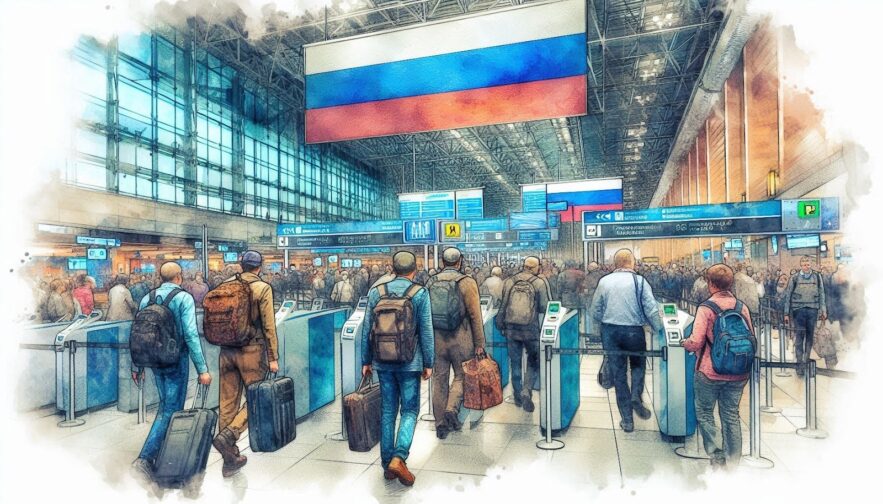
The suspension shifts Russian applicants onto standard Schengen rules, increasing fees, paperwork, and denial risk as sanctions-era mobility tightens across Europe and the United States
WASHINGTON, DC
The European Union’s decision to end visa facilitation with Russia transformed Schengen travel from a streamlined administrative process into a more complex, document-heavy system governed by standard rules and security-first scrutiny. Although the formal suspension dates to 2022, the effect is current and cumulative because Schengen visa issuance is capacity-constrained and appointment-driven. When a nationality moves from a facilitated lane to the general lane, friction does not simply increase at the margin. It compounds through longer queues, stricter evidentiary expectations, and a higher probability that borderline cases will be refused.
Visa facilitation agreements were designed to lower barriers for routine travel. They typically reduced fees, simplified documentation requirements, shortened decision timelines, and expanded access to multiple-entry visas for travelers with established histories. Removing facilitation reverses those advantages and changes the default posture of consular processing. Instead of a presumption that repeat travel is ordinary and manageable, applicants face a presumption that each trip must be proven, each financial claim documented, and each return trip demonstrated in a way that satisfies risk-based review.
The suspension also fits into a broader policy environment in which mobility is treated as conditional trust. European governments have increasingly linked travel privileges to security concerns, sanctions enforcement, and the integrity of identity and vetting systems. The United States has adopted similar logic through its own restrictions and operational constraints. The result is a parallel tightening across major travel blocs that affects not only Russian citizens but also carriers, consulates, and third countries that absorb rerouted demand.
What “visa facilitation” meant, and what its removal changes
Visa facilitation agreements are administrative shortcuts embedded in foreign policy. They do not replace the Schengen Visa Code, but they carve out exceptions or simplified procedures for defined categories of travelers. In practice, facilitation can change everyday outcomes in three ways.
First, it reduces the cost of applying. Lower fees matter not only as a price point but as a signal. When fees are low, applications are more frequent, more routine, and less psychologically tied to “high-risk” migration behavior. When fees rise sharply, the system discourages casual or speculative travel and makes each application more consequential.
Second, it simplifies the documentation burden. Facilitation can reduce the number of supporting documents required to prove purpose, means, accommodation, and travel history. That matters because document-heavy systems create more opportunities for inconsistency, omission, and credibility disputes.
Third, it influences how multiple-entry visas are treated. Facilitation tends to broaden access to longer-validity visas for repeat travelers. That is one of the most valuable benefits of a facilitation regime. It allows routine business travel, family visits, and cultural exchange without forcing a new full application for every trip.
When facilitation is removed, those benefits reverse. Applicants are brought into the standard Schengen framework, where consulates apply general evidentiary rules, exercise greater discretion, and require tighter justification for multiple-entry requests. In a security-first era, the general framework can become more restrictive in practice even when the legal text remains stable, because consular risk postures respond to geopolitical conditions and to operational instructions.
Why the 2022 suspension still shapes travel in 2026
The most important reason the suspension remains “current” is that Schengen visa processing is not a purely legal process. It is a production line with limited capacity.
Consulates operate on time slots. External service providers operate on appointment calendars. Decision-making depends on staff, verification resources, and fraud screening bandwidth. When a nationality is moved into a higher-scrutiny lane, each file tends to take more time to process. That reduces throughput. Reduced throughput increases backlogs. Backlogs create delays that force applicants to submit earlier, update documents more often, and accept greater uncertainty.
This is how a policy decision taken in 2022 continues to shape outcomes in 2026. The system does not revert to normal simply because time has passed. It normalizes the higher friction. Applicants learn to expect longer waits. Consulates learn to allocate fewer resources to high-friction categories. Carriers learn to scrutinize documentation more aggressively. The entire travel ecosystem adjusts around a new baseline.
This adjustment is also reinforced by parallel developments in European border management. Even where short-stay rules are unchanged, enforcement trends favor more standardized identity verification, more consistent recordkeeping, and more systematic detection of compliance issues. The more data-driven the environment becomes, the less room remains for informal explanations or clerical ambiguity.
Fees, timelines, and paperwork: How the practical burden rises
A core feature of the post-facilitation environment is higher costs and a greater administrative burden. The fee increase is visible and immediate. Under facilitation, many applicants paid a reduced fee. Under standard rules, applicants face the standard Schengen fee regime, and that standard fee has itself increased in recent years.
Beyond fees, timelines change. Under facilitation, decision deadlines were often shorter. Under standard rules, processing can take longer, and consulates can extend timelines, particularly when additional verification is required or when appointment demand is high. Longer processing does not merely delay travel. It increases the likelihood that supporting documents will expire or need to be reissued, such as bank letters, employment confirmations, insurance policies, and, in some cases, civil status documents when family travel is involved.
Paperwork burdens also expand. Under standard Schengen review, applicants are typically expected to provide a coherent, documented narrative of their purpose, itinerary, means of support, accommodation, and ties to the country of residence. For business travelers, that can mean employer letters that specify role, salary, travel purpose, and responsibility for costs. For family visits, this may include invitation letters, proof of relationship, and proof of host status. For tourists, it can mean detailed accommodation bookings and travel medical insurance aligned with required standards.
In a sanctions-era environment, the same documents may be reviewed through a stricter credibility lens. Consulates may ask for additional evidence to corroborate claims that would have been accepted more readily under facilitation. That is not necessarily a statement about an individual applicant. It reflects a risk environment in which travel is no longer treated as a neutral background activity.
Multiple-entry visas: The quiet fault line in repeat travel
One of the most significant effects of ending facilitation is on repeat travel and multiple-entry expectations. For many travelers, the ability to obtain a longer-validity multiple-entry visa is what makes Schengen travel workable. It reduces repeated appointments, repeated fees, and repeated documentation cycles.
When facilitation ends, multiple-entry access tends to narrow. Consulates may issue visas with shorter validity, limit the number of entries, or require stronger proof of repeated legitimate need. The practical consequence is that routine travel becomes non-routine. Each trip becomes a new application, and each application becomes a new exposure to denial risk.
This shift has a filtering effect. Travelers with stable income proof, a clear travel history, and strong ties to their residence tend to remain viable applicants, though with greater friction. Travelers with unstable employment documentation, ambiguous residence patterns, or inconsistent travel narratives become more vulnerable. In risk-based systems, marginal applicants are often refused not because of a single disqualifying fact, but because the file does not convince the reviewer that the traveler will comply with the terms of entry.
The broader policy logic is simple. In a high-scrutiny environment, multiple-entry visas reduce the number of screening moments. If authorities want more frequent scrutiny, single-entry or short-validity visas achieve that goal by forcing repeated review.
Third-country processing and regional spillover: Where demand relocates
Sanctions-era restrictions and the suspension of facilitation have also reshaped the geography of Schengen applications. When direct access to certain consular services becomes constrained, applicants shift to third-country processing. That can mean applying in a country where the applicant is lawfully present, where appointment capacity is available, or where travel logistics are feasible.
Third-country processing is not automatically improper, but it introduces complications. Many consulates prioritize applicants who are legally resident in their district, not simply present on a short visit. Applicants who cannot demonstrate stable lawful presence in the processing location may face application refusal or be treated as higher risk.
Regional spillover effects are predictable. When large numbers of applicants concentrate in regional hubs, appointment calendars tighten. Verification workloads rise. Fraud screening intensifies. Even applicants from other nationalities can experience indirect delays because consular capacity is finite, and high-friction files consume more time.
This spillover is one reason why the suspension affects non-Russian travelers indirectly. It can change the operational environment in consulates that already face heavy demand. It can also change local economies around visa processing, including the growth of intermediaries and the risk of fraudulent document providers exploiting applicants under pressure.
Airlines and gatekeeping: The upstream enforcement layer
Visa policy does not end at the consulate. It extends to airline check-in counters and gate decisions. Carriers face penalties and operational costs when passengers are refused entry. In a tightening environment, airlines often increase document scrutiny, not out of political intent, but out of compliance duty.
As facilitation ends and documentation becomes more complex, the likelihood of check-in disputes increases. A traveler may have a visa but face questions about passport validity, insurance documentation, onward tickets, or the consistency of travel purpose with the documentation presented. For travelers who rely on tight connections or multi-segment itineraries, a small documentation problem can cascade into missed flights and stranded travel.
This is also where identity consistency becomes critical. Names, passport numbers, dates of birth, and reservation data must align. Minor errors that might have been corrected casually in a lower-friction era can become trip-stopping issues when systems are less tolerant and when carrier staff follow strict document-check guidance.

Schengen scrutiny and sanctions-era logic: Travel as conditional trust
The suspension of facilitation is best understood as part of a larger sanctions-era posture. European governments have framed travel privileges as inconsistent with certain forms of aggression, security threats, and the weaponization of cross-border movement. Even where the legal mechanism is administrative, the narrative is political: access to Europe is a privilege conditioned on trust.
That narrative changes how consular decisions are justified and operationalized. In a trust-based environment, border systems tolerate some ambiguity because the baseline assumption is that most travelers are benign. In a conditional-trust environment, systems seek clarity, verify more aggressively, and narrow discretionary benefits, such as long-validity multiple-entry issuance.
This does not mean Schengen travel for Russians is categorically banned in all cases. Many categories remain legally possible, and consulates can issue visas under standard rules. The reality is that the pathway is narrower, slower, and more dependent on a strong, coherent file.
The United States, in parallel, has fewer channels and more friction
The U.S. system is distinct from Schengen, but the trendline is similar. Sanctions-era policies, operational constraints, and changes to security screening can reduce lawful travel channels and increase reliance on third-country processing.
When Europe tightens, and the United States tightens in parallel, the combined effect is structural. Families adjust by meeting in alternative jurisdictions. Business travel shifts toward hubs where visa access is more predictable. Remote work arrangements are becoming more common, not as a lifestyle preference but as a legal and logistical workaround to mobility constraints.
Parallel tightening also amplifies compliance expectations. The more regimes tighten, the more travel depends on clean documentation trails and consistent identity records across applications. Travelers with complex residency histories, multiple passports, or inconsistent documentation practices are more likely to face questions and denials.
For institutions, the impact can be significant. Universities, employers, cultural organizations, and families all rely on predictable travel channels. When those channels become higher-friction, institutions face higher coordination costs, greater uncertainty, and greater vulnerability to last-minute denials.
What consular officers evaluate in the risk-based file in practice
Schengen visa adjudication is often described in terms of required documents, but the deeper reality is risk assessment. The file is evaluated as a story that must make sense and be supported by evidence.
Purpose must be credible. A business trip should be supported by employer documentation and a plausible itinerary. A family visit should be supported by relationship proof and host documentation. Tourism should be supported by a coherent plan and realistic financial means.
Means must be demonstrable. Bank statements, income proof, sponsorship evidence, and cost responsibility must align with the scale of the trip. In a tightening environment, vague financial claims are less likely to be accepted.
Ties to residence are central. Stable employment, property, family obligations, and lawful residence status are common indicators used to assess whether a traveler will return and comply with the visa requirements.
Travel history matters. Prior compliance with Schengen rules, particularly the 90-day limit in any 180-day period, can support credibility. Prior overstays or inconsistent exit evidence can undermine it.
Consistency is decisive. Discrepancies across documents, such as mismatched dates, conflicting job titles, inconsistent addresses, or unclear proof of relationship, can turn a routine file into a refusal risk.
In a post-facilitation environment, the same evaluation logic applies, but the thresholds can feel higher because the system is less inclined to grant discretionary benefits and more inclined to resolve uncertainty against the applicant.
Enforcement patterns: How higher friction changes outcomes
Higher friction tends to produce predictable enforcement patterns.
One pattern is the rise of short-validity visas that limit repeat travel. This increases the number of times an applicant must present a file and the number of opportunities for refusal.
Another pattern is intensified scrutiny of marginal applicants, particularly those without stable income proof or those whose travel purpose appears weakly supported. In a facilitated environment, some marginal files may pass through. In a high-scrutiny environment, marginal files are more likely to be refused.
A third pattern is increased sensitivity to documentation services and intermediaries. When demand rises and applicants face pressure, intermediaries proliferate. Some provide legitimate assistance. Others provide inflated itineraries, templated employer letters, or manipulated financial statements. Consulates respond by tightening verification and treating certain patterns as risk signals, which can harm legitimate applicants who rely on standardized documentation support.
A fourth pattern is the normalization of long processing timelines. Longer timelines create operational burdens, including document expiration and the need to reissue proofs, which further increases friction and can lead to abandonment of travel plans.
Does this affect non-Russian travelers? The indirect capacity effect

The indirect impact on non-Russian travelers is operational rather than legal. Consular capacity is finite. High-friction cases consume more resources. When an entire nationality shifts into a higher friction category, consulates that process those applications can experience reduced throughput.
This can lead to longer wait times for appointments, longer decision-making times, and a more conservative risk posture overall, especially in posts that also handle high volumes from multiple nationalities. Even travelers from low-risk categories can feel the effect if consular staff are overwhelmed and prioritize operational stability over speed.
This is why visa policy changes affecting large populations can reshape a region’s mobility environment. The effects radiate outward through capacity constraints, service provider backlogs, and more conservative screening.
Practical compliance checklist for applicants and planners
In a sanctions-era, post-facilitation environment, administrative discipline is rewarded.
Plan early. Appointment calendars and processing timelines can be unpredictable. Late applications increase the likelihood of delays that result in missed travel.
Build a coherent narrative. The purpose of travel should be specific, plausible, and supported by documentation that aligns across forms, letters, and bookings.
Document means clearly. Financial evidence should be consistent with the trip’s scope and should not rely on last-minute deposits that can raise questions.
Strengthen ties with evidence. Stable employment, lawful residence, family obligations, and return commitments should be documented where appropriate.
Avoid inconsistencies. Names, addresses, dates, and passport details must align across bookings and application materials.
Treat multiple-entry requests as a case. If seeking repeat travel access, document the reason for repeated trips, prior compliant travel, and the ongoing need.
Do not rely on speculative itineraries. Inflated hotel bookings and implausible schedules can undermine credibility if they appear engineered.
Maintain travel history discipline. Track Schengen days carefully and avoid patterns that resemble de facto residence through repeated near-maximum stays.
These steps do not guarantee issuance, but they reduce avoidable risk in a system where small mistakes can trigger denials or delays.
Key questions readers ask
Is Schengen travel for Russians banned?
Not categorically in all cases. The visa facilitation framework is suspended, and Russian applicants are generally processed under standard Schengen rules with higher friction and stricter scrutiny. Outcomes depend heavily on documentation quality, purpose credibility, and risk assessment.
Why do fees and paperwork matter?
Schengen decisions are risk-based, and documentation quality often drives outcomes. Higher fees reduce casual applications, and heavier documentation burdens create more opportunities for inconsistencies that can lead to refusal or delay.
Can facilitation be restored quickly?
Restoration is typically political and slow. Once facilitation is fully suspended, reinstatement requires renewed diplomatic confidence and a willingness to lower friction. In a sanctions-era environment, the baseline assumption tends to favor continued restriction.
Does this affect non-Russian travelers?
Indirectly. Consular capacity is finite. Higher-friction cases consume more resources, which can lengthen appointment waits and slow processing for others in the same posts or regions.
What are the most common refusal vulnerabilities?
Weakly supported purpose, insufficient proof of means, unclear ties to residence, inconsistent documentation, and travel patterns that raise overstay or de facto residence concerns.
How do U.S. restrictions interact with the EU tightening?
They reduce the number of lawful low-friction channels in parallel, increasing reliance on third-country processing and underscoring the importance of consistent identity records and documentation trails across jurisdictions.
Amicus International Consulting provides professional services supporting lawful mobility planning, documentation review, and cross-border compliance strategies amid sanctions-era travel constraints.
Amicus International Consulting
Media Relations
Email: info@amicusint.ca
Phone: 1+ (604) 200-5402
Website: www.amicusint.ca
Location: Vancouver, BC, Canada