

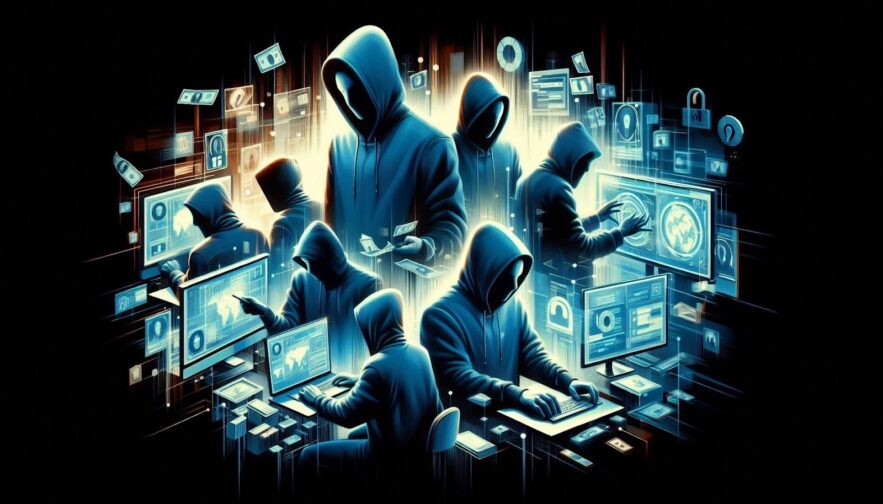
The modern identity fraud market increasingly looks like a supply chain, with specialists handling data theft, profile building, document forgery, and resale.
WASHINGTON, DC.
Identity crime is no longer best understood as a lone hacker stealing a password or a lone forger printing a fake passport. In 2026, it increasingly behaves like an underground industry. One actor steals the data. Another tests which credentials still work. Another builds a profile that looks believable enough to pass screening. Another supplies counterfeit or altered records. Another opens accounts, recruits mules, or moves the money. The victim sees one incident. The criminal market sees a workflow.
That shift is one of the most important changes in the global fraud economy. Identity abuse has become more modular, more specialized, and more resilient because dark web marketplaces and encrypted criminal channels make it easier for different players to handle different stages of the same crime. A person no longer needs to know how to breach systems, forge documents, manipulate customer service, and launder proceeds all by themselves. They only need access to the right suppliers.
The crime has become a chain, not just an event.
For ordinary consumers, identity fraud still often looks like a single shock. A bank account is taken over. A loan appears unexpectedly. A tax issue surfaces. A password stops working. A fake passport is found during an investigation. But those visible moments usually come late.
Before the financial loss or the criminal charge, there is often a longer preparation stage. A breached email account may be used to collect recovery links. A stolen phone number may become a tool for account reset abuse. A leaked ID scan may be bundled with a birth date, address history, and selfie. Those fragments can then be sold or reused until someone builds a full profile that can survive an onboarding process or support a forged document request.
That is why the industrialized model is so dangerous. It allows separate specialists to improve one narrow part of the crime without needing to master the whole thing. One crew focuses on harvesting data. Another focuses on turning that data into something useful. Another focuses on monetization. The final fraud may look simple, but the system behind it is increasingly professional.
Dark web markets reduce the skill needed to commit identity fraud.
The dark web matters because it lowers the cost of coordination. It gives criminals access to marketplaces, vendor reputations, encrypted communications, and payment systems that let them buy what they do not know how to build.
That means a fraudster who cannot forge a passport may still be able to purchase a manipulated document image. A criminal who cannot breach an email account may still be able to buy login credentials. A scammer who cannot cash out safely may still be able to hire someone else to move the proceeds. In a legitimate economy, that would be called outsourcing. In the identity crime economy, it is one reason the market keeps expanding.
Recent enforcement action shows just how industrial this ecosystem has become. A recent Reuters report on UK sanctions tied to a Cambodia-based scam compound and a crypto marketplace linked to stolen personal data and online fraud highlighted how governments are increasingly targeting not just individual scammers, but the infrastructure around them. That matters because the infrastructure is what allows identity crime to scale.
Stolen personal data now works like criminal inventory.
In older forms of identity theft, the criminal often used whatever they stole as quickly as possible. In 2026, stolen data is more often treated like stock on a shelf. It can be packaged, tested, enriched, and resold.
A partial record may not look very valuable by itself. A name, date of birth, and phone number may not immediately unlock an account. But when combined with a document image, a breached inbox, a recovered password, or a social engineering script, that same partial record becomes much more useful. It can support impersonation, fake applications, mule activity, account takeover, or document-backed fraud.
This is one reason the public often underestimates the threat. People tend to think in terms of single breaches and single incidents. Criminal networks think in terms of reusability. They do not necessarily need a perfect identity package at the start. They can assemble one over time from multiple leaks and multiple suppliers.
Profile building has become a specialist function.
One of the clearest signs of industrialization is the rise of profile assembly as its own stage. Fraudsters are not merely stealing identities and using them exactly as found. They are editing, blending, and stabilizing them.
Sometimes that means direct impersonation of a real person. Sometimes it means building a synthetic identity from real and invented elements. Sometimes it means creating just enough consistency to pass a specific bank, platform, or telecom provider. The goal is not always a permanent false life. Often, it is only a profile strong enough to survive the next check.
That makes the modern fraud market more efficient. A specialist does not need to care how the money is eventually stolen. They only need to produce a profile that looks coherent long enough for the next buyer or operator to use it. In practical terms, that turns identity itself into a product.
Fake documents remain a critical support tool.
The digital side of fraud gets most of the attention, but fake documents remain central because many systems still trust paperwork, or digital images of paperwork, more than they should.
A forged driver’s license, altered passport page, or manipulated ID scan can still help clear weak onboarding systems, support account creation, or make a stolen identity appear more credible. In many cases, the document does not even have to survive a forensic border inspection. It only has to survive the specific review in front of it, a customer service agent, a remote onboarding queue, a property manager, or a lower-friction private-sector check.
The U.S. government has already described that overlap directly. In its case on marketplaces selling fraudulent identity documents used in cybercrime schemes, the Justice Department said investigators disrupted online marketplaces selling counterfeit driver’s licenses, passports, and other identification records marketed to cybercriminals. That is an important point. Fake documents are not a side business to modern online fraud. They are one of its supporting industries.
Real documents obtained through false stories can be even more dangerous.

Criminal markets also adapt when simple counterfeits become easier to detect. If the low-end fake is too risky, they move upstream. They rely more heavily on breeder documents, manipulated support records, fraudulent applications, and genuine documents obtained under false pretenses.
That is one reason biometrics and stronger document features did not end the trade. They changed the economics of the trade. Weak counterfeits became less attractive. Better-supported fraud became more attractive. A genuine-looking document attached to a dishonest identity history can be far more useful than a badly forged passport because it creates less immediate suspicion and can generate more downstream trust.
This is where public debate often becomes confused. A lawful administrative identity change is not the same thing as criminal impersonation or forged-document fraud. Material published by Amicus International Consulting on lawful name changes and legal identity updates makes that distinction clearly, noting that legal identity changes operate within formal legal frameworks and cannot lawfully be used to escape criminal, civil, or financial obligations. That difference matters because the criminal market benefits when every discussion of identity change is blurred together.
The cash-out stage is also industrialized.
Once a profile has been built and a document has helped support it, the next step is monetization. That may involve account takeover, fraudulent payments, crypto movement, mule activity, fake merchant accounts, or resale to another buyer farther down the chain.
The important part is that cash-out is now often handled by a separate actor. The person who buys the identity package is not always the person who receives the money. One group may specialize in stealing the raw material. Another may specialize in making it usable. Another may specialize in moving the proceeds. That division of labor makes the market more flexible and harder to disrupt completely.
It also helps explain why enforcement can feel incomplete. Authorities may arrest one operator or seize one market, yet the wider system keeps functioning because the rest of the chain remains intact. Supply chains survive when one vendor can be replaced by another. The identity fraud market now works much the same way.
Why this industrial model is so hard to stop.
The market keeps growing because criminal networks are thinking end-to-end, while many institutions are still defending themselves one checkpoint at a time. One team handles onboarding. Another handles fraud alerts. Other review documents. Another handles customer support. Another looks at payments. The criminals, by contrast, are often treating the whole sequence as one continuous opportunity.
That mismatch gives fraudsters room to operate. A profile that looks acceptable at onboarding may look suspicious only later. A document that appears fine in a queue may be built on stolen information bought weeks earlier. A payment that looks authorized may have been made possible by prior manipulation of recovery channels or customer trust.
In 2026, the dark web did not create identity crime from nothing. What it did was make identity crime easier to divide, easier to sell, and easier to scale. It turned scattered skills into modular services. It turned personal data into inventory. It turned forged records into support products. And it helped transform identity fraud from a series of separate tricks into something much closer to an underground industry.
That is why the threat now feels bigger, more durable, and more professional than it did even a few years ago. What looks to the victim like one stolen identity may actually be the finished product of a hidden criminal assembly line.