

Cambrie Shell
Not every breakthrough happens overnight. Some are built slowly, through invisible hours, late-night experiments, failed models, and the quiet persistence of one person determined to push the limits of what’s possible. This is the story of Satish Bhambri, whose 2025 wave of scientific publications is not the result of sudden output, but the culmination of more than ten years of relentless work.
Connecting the worlds of space science and artificial intelligence has shaped Satish Bhambri’s career. He has built AI models that help Scientists with personalization and Recommendations in e commerce world giants like walmart to render very relevant content to the users, astrophysicists study the universe and developed deep learning systems for image processing to beat state of the art models to be industry standards now deployed by big companies and used by millions of people in everyday commerce. His work spans machine learning, deep learning, neural nets, astrophysics and quantum computing, bringing research and engineering together in a practical and impactful way.
Bhambri earned his Bachelor’s degree in Computer Science from Thapar University in 2015, followed by a Master’s in Software Engineering with a focus on machine learning at Arizona State University. At ASU’s School of Earth and Space Exploration, he worked closely with scientists and engineers on AI and computational astrophysics projects. He also holds a patent for an AI powered smart grid optimization framework that integrates deep learning, real-time IoT sensing, and adaptive control algorithms to improve grid stability and efficiency, a demonstration of his original, high-impact contributions to intelligent infrastructure.
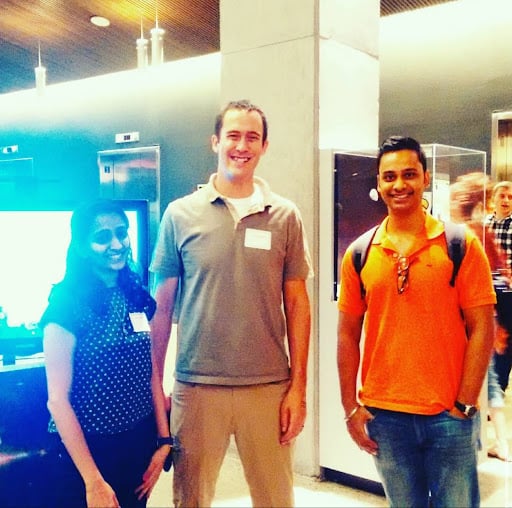
Bhambri at the School of Earth and Space Exploration at Arizona State University with Dr. Adam Beardsley – Image
During this time, he collaborated with Dr. Karen Olsen and Dr. Adam Beardsley on research in radio burst detection, galaxy emission modeling, and dark matter simulations. These projects showed him how powerful computing methods can support scientific discovery and how deep learning and machine learning can be used for core sciences and to advance industry at the same time.
His interest in emerging technologies started even before graduate school. In 2014, he wrote Quantum Clouds: A Future Perspective, a paper exploring how quantum computing could reshape cloud infrastructure. The paper introducing the term “Quantum Clouds” is available on arXiv and is indexed in NASA’s Astrophysics Data System and Harvard’s Smithsonian Astrophysical Observatory.
In industry, Bhambri applies this mix of research and engineering at scale. As a Senior Data Scientist at Walmart Labs, he has worked on Vision language models, conversational agents, retrieval-augmented systems, and recommendation engines built with Transformers, BridgeVLM, LangChain, Vertex AI, and vector databases. His work in personalization and ranking is currently serving millions of users going on the walmart website everyday, 17.7 million daily and over 535 million to be specific for the month of October to render user specific content, driving retail business on humongous scale, smart ads engine increased click-through rates by 20 percent, and GPU-accelerated pipelines reduced processing time by 30 percent. The scale of impact on lives is unimaginable considering serving around 5 percent of the global population in a month’s time. He also improved personalization diversity scores by 25 percent and created evaluation methods for AI models in situations without labeled data.
Before Walmart, Bhambri worked as a Senior Data Scientist at BlueYonder. There, he built a supply chain risk platform that helped retailers anticipate disruptions, supporting potential savings of about $2 million. His shipment ETA prediction models reduced error rates by 40 percent, improving delivery planning for large logistics networks. He also developed automation tools that strengthened sales and operations workflows.
His earlier roles at Veras Retail, Apisero, and Sapient Global Markets gave him experience with enterprise integrations, commerce APIs, and energy trading systems. These positions broadened his understanding of how large-scale software systems function and how machine learning can make them more efficient.
Bhambri also remains active in the research community. He has been working on research in AI and Deep learning for over 8 years extensively and that has born the fruit by being published this year, so based on his last almost decade of research and collaborations, he has written more than ten papers in AI, machine learning, NLP, and cybersecurity, several of which earned best paper awards at IEEE and Springer conferences and are in the process of being published. He is a Distinguished Fellow of the Soft Computing Research Society and reviews research for IEEE and Springer and an IEEE Senior member.
Behind the scenes, Bhambri has spent nearly a decade architecting ideas across quantum computing, deep learning, financial AI, robotics, natural language understanding, and optimization systems, long before these areas became industry buzzwords.
Starting with his 2014 paper Quantum Clouds, a prophetic exploration indexed by NASA and Harvard ADS, Bhambri set a research path that would intersect some of the most important technological evolutions of the last decade. His 2025 releases read like a map of AI’s future: interactive learning-by-asking systems for visual question answering, benchmark frameworks for object detection, transformer evaluations, neural machine translation, and sophisticated machine-learning-based fraud detection models that respond to the realities of global digital security.
What is striking is not just the breadth but the discipline behind it. These papers represent thousands of hours of experiments, model failures, dataset engineering, hardware bottlenecks, and incremental improvements, pushed forward while Bhambri contributed to large-scale AI systems in industry. The result is a portfolio that stands out for both its technical range and its longevity of execution.
If the world is now taking notice, it is because the culmination finally arrived: a decade of innovation crystallized into one prolific and high-impact body of work. And by all indicators, this is only the beginning.
At the time of this article publication, around 10 of the papers that have been accepted and published recently with prestigious IEEE and Springer publications in 2025:
• Hybrid Machine Learning and Optimization Framework for Enhancing Decision-Making in Software Testing Processes : IEEE
- Advanced Detection of Online Payment Fraud in Digital Transactions Through Optimized Attention Augmented : Springer
- Machine Learning-Driven Optimization for Real-Time Inventory Classification and Management : IEEE
- Fraudulent Firm Classification in External Financial Audits using Machine Learning : IEEE
- Machine Learning Pre-trained Language Models for English-French Neural Machine Translation using Topsis : IEEE
- Performance Evaluation of different Machine Learning Techniques for Pothole Detection : IEEE
- A Systematic Framework for Evaluating Transformer Architectures in Semantic Sentence Similarity : IEEE
- Comparative Analysis of Torchvision Object Detection Models : IEEE
- Extending Learning-by-Asking to Real-World Visual Question Answering : IEEE
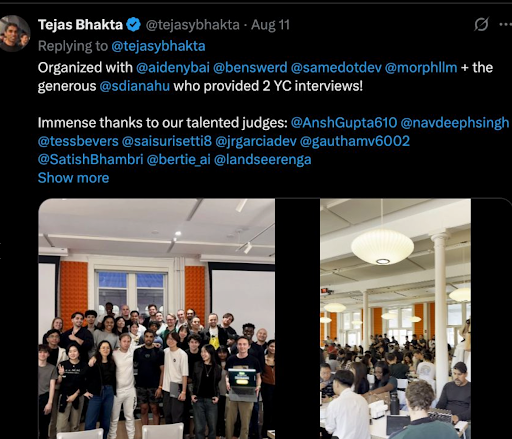
Owing to his research and critical work at walmart labs, Bhambri was also invited to judge the startup pitches at Y Combinator Hackathons, where he evaluated startup pitches for one of the world’s most recognized accelerator programs. Being invited to judge YC pitches is amongst most prestigious recognitions as companies like Airbnb, Stripe, Coinbase, Instacart, DoorDash, and Reddit came through from YC. He has been an avid and active member of the prestigious shack 15 incubator as well collaborating his research with the entrepreneurs there.
Bhambri’s dedication to advancing the science and application of artificial intelligence has been acknowledged at the highest levels. This profound impact was formally recognized when he was invited to be amongst the panel of Deepinvent AI and NeurIPS judges, esteemed innovation and research platforms.
This invitation is a rare and powerful validation of his expertise: NeurIPS (Neural Information Processing Systems) is globally recognized as the most prestigious and selective academic conference for AI and deep learning research, meaning his selection as a judge (Program Committee member) confirms his status as an elite scholarly authority trusted to rigorously vet the next generation of theoretical breakthroughs. Simultaneously, his role at Deepinvent AI, a high-profile platform focused on commercializing AI innovation, proves that his influence extends beyond the lab, certifying his unique ability to evaluate a project’s technical merit alongside its real-world market potential and impact. Being called upon to adjudicate submissions for both of these demanding venues firmly establishes him as a globally recognized thought leader at the crucial intersection of foundational research and practical industry application.


Satish Bhambri at the podcast studio – Image

He appeared on the MLOps Community Podcast to talk about the evolution of deep learning, from RNNs and LSTMs to transformers and RAG systems. He also discussed how to build production-grade AI pipelines and scale recommendation engines.
These engagements keep him involved in conversations that shape the future of applied AI and modern machine learning.
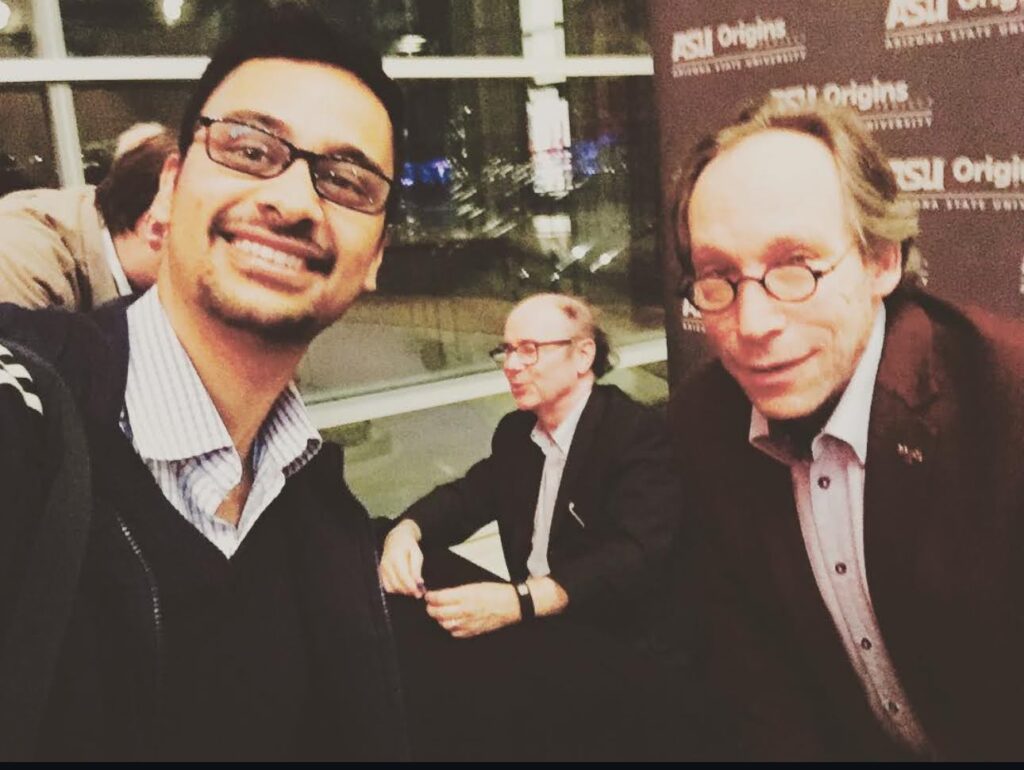
Bhambri with Dr. Krauss and Nobel Prize–winning physicist Dr. Frank Wilczek – Image
Turning Research Into Results
At Walmart Labs, Bhambri’s AI systems serve millions of users. His recommendation engine improved ad engagement by 20 percent, and GPU-accelerated workflows reduced processing time by 30 percent. His work on personalization raised diversity scores by 25 percent, improving the balance and reach of product recommendations.
At BlueYonder, his supply chain risk platform provided retailers with early insight into natural disasters and port delays, enabling potential savings of around $2 million. His shipment ETA models reduced forecasting errors by 40 percent, helping teams plan inventory and deliveries more accurately.
In astrophysics, his GPU-optimized radio burst detection and machine learning tools for galaxy-emission simulations helped researchers analyze large datasets faster and with greater accuracy. These contributions support studies on dark matter and the universe’s large-scale structure.
“For me, the goal has always been to build systems that deliver real value, whether that’s helping scientists understand the universe or making technology more useful in everyday life,” he says.
With that mindset, Bhambri hopes to lead an interdisciplinary AI research lab that brings together computer scientists, physicists, and engineers. He aims to mentor future technologists and explore new possibilities for intelligent systems. His career shows how work in one field can support progress in another. By combining research with large-scale engineering, he continues to build solutions that address today’s needs and create opportunities for the future of science and industry.