


Viacheslav Yakovlev
Specialist in environmental engineering and monitoring, pollution control, and regulatory compliance
Abstract
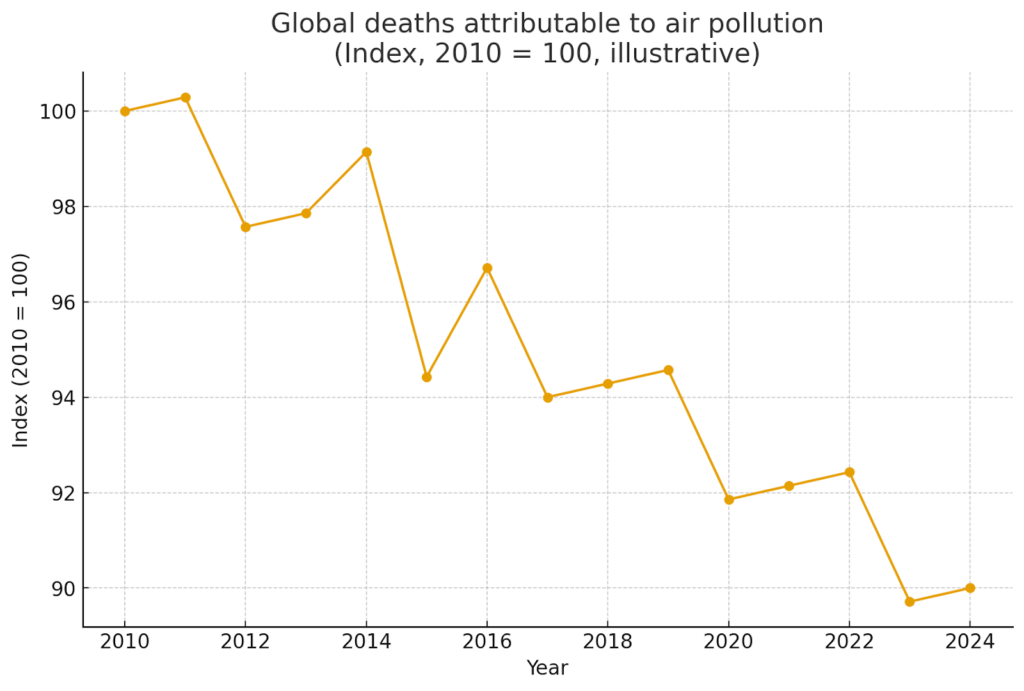
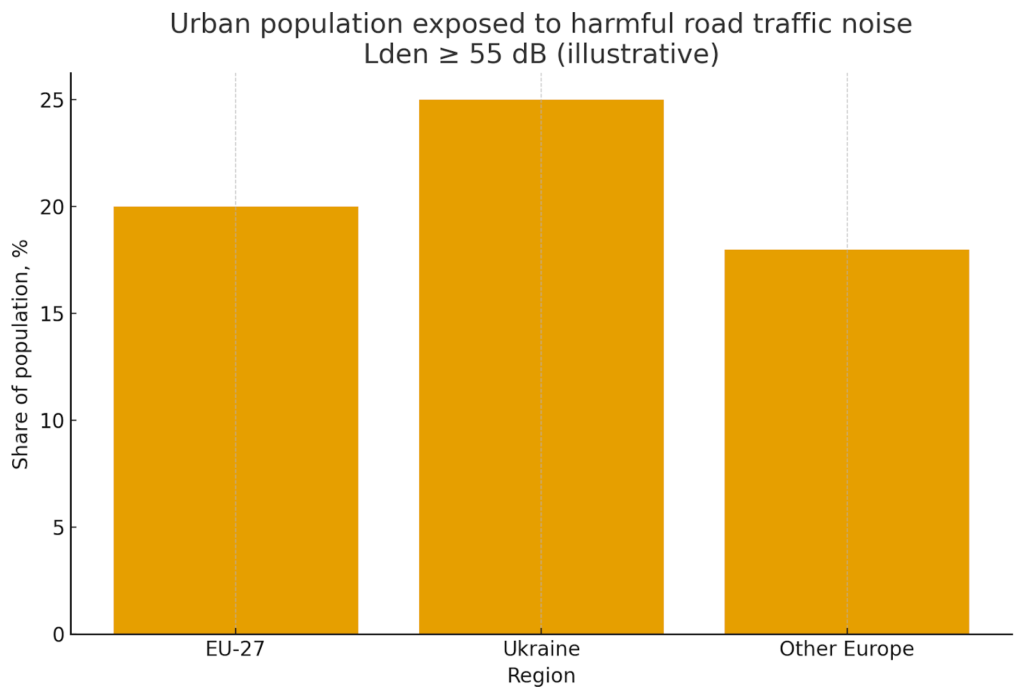
Urban residents increasingly complain about noise, poor air quality, and discomfort in homes and offices. However, without objective measurements, such complaints remain at the level of emotions and rarely lead to sustainable solutions. At the same time, the body of scientific data is growing: according to the European Environment Agency, at least 20% of the population in Europe is exposed to harmful transport noise, which annually leads to tens of thousands of new cases of ischemic heart disease and premature deaths. The World Health Organization estimates that the combined impact of ambient and household air pollution accounts for approximately 7 million premature deaths per year.
This article examines the practical experience of local environmental monitoring in Ukrainian cities: a family laboratory has been conducting measurements of noise, air and water quality, and microclimate for over eight years, serving at least 60 clients per month. Using concrete examples, it demonstrates how objective data help resolve conflicts between residents and businesses, protect workers’ rights, and prepare for inspections and legal proceedings. It shows that the combination of “scientific risk data plus local measurements at the level of a home or office” is equally relevant for Ukrainian cities as well as megacities such as Los Angeles.
Keywords
environmental monitoring; urban noise; air quality; health; Ukraine; local measurements; neighbor conflicts; sustainable cities; Times LA
Introduction: Noise and Air as an Invisible Infrastructure of Risk
A city is rarely perceived as a “medical factor.” We talk about transport, housing, offices, restaurants, but less often about the noise and air in which we live. Meanwhile, according to the European Environment Agency, long-term exposure to transport noise in Europe is annually associated with approximately 12,000 preventable deaths and 48,000 new cases of ischemic heart disease.
WHO reports and the State of Global Air initiatives show that polluted air has become one of the key factors of premature mortality worldwide: in 2021 alone, air pollution was associated with 8.1 million deaths. In European countries, the majority of urban residents still live with PM2.5 concentrations above WHO recommendations.
Ukraine is no exception: recent estimates show that 100% of the country’s population lives at PM2.5 levels above WHO guidelines, and up to 10% of all morbidity and mortality is in some way associated with air pollution.
Against this background, everyday stories—“a noisy café under the windows,” “a stuffy office,” “suspicious water”—are part of a larger picture. But to move them from the level of emotions to the level of solutions, data are needed: correctly conducted measurements, clear numbers, and transparent methodology.
The family laboratory, which has been operating for eight years, focuses precisely on this: conducting dozens of on-site visits every month at the request of residents, small businesses, schools, private clinics, and office centers.
1. From Complaint to Measurement: What the Practical Route Looks Like
Almost all cases begin in the same way:
- “The neighboring bar started playing louder, I can’t sleep.”
- “There is a constant heaviness in the office, people complain about stuffiness.”
- “After the renovation, there is a smell in the apartment, we are worried about the children.”
At the first stage, these are emotions. The next step is the question: “Is this just uncomfortable, or is it already above the norm and hazardous to health?”
This is where the laboratory’s work begins. The basic route looks like this:
Collection of Initial Information.
Type of object, time when the problem is most pronounced (night, rush hour, shift), suspected sources.
Selection of Parameters.
- For noise — daytime/nighttime levels, specific points in rooms and on facades;
- For air — PM2.5/PM10, CO₂ as a ventilation indicator, if necessary — specific gas pollutants;
- For microclimate — temperature, humidity, air velocity;
- For water — basic chemical and microbiological parameters.
Field Measurements According to Methodology.
Verified instruments are used, and conditions are recorded: are windows open, is equipment operating, how many people are present.
Comparison with Standards and Recommendations.
The report contains two levels:
- Legal — compliance with national sanitary regulations;
- Medical/indicative — comparison with WHO recommendations for noise and air quality.
Turning Numbers into Decisions.
The conclusion not only indicates “exceedance/no exceedance” but also proposes possible actions: from relocating equipment and limiting operating hours to installing soundproofing and upgrading ventilation.
2. Noise: The Main “Visible” Conflict and an Invisible Risk Factor
Noise is the most noticeable component of urban ecology. It immediately triggers emotions, conflicts, and complaints. Yet this is precisely where the gap between perception and numbers is particularly large.
According to European institutions, at least 20% of Europe’s population is chronically exposed to noise levels considered harmful to health (55 dB and above for the day–evening–night composite indicator). WHO and EEA studies show that such noise is linked to increased blood pressure, risk of ischemic heart disease, sleep disturbances, and impaired cognitive functions, including in children.
In urban practice, this manifests in three typical scenarios:
Entertainment venues under windows.
Nighttime noise levels in apartments reach 45–55 dB and higher. Formally, the nighttime standard is exceeded, but in reality, people live with chronic sleep deprivation for years. Professional measurements allow:
- substantiating complaints to regulatory authorities;
- showing the venue owner exactly where and at what times the exceedances are highest;
- selecting measures — from limiting sound levels at certain hours to enhancing soundproofing.
Transport and “new urbanism.”
Expansion of roads, new interchanges, or logistics centers suddenly change the noise profile of a neighborhood. Local measurements on facades and in courtyards provide arguments for dialogue with the municipality: where noise barriers are needed, where traffic patterns should be changed.
Noise at the workplace.
In workshops, factories, and service stations, noise levels are not only a source of fatigue but also a risk factor for occupational diseases. Regular measurements and proper documentation help employers and employees:
- correctly select PPE (headphones, earplugs);
- justify equipment operating schedules;
- reduce the risk of claims from labor inspectors.

In all cases, balance is crucial: the laboratory’s task is not to “shut down the business” but to provide an objective picture that allows finding a compromise.
3. Air and Microclimate: From “Stuffy” to CO₂ and PM2.5 Readings
The second block of conflicts involves indoor air. Subjectively, it is described as “hard to breathe,” “headache,” or “like a sauna in the evening.”
From a measurement perspective, the parameters used include:
- CO₂ concentration as an indicator of ventilation effectiveness;
- temperature and relative humidity;
- if necessary — concentrations of fine particles PM2.5 and PM10.
Global assessments by WHO and European agencies confirm that fine particles (PM2.5) are the main driver of health damage from air pollution. Even without complex chemical analysis, monitoring CO₂ and microclimate in an office or classroom already shows:
- how quickly CO₂ concentration rises in “crowded” rooms;
- how temperature and humidity move outside comfortable ranges during the day;
- what happens after changing ventilation schedules or installing additional ventilation.
The practical effect for employers or school/clinic administrations is simple: fewer complaints, fewer “headache” days, better subjective well-being of people — achieved with reasonable investments.
4. Water: Personal Ecology “at the Tap”
If noise and air are felt immediately, water is a more hidden factor. Nevertheless, for many families and small businesses (private wells, local water supply systems), water quality is a key concern.
Typical questions include:
- “Can we drink water from this well without a filter?”
- “Is it safe to use water in a clinic or salon?”
- “Will the water damage the equipment?”
Laboratory analysis using a basic set of parameters (organoleptic properties, major ions, sanitary-microbiological indicators) provides a clear answer, and if necessary, recommendations for selecting filtration systems. This is a case where measuring once is cheaper than trying to assess risks over years.
5. How Local Data Becomes Part of the Bigger Picture
Although each measurement is conducted “for a specific problem,” careful anonymization allows them to be aggregated into a broader picture.
With a digital database and georeferencing, it is possible to:
- identify areas with chronically elevated noise levels;
- see which types of buildings most frequently experience microclimate problems;
- compare local measurements with data from government stations and global assessments by WHO, EEA, and IQAir on air quality.
Such datasets are of interest not only to the laboratory’s clients but also to:
- city administrations (for planning reconstruction and transport policies);
- researchers (assessing the real impact of war, industrialization, or climate anomalies on Ukrainian cities);
- journalists and activists who want to rely on numbers rather than individual stories.
6. Why the Experience of Ukrainian Cities is Relevant to Los Angeles
At first glance, Ukrainian cities and Los Angeles differ greatly in scale, economy, and climate. But the set of environmental problems is surprisingly similar:
- transport noise and congested highways;
- local industrial zones and warehouses near residential areas;
- conflicts between entertainment venues and residents;
- “pockets” of poor air in lowlands, along highways, or in enclosed valleys.
In Los Angeles, public discussions traditionally focus on smog and traffic jams. In Ukrainian cities, the focus is on a combination of industrial and domestic pollution. But for a specific family or office, the question remains the same: “What are we breathing, what are we hearing, and can this be changed?”
Local monitoring practice provides a universal answer:
- without measurements, you argue with opinions;
- with measurements, you argue about solutions.
This is equally true for an apartment building in Kyiv and a neighborhood near a highway in Los Angeles.
Conclusion
Global reports from WHO, the European Environment Agency, and international research centers paint a worrying picture: noise and polluted air have become key risk factors for urban health. Yet this “big statistics” only becomes truly meaningful when combined with local measurements at the level of homes, offices, schools, or small workshops.
The experience of a family laboratory in Ukraine shows that:
- objective data help translate conflicts from the emotional plane into a professional discussion about solutions;
- regular measurements of noise, air, and water become part of a risk management strategy for businesses and residents;
- digital protocols and georeferencing create a foundation for private laboratories to participate in broader citywide and international projects.
In a world where noise and air are recognized as full-fledged risk factors, the ability to measure them correctly and communicate results in simple language becomes not only a technical competence but also an important social function. The more cities—from Ukrainian agglomerations to Los Angeles—rely on this combination of “data + dialogue,” the higher the chances that the invisible infrastructure of our health will stop being a blind spot in urban policy.
References
- European Environment Agency (EEA). Harm to human health from air pollution in Europe: burden of disease status, 2024 & 2025 briefings.
- WHO. Ambient (outdoor) air quality and health. Fact sheet, 2024.
- State of Global Air 2024. Health Effects Institute / IHME: Air pollution and global burden of disease.
- WHO Europe. Environmental noise – protecting people from harmful exposure; Environmental Noise Guidelines for the European Region.
- European Environment Agency. Europeans exposed to harmful noise pollution levels; Environmental noise in Europe 2025.
- Belis C.A. et al. Status of Environment and Climate in Ukraine. JRC Technical Report, 2025.
- IQAir. Ukraine Air Quality Index (AQI) and PM2.5 data, 2024 country ranking.
- 2024/2025 World Air Quality Report (PM2.5, WHO guideline framework). Greenpeace & IQAir.