


Across Louisiana, examiners who administer the Road Skills Test consistently report that most first-time failures follow highly predictable patterns rather than unexpected mistakes. These trends appear in both rural and urban parishes and mirror national research on novice driver behavior. The findings emphasize that preparation is often less about raw driving talent and more about learning the specific observation habits, lane behaviors, and judgment cues that new drivers routinely overlook.
A recent guide published by Magnolia Driving Academy offers a detailed look at the core categories used by Louisiana examiners and has helped families better understand the causes of early failures. Their step-by-step breakdown, highlighting how state scoring processes, underscores how observation, control, and legal compliance directly impact test outcomes and safety.
Observation Habits Remain the Number One Source of Point Loss
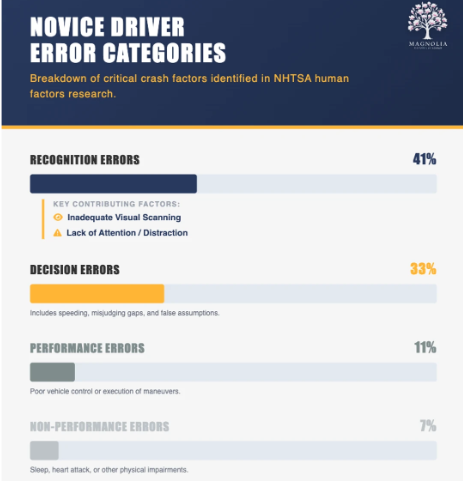
Among all the factors evaluated during the test, examiners say the most common reason for failure is inconsistent scanning of mirrors, blind spots, and surrounding traffic. Emphasizing how improving observation habits can boost confidence helps new drivers feel capable of mastering these skills.
In practical terms, examiners report that new drivers often:
- Check mirrors too infrequently for dynamic traffic environments
- Skip blind spot checks before lane changes
- Fail to scan side streets or cross traffic during approach
- Lose awareness of rear traffic when preparing to stop
These behaviors are rarely intentional. Instructors can emphasize these common mistakes during practice, helping students recognize and address cognitive overload that leads to overlooking key observation habits.
Rolling Stops and Line Placement Issues Are a Recurring Problem
Another predictable issue involves incomplete stops at intersections. Examiners across the state describe a near-universal pattern in which first-time test takers slow significantly but fail to bring the vehicle to a complete stop behind the marked line. This behavior is supported by research, such as data from the Insurance Institute for Highway Safety showing that teens frequently misjudge stopping distance and approach angles at controlled intersections.
In examiner reports, these incomplete stops rarely represent a lack of knowledge. Instead, they stem from practice sessions where students mimic what they see adults do in daily driving. On test day, these habits lead to immediate deductions that can jeopardize an otherwise strong performance.
Lane Discipline Issues Often Distinguish Passing From Failing
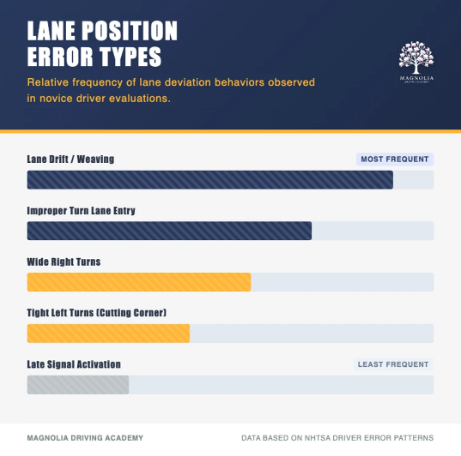
Lane position is another category where first-time drivers struggle. Examiners note that students often drift toward lane boundaries or approach turns with overly wide or overly tight angles. These errors align with data from a federal driver error analysis conducted by NHTSA, highlighting lane deviation as a primary factor in early-stage crash involvement.
During road tests, the most common lane-related observations include:
- Entering the wrong lane after a turn
- Allowing the vehicle to drift within the lane during straight segments
- Poor lane centering when approaching stop signs
- Late signal activation during lane changes
Instructors are encouraged to use structured checklists during training, as this approach helps students improve lane discipline by shifting from intuitive steering to deliberate control, which is crucial for passing the test.

Warm-Up Sessions Reveal Correctable Patterns
In many Louisiana driving schools, warm-up sessions have become a practical tool for identifying and correcting these predictable behaviors. Instructors report that after a focused session emphasizing full stops, mirror usage, turn precision, and lane centering, students often feel more prepared and less anxious for their next attempt.
The Magnolia Driving Academy guide emphasizes the importance of understanding examiner scoring expectations rather than relying on improvised practice. By linking scoring categories to real-world safety outcomes, these warm-up sessions help students internalize the purpose behind each maneuver.
Documentation Issues Still Cause Unnecessary Delays
While most failures stem from driving habits, a significant number of test disruptions come from missing or incomplete documentation. Louisiana OMV examiners stress that bringing all required permits, driver education certificates, and a vehicle that meets safety standards Recent state-level audits and data from the Federal Highway feel prepared and in control, easing te t-day anxiety.
Driving instructors say that when students understand documentation as part of responsible driving behavior rather than an isolated requirement, the test day becomes less stressful and more predictable.
A Clear Path for Improving First-Time Pass Rates
Taken together, the evidence suggests that first-time failures in Louisiana are rarely a surprise. They reflect consistent behavioral patterns documented at both the state and national levels. When examiners outline reasons for point deductions, the feedback almost always centers on predictable, fixable habits rather than fundamental inability to drive.
Educators who use structured scoring checklists, warm-up sessions, and targeted habit correction report significantly higher pass rates. As Louisiana continues refining its approach to driver education, alignment between instructor feedback and national safety research points to a clearer, more effective path for new drivers preparing for the Road Skills Test.