

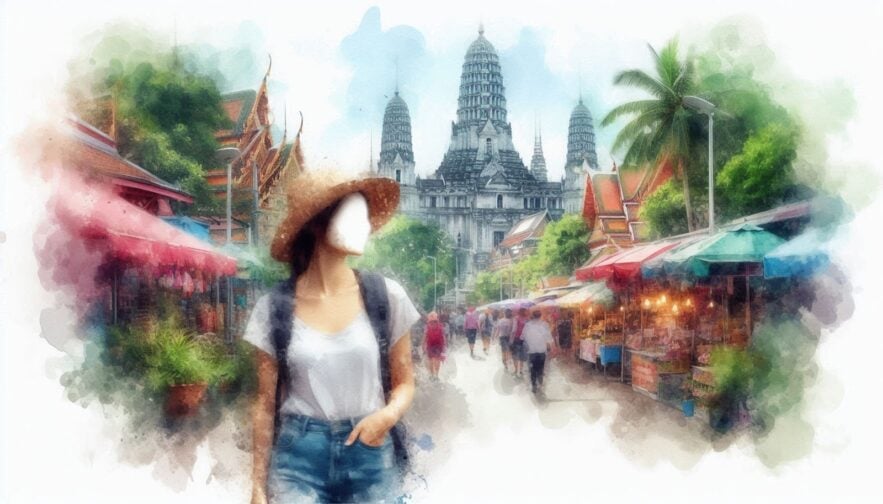
For some travelers, the appeal lies in moving through a place without the expectations, labels, and history they carry with them from home.
WASHINGTON, DC,.
For a long time, travel was sold as visibility. The ideal trip was not only something to enjoy, it was also something to document, post, tag, map, caption, and replay for an audience. A person booked the flight, checked into the hotel, photographed the meal, shared the pool, showed the view, and returned home with proof that the getaway had happened exactly as planned. In 2026, that model is starting to look tired. More travelers are moving in the opposite direction. They still leave. They still spend.
They still cross borders and book rooms and take pictures. But many are becoming less interested in narrating the experience in real time, and more interested in what it feels like to move through a place without carrying their full digital identity, professional role, social expectations, and personal history into every moment. That is the deeper appeal behind the rise of anonymous travel. It is not necessarily about vanishing. It is about reducing the amount of self that a person has to perform while away.
That distinction matters because anonymous travel in 2026 is less about drama and more about relief. Most travelers seeking a lower-profile experience are not trying to disappear in any cinematic sense. They are trying to loosen the grip of recognition. At home, people are surrounded by context. They are known as the boss, the parent, the former spouse, the founder, the employee, the neighbor, the creator, the person who always answers messages, the person with a history in a certain city, and a role in a certain social structure. Travel has always promised some distance from that.
What is changing now is that many travelers feel ordinary tourism no longer delivers the same release, because digital life follows them too efficiently. The phone comes along. Notifications remain active. Social feeds keep running. Work can still find them. Friends still expect updates. The internet still asks them to stay legible. Anonymous travel answers that fatigue by restoring some of what travel used to offer more naturally, a chance to move through the world with fewer labels attached.
That helps explain why the concept has moved beyond niche privacy circles and into wider travel behavior. The hyper-documented world has changed how people experience mobility. A trip now leaves traces through booking platforms, airline apps, hotel systems, location settings, digital wallets, device metadata, camera rolls, and social media habits before the traveler ever reaches the gate. Even at the checkpoint, the system can feel more data-rich than many people once imagined.
The Transportation Security Administration says facial comparison technology is voluntary, but the broader environment still reminds travelers that movement today is wrapped inside a larger digital identity structure. For some people, that does not produce panic. It produces selectivity. They may accept that certain systems are unavoidable, yet become more careful about what they voluntarily add on top. They stop posting in real time. They stop geotagging hotels. They stop announcing itineraries to casual acquaintances. They stop treating a vacation like an open source file. Anonymous travel begins there, not with fantasy, but with restraint.
In that sense, anonymous travel is less a single product than a change in posture. It can mean quieter hotels, later posting, less tagged content, and fewer public clues about where a traveler is staying or how long they will be gone. It can mean choosing places where a person is less likely to run into familiar networks or perform familiar routines. It can mean preferring destinations that feel atmospherically private, not because nobody else is there, but because nobody there expects anything from you.
That emotional dimension is important. Some travelers are not searching for secrecy so much as neutrality. They want the pleasure of being somewhere they do not have to explain themselves. They want the freedom of entering a café, a beach town, a mountain lodge, or a city neighborhood without the usual biography attached. They want to be read first as a traveler, not as a job title, an online persona, or a walking archive of prior decisions. In a culture obsessed with continuity, that temporary break can feel surprisingly luxurious.
The appeal also grows stronger as digital scrutiny becomes part of the public conversation around travel itself. Reuters has reported on proposals that would require some foreign visitors to disclose years of social media history, a reminder that online identity and cross-border mobility are increasingly linked in ways travelers can feel, even when they are not personally affected by every rule change. A person does not need to be a privacy extremist to notice the direction of travel. The message is simple enough.
More systems want more context. More platforms encourage more disclosure. More devices remember more than people expect. In response, some travelers are developing a quiet instinct to hold back where they still can. They may not be able to step outside every layer of documentation, but they can choose not to amplify it with voluntary self-exposure. That is one reason anonymous travel has become such a resonant phrase. It captures a wish to move through a place with less digital drag attached.
There is also a psychological reason the idea lands so well right now. Anonymous travel offers a softer, more practical version of reinvention. A traveler does not need a whole new life to benefit from partial obscurity. Sometimes the reward is as simple as spending a week in a place where nobody knows your timeline, your old mistakes, your business, your divorce, your followers, your competitors, or your social obligations. That can be deeply restorative. The person is still themselves, but the social load becomes lighter.
The vacation stops being a stage and starts becoming an actual change of atmosphere. This is especially attractive to people whose everyday lives involve high visibility or high emotional labor. Executives, creators, professionals, caregivers, and founders often spend much of the year being reachable, identifiable, and interpretable. Travel with a lower profile offers a temporary release from being constantly read. It replaces performance with observation. It replaces explanation with presence.
Luxury travel is beginning to absorb this logic. For years, premium travel was defined mostly by scale and access, better suites, better service, better views, and harder reservations. That still matters, but another layer of value has emerged. Privacy itself now behaves like a luxury good. So does discretion. So does the ability to enjoy a destination without converting the experience into public content while it is still happening. Anonymous travel fits neatly into that shift because it makes lower exposure feel like a feature, not a limitation.
The untagged property has its own appeal. The quiet arrival matters. The absence of public narration can make the trip feel more expensive even when it is not. That is because what the traveler is buying is not only the room or the route. They are buying relief from recognition, relief from commentary, relief from the tiny but constant obligation to signal that they are having a good time. In a very online culture, the privilege of not performing can feel more valuable than another upgrade.

This is one reason the idea has drawn attention from firms that work around privacy-minded mobility. Analysts at Amicus International Consulting argue that more travelers are treating anonymity not as an extreme goal but as a practical travel preference shaped by lawful privacy planning, lower-visibility habits, and greater control over personal exposure abroad. That framing matters because it brings the discussion back to ordinary behavior.
The traveler interested in a lower-profile trip is not always seeking a dramatic transformation. Often, the goal is much simpler. It is to have a holiday without broadcasting location, routines, companions, or identity signals more widely than necessary. It is to travel in a way that feels less noisy and less socially crowded. The market for that kind of discretion is plainly larger than it used to be.
At the same time, anonymous travel carries a more intimate appeal that has nothing to do with strategy and everything to do with sensation. Places feel different when a person is not busy packaging themselves inside them. A city can feel more cinematic when nobody back home is awaiting updates. A coastline can feel larger when it is not being framed for posting. A breakfast can feel more restful when it does not become content. The traveler notices more when they are not simultaneously managing the public meaning of what they are noticing.
This is why anonymous travel overlaps so naturally with hush vacations, secret destination trips, slower itineraries, and the broader move toward less performative leisure. All of these trends are responses to the same pressure. People want to recover direct experience in a culture that keeps pushing them to mediate it.
That desire is not likely to fade soon. The systems around travel will only become more digital. Devices will only become more central. Social platforms will not suddenly stop rewarding disclosure. Work will not become easier to leave behind. Against that backdrop, anonymous travel looks less like a passing fad and more like a rational adjustment. It does not require anyone to reject modern travel outright. It simply invites them to ask a different question.
Not where can I go that looks impressive, but where and how can I travel so that I feel less observed, less obliged, and more present once I get there. For some travelers, that means smaller properties. For others, it means delayed posting, quiet arrivals, fewer tags, less itinerary disclosure, and a stronger line between the people taking the trip and the outside world watching it.
In the end, the rise of anonymous travel reflects a deeper hunger than privacy alone can satisfy. It reflects a wish to experience a place before the world around you get to label the experience for you. It reflects a desire to step outside the biography that governs ordinary life, if only for a few days. In a hyper-documented world, that can feel radical even when it is modest. A person does not need to change their name, erase their history, or disappear from the map to understand the appeal. Sometimes it is enough to walk through a new place without carrying every old expectation into it. Sometimes the luxury is not being unknown forever. It is simply being less known for a little while.