


Polina Semina
FinTech Project Manager
This article examines modern approaches to managing distributed teams in the context of the digital economy. It analyzes key trends and tools that enable efficiency, engagement, and sustainable employee development in multicultural and remote environments. Special attention is given to the role of digital leadership, agile methodologies, and productivity metrics.
Keywords
digital leadership, remote work, distributed teams, operational efficiency, project management
Introduction
Distributed work has ceased to be a temporary measure and has become a standard in the corporate environment. According to Gartner (2025), more than 70% of international companies have implemented hybrid or fully remote team management models. This has transformed not only operational frameworks but also the very philosophy of leadership: efficiency is no longer measured by physical presence in the office, but by the speed of decision-making, communication transparency, and the quality of interaction among team members.
Digital Transformation of Team Management
New technologies are a key factor shaping the modern management architecture. Project management tools (Asana, Notion, Jira) and analytics platforms (Power BI, Tableau) enable managers to oversee projects in real time, track performance indicators (KPIs, OKRs), and foster a culture of transparent reporting.
In distributed teams, data becomes the primary management tool: every action is recorded, every metric is visualized, and process transparency increases trust among participants.
According to a McKinsey study (2024), companies that implemented digital coordination and process visualization methods increased productivity by 22% and reduced operational costs by 15%.
Leadership in the New Reality
Traditional management models based on control are becoming less effective. In the era of digitalization, an effective leader becomes a facilitator — someone who creates an environment where employees feel autonomy while maintaining accountability for results.
The 21st-century leader combines empathy and analytical thinking, understanding not only business metrics but also the emotional state of the team.
According to Gallup (2025), companies with high employee engagement demonstrate 21% higher profit growth compared to the industry average. This proves that “soft” leadership skills — emotional intelligence, feedback culture, and cognitive flexibility — are becoming a strategic advantage.
Tools and Performance Metrics
Evaluating the productivity of digital teams requires a comprehensive approach. Traditional KPIs (task completion speed, ROI) are supplemented by flexible indicators such as engagement, communication quality, and employee satisfaction.
The use of dashboards with real-time metrics helps identify bottlenecks in workflows and enables data-driven decision-making.
According to Deloitte (2025), organizations using comprehensive People Analytics systems adapt to market changes and crises 37% faster.
The Impact of Culture and Globalization
In distributed teams spanning different time zones and cultural contexts, standardizing communication is essential. International companies are adopting “follow the sun” principles (continuous global workflow across time zones) and unified corporate language standards. This helps reduce process fragmentation and strengthens the sense of belonging to a single organizational system.
Conclusion
Modern management of digital teams is a balance between technology and the human factor. Future leaders must not only use digital tools but also build a culture of trust, transparency, and mutual accountability.
The main goal is not to replace human interaction with technology, but to make the digital environment more human-centered.
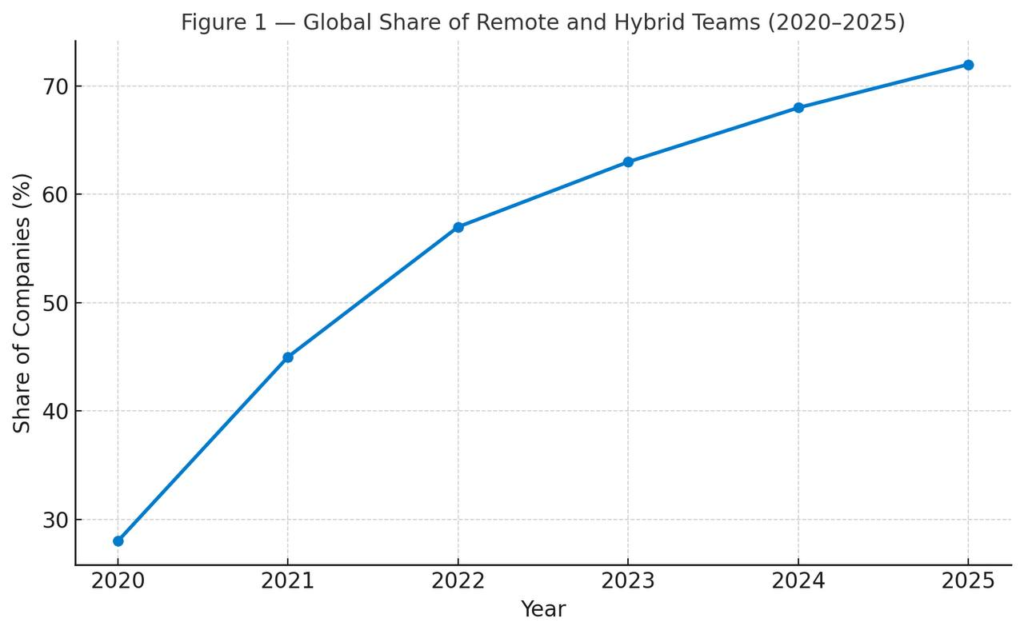
📊 Figure 1 — Global Share of Remote and Hybrid Teams (2020–2025)

Year — Share of companies using a hybrid model (%)
2020 — 28
2021 — 45
2022 — 57
2023 — 63
2024 — 68
2025 — 72 (forecast)
Source: Gartner Research, 2025
Sources:
1. Gartner. Future of Work: Remote and Hybrid Workforce Trends. 2025.
2. McKinsey & Company. The State of Digital Collaboration in 2024. 2024.
3. Gallup. The Real Future of Employee Engagement. 2025.
4. Deloitte. People Analytics in a Data-Driven Era. 2025.
5. Harvard Business Review. Leading Remote Teams: New Rules for the Digital Workplace. 2024.