

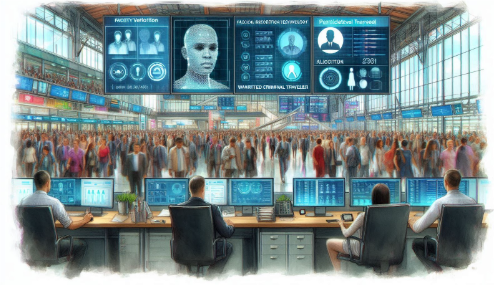
How facial recognition, identity verification, and predictive travel analytics alert authorities to wanted travelers
WASHINGTON, DC — November 9, 2025 Artificial intelligence is reshaping the way borders are monitored, managed, and secured. Once dependent on manual inspections and human intelligence, border control has become one of the most technologically advanced functions of modern governance. Through facial recognition, biometric verification, and predictive analytics, governments are now capable of identifying fugitives and persons of interest before they enter a country. The fusion of AI and global data exchange has turned international borders into real-time surveillance networks capable of detecting and deterring criminal movement.
By 2026, AI-enabled border systems will be operational across all major global regions. These systems are revolutionizing how states track individuals, manage immigration flows, and enforce extradition treaties. Authorities can cross-reference passenger data, travel histories, and biometric information within seconds, instantly alerting law enforcement to the presence of wanted travelers.
Amicus International Consulting’s in-depth analysis of AI at the border reveals a future in which technology drives global cooperation in fugitive detection and immigration control. The integration of artificial intelligence into international border frameworks is transforming not only law enforcement but also the very concept of state sovereignty and personal mobility.
The New Infrastructure of Global Border Intelligence
Border control has long been a cornerstone of national security. In the past, enforcement depended on human inspection, paper documentation, and slow diplomatic coordination. Today, borders operate as digital ecosystems powered by artificial intelligence and data analytics.
Machine learning algorithms now screen millions of passengers each day, analyzing faces, fingerprints, and behavioral data. The goal is to detect anomalies that suggest false identities, forged documents, or potential criminal links. AI-driven systems connect airports, seaports, and land crossings into a unified network where information moves faster than the people it monitors.
These technologies are not isolated within individual nations. Through global cooperation mechanisms such as Interpol’s I-24/7, the European Union’s Entry/Exit System (EES), and the Five Eyes Intelligence Alliance, data on fugitives, lost documents, and biometric identifiers circulates across jurisdictions instantly. AI automates the process of pattern recognition, comparing border entries with international watchlists and criminal databases to identify potential threats.
This transformation represents the next phase of border intelligence, one where automation and prediction replace reactive enforcement. Borders have become dynamic sensors within a broader global surveillance grid.
Facial Recognition: The First Line of Digital Defense
Facial recognition has become the foundation of modern border security. Using high-resolution cameras and deep learning algorithms, border agencies can now identify individuals in real time, even when they alter their appearance or use fraudulent documents.
In the European Union, the rollout of the Entry/Exit System (EES) has standardized biometric checks across the Schengen Area. Every non-EU traveler’s facial image and fingerprints are captured upon entry and exit, creating a unified digital record. The system automatically compares these biometrics against Interpol’s SLTD database (Stolen and Lost Travel Documents) and Europol’s Criminal Information System.
The United States operates one of the most extensive AI-based biometric systems through U.S. Customs and Border Protection (CBP). The Biometric Entry-Exit Program uses facial recognition to confirm traveler identity against passport and visa data. Since 2022, it has identified hundreds of individuals attempting to travel under false identities or with outstanding warrants.
In Asia, countries such as Singapore, Japan, and South Korea are at the forefront of integrating AI facial recognition with national identity systems. Singapore’s Changi Airport operates a fully automated biometric terminal where passengers check in, clear security, and board using only their facial image. AI systems analyze micro-patterns in facial features to ensure authenticity and detect impostors.
Even in high-traffic land crossings, AI has proven effective. The European Border Surveillance System (Eurosur) and Frontex’s Integrated Border Management Program use AI cameras at external borders to scan vehicle occupants. Combined with predictive algorithms, these tools identify fugitives traveling under new identities.
Facial recognition is not limited to identification. It also supports behavioral analytics. Algorithms analyze facial expressions, body movements, and micro-reactions that may indicate stress, deception, or an intent to evade authorities. While these tools are controversial, they are increasingly used to assist border agents during interviews and screenings.
Biometric Verification and Identity Matching
Biometric verification extends beyond facial recognition. Fingerprints, iris scans, and even voice signatures now serve as the new passports of global travel. AI plays a central role in verifying these biometric identifiers across vast, distributed databases.
The Eurodac system in Europe, initially designed for asylum management, has expanded to include AI-assisted fingerprint matching across millions of records. It identifies duplicate applications and detects individuals who attempt to claim asylum in multiple member states.
The United Kingdom’s Home Office uses AI-integrated biometric matching within its immigration and visa processing units. The system cross-checks applicants’ fingerprints against law enforcement databases, ensuring that fugitives cannot exploit immigration loopholes.
In India, the Aadhaar program the world’s largest biometric database, has evolved into a security and identity verification backbone. Immigration and financial institutions use AI models trained on Aadhaar’s datasets to authenticate individuals and detect fraudulent activity.
Biometric integration also plays a key role in extradition enforcement. When fugitives apply for visas, residency permits, or international protection, AI systems instantly match their biometric data with Interpol Red Notices. This automation significantly reduces the time required to identify wanted persons.
Predictive Travel Analytics and Risk Profiling
AI’s most transformative role at the border is its predictive capacity. Predictive travel analytics combine machine learning, behavioral modeling, and big data to assess risk in real time.
Systems like ETIAS (European Travel Information and Authorisation System) use algorithms to analyze travelers’ digital footprints before arrival. ETIAS cross-references travel intentions, payment methods, and itineraries with data from Europol and Frontex to flag potential security risks.
The Passenger Name Record (PNR) Directive, implemented across the EU, requires airlines to share passenger data with national authorities. AI models evaluate these datasets, identifying patterns consistent with smuggling, trafficking, or flight as a fugitive. For example, sudden one-way travel to jurisdictions without extradition treaties may trigger alerts.
In the United States, the Automated Targeting System (ATS) analyzes flight manifests, cargo data, and travel histories using AI to assign risk scores to passengers and shipments. This system has proven essential in detecting fugitives attempting to evade prosecution or enter the country under false identities.
Frontex’s Predictive Analysis Centre integrates satellite data, maritime radar, and land sensors with AI algorithms to anticipate migration flows. These tools help member states prepare for irregular crossings and detect organized movements that may be linked to fugitives or smugglers.
The combination of predictive analytics and biometric intelligence enables pre-emptive law enforcement. Rather than waiting for fugitives to cross a checkpoint, authorities can intercept them mid-journey based on algorithmic forecasts.
Data Integration and Global Cooperation
The effectiveness of AI at the border depends on the sharing of data between nations and institutions. Modern fugitive detection systems operate through vast networks of interoperable databases that merge national, regional, and global intelligence.
The European Union’s Interoperability Framework, managed by EU-LISA, connects six major systems: SIS, VIS, EES, ETIAS, Eurodac, and ECRIS. AI facilitates cross-database searches, ensuring that any record entered in one system becomes accessible across all relevant agencies.
Interpol’s Biometric Hub enhances global identification by linking the fingerprint and facial image repositories of member states. AI algorithms conduct continuous cross-matching, automatically updating Red Notices when new biometric data becomes available.

The Five Eyes Alliance, comprising the United States, United Kingdom, Canada, Australia, and New Zealand, has integrated AI-enhanced intelligence sharing into its counterterrorism and border control operations. These systems allow member states to access shared watchlists, flight data, and digital forensic evidence under strict confidentiality protocols.
In Asia, ASEANAPOL is developing an AI-driven regional database for fugitives and transnational crimes. The platform will connect Southeast Asian police agencies, improving border coordination and extradition efforts.
Africa and Latin America are also advancing digital border modernization. The African Union’s Migration Data Network and Interpol’s Latin America and Caribbean Initiative use AI to harmonize data formats and enhance regional cooperation.
Legal and Ethical Considerations
The rapid expansion of AI in border enforcement raises pressing legal and ethical issues. Balancing national security with fundamental rights remains a key challenge.
In the European Union, all AI-based border technologies must comply with the General Data Protection Regulation (GDPR) and the forthcoming EU Artificial Intelligence Act. These laws require that any system affecting individual rights undergo risk assessment, transparency evaluation, and human oversight. Automated decisions that deny entry or classify individuals as high risk must include the option for appeal and explanation.
Civil liberties organizations warn that algorithmic profiling can perpetuate bias or error. For example, facial recognition systems have demonstrated lower accuracy for specific demographic groups, resulting in a higher rate of false positives. The European Data Protection Supervisor (EDPS) has urged member states to adopt bias testing and regular algorithmic audits.
In the United States, concerns center on the use of AI at domestic borders and within immigration enforcement. Advocacy groups have called for stronger privacy protections under the Fourth Amendment and increased oversight of data retention practices by agencies like CBP and ICE.
Internationally, the United Nations High Commissioner for Human Rights (OHCHR) and the International Organization for Migration (IOM) are developing guidelines for the ethical use of AI in migration and border governance. These initiatives emphasize transparency, consent, and accountability.
Case Studies: AI in Fugitive Detection at International Borders
Case Study 1: Interpol’s Red Notice Automation
Interpol’s AI-assisted Red Notice system identified a fugitive financial criminal attempting to enter Spain under a new passport. The algorithm matched facial data from border entry photos with archived biometric records, alerting authorities before the individual cleared customs. The arrest marked one of the first cases of AI-driven pre-entry detection.

Case Study 2: The European Entry/Exit Pilot in 2025
During a Frontex-led pilot at major Schengen airports, AI-based biometric matching detected multiple individuals using forged identity documents. The system processed over 40 million entries within three months, achieving a detection accuracy of 99.4 percent.
Case Study 3: U.S. Biometric Exit Program
At John F. Kennedy International Airport, facial recognition identified a fugitive wanted on multiple charges as he attempted to board an outbound flight. The system alerted the Department of Homeland Security within seconds, enabling immediate detention.
Case Study 4: Singapore Smart Borders Initiative
Singapore’s Immigration and Checkpoints Authority integrated predictive analytics with passenger data from partner airlines. AI detected travel irregularities consistent with fugitive flight, resulting in several arrests during 2024 and 2025.
Case Study 5: Maritime Fugitive Detection in the Mediterranean
AI satellite imaging under the Eurosur system identified a vessel carrying individuals wanted under international arrest warrants. The data, shared between Italy, Greece, and Frontex, facilitated an interception at sea.
Regional Analysis
Europe
Europe’s leadership in AI governance extends to border management. Its combination of data protection and operational sophistication sets a benchmark for balancing innovation with rights protection. The EU’s interoperability initiative aims to unify law enforcement databases by 2026, thereby establishing the world’s most comprehensive AI-integrated border network.
North America
The United States and Canada prioritize speed and integration. AI systems under the purview of CBP, ICE, and the Canada Border Services Agency (CBSA) operate within joint frameworks that emphasize interoperability, but face ongoing scrutiny regarding privacy and transparency.
Middle East and Asia-Pacific
The Middle East has rapidly adopted AI-driven border systems, particularly in the Gulf states. Dubai and Abu Dhabi use real-time biometric analytics, while Japan and South Korea focus on ethical AI and precision. China’s nationwide surveillance network represents the most extensive deployment of AI for movement control globally.
Africa and Latin America
AI adoption in Africa and Latin America is accelerating through regional partnerships supported by Interpol and the UNODC. Kenya, Nigeria, and Brazil are developing national biometric border systems with integrated AI analytics to prevent identity and visa fraud.
The Future of AI at the Border
By 2026, AI will define how nations perceive and manage their borders. Facial recognition, predictive analytics, and integrated data networks will merge into seamless security architectures. The next frontier involves combining these systems with blockchain verification and digital identity passports to create transparent, tamper-resistant border ecosystems.
The World Economic Forum’s 2025 report on Digital Borders predicts that over 80 percent of international travel processes will be automated by 2030. Machine learning models will evaluate travel intent, criminal risk, and health status before travelers even arrive at departure points.
However, global cooperation will be essential. Without harmonized legal standards, AI-based border control could fragment into competing regimes, undermining both efficiency and human rights. The challenge for governments lies in ensuring that AI enhances safety without creating barriers to lawful movement or enabling surveillance beyond what is necessary.
Conclusion
Artificial intelligence is transforming borders from physical checkpoints into digital systems of continuous monitoring. It offers powerful tools for detecting fugitives, preventing fraud, and enhancing security, but it also demands vigilant oversight and ethical governance.
The success of AI at the border will depend on transparency, interoperability, and respect for privacy. Nations that balance technological capability with rule-of-law principles will define the next generation of global mobility management.
The integration of AI into border intelligence demonstrates that technology, when properly regulated, can strengthen justice without eroding freedom. The global community now faces the task of ensuring that the tools designed to protect do not become instruments of exclusion or control.
Contact Information
Phone: +1 (604) 200-5402
Signal: 604-353-4942
Telegram: 604-353-4942
Email: info@amicusint.ca
Website: www.amicusint.ca