

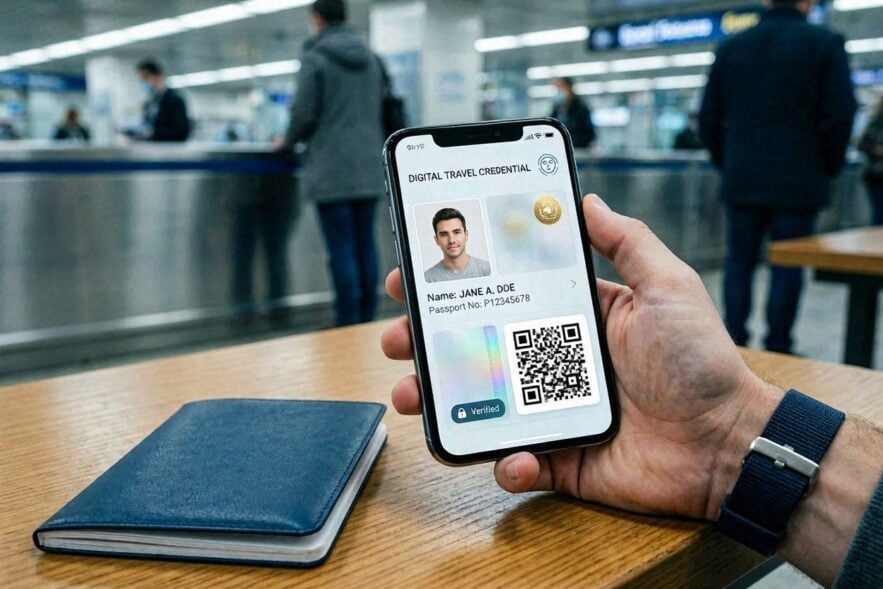
As digital credentials become the norm, hackers are shifting focus from physical theft to high-level biometric spoofing.
WASHINGTON, DC
The global shift toward Digital Travel Credentials is being sold as the future of faster airports, paperless visas, biometric boarding, and smartphone-based identity, but cybersecurity experts are warning that a new threat is emerging alongside the convenience.
The old airport fraud problem was built around stolen passports, altered visa stickers, forged stamps, fake identity cards, and impostors who hoped a tired officer would miss a flaw in a physical document.
The new fraud problem is more technical, more scalable, and harder for ordinary travelers to understand, because attackers are beginning to target the digital identity chain itself, including biometric enrollment, mobile wallets, device security, liveness testing, credential recovery, and the systems that decide whether a person is who the credential says they are.
Identity ghosting is the next evolution of document fraud.
Identity ghosting describes a new class of risk in which a criminal does not simply steal a passport booklet but attempts to create, borrow, clone, manipulate, or control a digital identity presence that appears legitimate inside trusted systems.
In the DTC environment, the criminal target is no longer only the traveler’s bag, because the more valuable prize may be the phone, the wallet credential, the biometric template, the identity account, the recovery channel, or the enrollment process that links a face to a travel document.
That shift matters because a successful digital identity compromise could allow a fraudster to move deeper into airline, hotel, banking, visa, and border systems before a human officer ever sees a physical document.
The danger is not that Digital Travel Credentials are inherently unsafe, but that the trust placed in them makes every weakness more consequential once airports, governments, and airlines begin treating digital identity as the normal route through travel.
The DTC is secure only if the entire chain is secure.
A Digital Travel Credential depends on cryptographic trust, passport data, biometric comparison, issuing authority validation, mobile device security, and systems capable of verifying that the person presenting the credential is the person to whom it belongs.
The International Civil Aviation Organization’s guidance on Digital Travel Credentials describes the DTC concept as part of a secure travel-document ecosystem rather than a simple image of a passport stored on a phone.
That distinction is critical because attackers do not need to break the strongest part of a system if they can exploit the weakest link, whether that weakness is a bad enrollment process, a poorly protected phone, a compromised help desk, or an identity recovery flow vulnerable to social engineering.
In cybersecurity terms, the passport is becoming a network, and networks are defended not by a single strong lock but by the strength of every connection that enables trust to move.
Biometric spoofing is moving from science fiction to operational risk.
Biometric spoofing, also known as a presentation attack, can involve attempts to fool a biometric system with manipulated images, replayed video, masks, synthetic faces, deepfake media, or other artifacts designed to imitate a real person.
The National Institute of Standards and Technology’s digital identity guidance has placed increasing attention on presentation attack detection, with NIST materials emphasizing that biometric systems used for identity proofing must be tested against spoofing and related impersonation risks.
That focus reflects the reality that attackers are no longer limited to crude fake photos, as artificial intelligence can generate more convincing images, voices, documents, and identity artifacts than earlier fraud systems could.
The more airports rely on face-based verification, the more important it becomes to prove not only that a face matches a credential, but that the face is live, present, authorized, and connected to a legitimate traveler.
The attack surface is shifting from the counter to the enrollment screen.
Traditional passport inspection happens at a counter, kiosk, or border booth, where an officer or automated gate compares the traveler, document, chip, and travel record in a visible moment of decision.
Digital identity changes that timing because the traveler may enroll, verify, store, and share identity data before arriving at the airport, which means fraud prevention must begin long before the gate opens.
If an attacker can compromise enrollment, the latter airport process may treat the fraudulent credential as trusted because the system believes the hard work was already completed earlier.
That is why cybersecurity experts are focused on remote identity proofing, liveness detection, device binding, credential issuance, revocation, and account recovery, because the future airport gate may only be as reliable as the digital process that happens days before travel.
Hackers will follow the value, and verified identity is extremely valuable.
A verified digital travel identity can be valuable far beyond the airport, as it may support hotel check-ins, car rentals, age verification, banking access, visa processing, employment onboarding, and high-value online transactions.
Once an identity credential is trusted by governments and major platforms, criminals have a stronger incentive to steal, clone, corrupt, or manipulate it because it can unlock multiple services.
The aviation industry has already been preparing for a world of smartphone-based travel credentials, with major reports on paperless air travel describing the move toward digital journey passes, facial recognition, and reduced reliance on traditional boarding processes.
That convenience will make travel smoother, but it also means identity becomes a central target because the credential that moves a passenger through an airport may also become the credential that proves trust elsewhere.
The phone is becoming the new passport vault.
The smartphone is already a payment terminal, boarding pass, authentication device, cloud key, banking tool, messaging system, camera, location beacon, and account recovery hub.
When passport-linked credentials are added to that environment, the phone becomes a portable identity vault that must be protected with the same seriousness once reserved for passport printing facilities and secure government databases.
A lost or compromised device may not automatically expose a traveler if the wallet uses strong authentication and secure hardware, but attackers will still look for weak recovery channels, stolen passcodes, phishing opportunities, device malware, and human mistakes.
The future traveler will need to understand that phone security is no longer merely personal cybersecurity; it is becoming part of border, banking, and mobility security.
The most dangerous attacks may target recovery rather than encryption.
Strong encryption can protect a credential at rest, but many real-world identity compromises happen when attackers exploit account recovery, customer support, SIM swaps, weak email security, stolen backup codes, or social engineering against service desks.
Criminals may not need to break a biometric credential if they can convince a support system to reset access, add a new device, recover an account, or approve a fraudulent re-enrollment.
This is why digital identity systems must treat recovery as a high-risk event rather than a convenience feature, especially when the credential being recovered can affect travel, banking, immigration, or official identity.
A system that is difficult to hack but easy to recover fraudulently is not secure, because the recovery door becomes the real front door for attackers.
Airports will need layered defense, not blind trust in biometrics.
Biometric systems are powerful, but they should not be treated as magic because every identity tool has false matches, false non-matches, environmental limitations, demographic performance concerns, and adversarial risks.
A secure airport identity model should combine document validation, biometric comparison, liveness detection, device trust, risk scoring, human review, audit logs, and fallback procedures for travelers who cannot or should not use biometrics.
That layered approach protects both security and fairness because travelers may have disabilities, medical conditions, religious concerns, age-related changes, damaged documents, or privacy objections that require alternatives.
The goal should be stronger verification without creating a system in which a single failed face scan becomes an automatic travel crisis.
Privacy advocates fear centralization as much as hacking.
The cybersecurity debate is not only about criminals; privacy advocates also warn that DTC adoption could centralize identity in ways that create new surveillance and dependency risks.
If a single mobile wallet, biometric platform, or identity provider becomes the default gateway for travel, finance, and government services, citizens may become increasingly dependent on private or semi-private infrastructure to exercise basic mobility.
Centralization also creates concentration risk because a breach, outage, policy change, account suspension, vendor failure, or government overreach could affect millions of travelers at once.
A safe DTC future must therefore protect against hackers and excessive centralization, because identity systems can fail through both criminal intrusion and institutional overreach.
Identity ghosting could exploit the gap between convenience and consent.
Travelers often accept digital tools because they save time, but they may not fully understand what information is shared, who receives it, how long it is retained, or whether verification events create logs that can be used later.
A credential that shares only necessary data can improve privacy, but a credential that quietly expands into broader tracking can create a permanent record of movement, services, and identity checks.
The danger is function creep, where a tool introduced for airport processing becomes expected for hotels, rentals, banking, event entry, employment, and online age verification.
The DTC ecosystem must therefore be built around proportionality, meaning each verifier should receive only the information required for the specific purpose, not the full identity file by default.
Legal identity planning will require stronger continuity in the DTC era.
As digital credentials become more common, people with lawful name changes, dual citizenship, adoption histories, changed nationalities, or privacy-based identity restructuring will need cleaner documentation than ever before.
Amicus International Consulting’s work on legal identity solutions reflects this shift, as digital border systems increasingly compare names, faces, passports, biometrics, visas, and historical records across multiple systems.
A lawful identity transition can still be recognized, but it must be sufficiently organized to demonstrate continuity when automated checks flag mismatches between old and new records.
In the DTC era, privacy does not mean fewer records; it means better-managed records that reveal the truth to the right institutions while limiting unnecessary exposure elsewhere.

Second passports will face deeper biometric scrutiny.
Second citizenship and passport diversification remain important tools for mobility, family security, geopolitical risk planning, and access to more flexible travel options.
Amicus International Consulting’s second-passport planning fits into the new digital mobility environment because recognized issuance, source-of-funds clarity, tax compliance, and identity consistency are becoming increasingly important as travel systems automate.
A second passport may expand lawful freedom of movement, but it will not erase biometric continuity or prevent systems from comparing the same traveler across different documents.
That means multiple-passport holders must manage their identity carefully because digital systems are designed to detect inconsistencies that paper-based inspections may once have missed.
Fraud will become more sophisticated because the prize is larger.
In the paper era, a criminal might steal a passport, alter a visa, bribe an official, or use a lookalike document to pass a weak inspection point.
In the DTC era, the criminal may attempt biometric spoofing, credential injection, device compromise, enrollment fraud, deepfake verification, synthetic identity assembly, or corruption inside the digital trust chain.
The fraud will be more technical because the reward is greater: a trusted identity credential that can move across systems and potentially unlock multiple layers of travel, banking, and official access.
That is why governments cannot treat DTC deployment as an airport-convenience project: it is a critical identity infrastructure project.
Travelers will need personal cybersecurity habits before they fly.
The digital-first traveler should protect the phone with strong authentication, keep the operating system updated, secure email recovery, avoid suspicious links, use trusted apps, monitor account alerts, and understand how to remove credentials from a lost device.
Travelers should also keep a physical passport as backup, preserve official records, avoid storing unnecessary document scans in unsecured folders, and be cautious about sharing digital identity outside legitimate government or airline channels.
The transition period will be especially risky because scammers will exploit confusion with fake DTC apps, fraudulent visa portals, phishing messages, counterfeit airline notices, and bogus biometric enrollment links.
The safest traveler will be the one who understands that convenience does not eliminate responsibility, because digital identity requires active protection.
Governments must keep human review inside the system.
Automation can speed travel, but human review remains essential when biometrics fail, records conflict, devices are lost, travelers refuse digital processing, or vulnerable people cannot use standard systems.
A border process without meaningful human review can become brittle, producing unfair delays or denials when the machine cannot understand lawful complexity.
Human officers, appeals channels, correction procedures, and accessible alternatives must remain part of the DTC future because identity errors can affect travel, employment, immigration status, and family movement.
The best system will be fast for ordinary cases and fair for complicated ones, not fast for some travelers and punishing for everyone else.
The early adoption period will define public trust.
If early DTC systems are transparent, secure, privacy-preserving, and easy to correct, travelers may embrace the technology because the benefits will feel immediate and the risks manageable.
If early systems produce breaches, unexplained denials, biometric errors, confusing consent screens, or evidence of overcollection, public trust could collapse before the technology matures.
This is why cybersecurity experts are warning now, before digital credentials become unavoidable, because the design choices made during pilot programs often become permanent infrastructure later.
Identity systems are hardest to fix after they are widely deployed, which means the safest moment to demand strong protections is before convenience becomes dependency.
The future of travel identity will be a contest between speed and control.
Digital Travel Credentials can make airports faster, reduce document fraud, improve identity assurance, and create smoother travel experiences for millions of people.
They can also create new risks, including biometric spoofing, device compromise, recovery fraud, centralization, surveillance, and the exclusion of travelers who cannot participate digitally.
The answer is not to reject DTCs outright, but to build them with layered security, privacy limits, open standards, human fallback, transparent retention rules, and serious testing against real-world attacks.
The future traveler will move faster through airports, but the future criminal will attack identity at a higher level, and the difference between safety and chaos will depend on whether governments and technology providers secure the ghost before it learns to walk through the gate.