

Ronald L. Fischer disappeared as his Rhode Island sexual assault trial approached closing arguments, leaving his attorneys an extraordinary written farewell that described calculated flight, anticipated life abroad, and a refusal to accept even a limited risk of conviction.
WASHINGTON, DC
Ronald L. Fischer’s trial escape began during the final weekend of an April 2005 prosecution in Newport, Rhode Island, when the former anesthesiologist remained free, knew closing arguments were approaching, and decided that he would not return to hear the case conclude.
The departure transformed an already serious first-degree sexual assault prosecution into one of Rhode Island’s longest fugitive investigations, because Fischer abandoned the courtroom process after the jury had heard evidence but before lawyers completed their final arguments and jurors announced their decision.
His disappearance was not initially explained through an ambiguous missed appointment, medical emergency, or unexplained absence, because Fischer sent his attorneys an email titled “Goodbye” that described his intention to leave the United States and establish a deliberately planned existence elsewhere.
The message, sent during the evening of Saturday, April 23, 2005, gave prosecutors and investigators unusually direct evidence of a conscious decision to avoid potential punishment, while providing almost nothing that would identify his immediate location, transportation, destination, or supporting contacts.
Fischer was convicted in absentia after the court continued without him, and the judgment eventually produced a life sentence with parole eligibility after twenty-five years, alongside warrants involving failure to appear and unlawful flight to avoid prosecution.
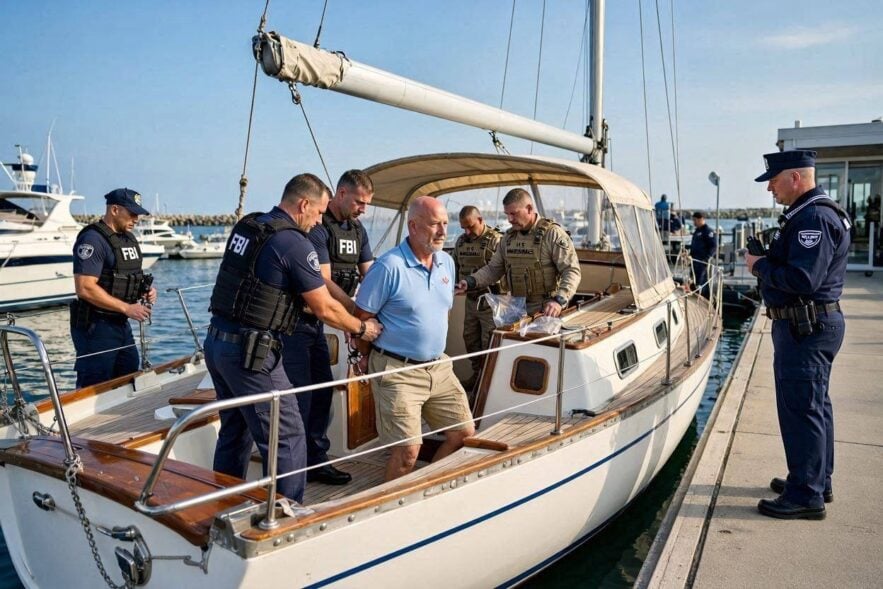
More than twenty-one years later, authorities captured Fischer aboard the fifty-six-foot sailboat Silver Lining off the New Jersey coast on July 16, 2026, ending the physical escape while renewing legal attention surrounding the extraordinary email and unfinished consequences of the 2005 courtroom departure.
The moment Fischer left Rhode Island
The publicly documented timeline places Fischer’s decision during a weekend recess as the Newport County Superior Court trial approached closing arguments, although no authoritative account identifies the precise hour when he physically crossed Rhode Island’s border or boarded any particular vehicle, aircraft, or vessel.
That distinction matters because the phrase trial escape can evoke a dramatic flight from courthouse security, while Fischer reportedly departed as a defendant who remained at liberty and was expected to return voluntarily when the court reconvened for the proceeding’s final stages.
The underlying case concerned a woman who testified that Fischer sexually assaulted her aboard his yacht Lion King at a Portsmouth marina during a first date in 2003, an account that Fischer contested through counsel before choosing not to remain for the jury’s decision.
During trial, witnesses had testified, exhibits had been introduced, and both sides had developed their competing narratives, meaning Fischer disappeared after receiving an extensive opportunity to observe the prosecution’s case and assess the risks facing him personally.
The timing strongly shaped public interpretation because he left immediately before closing arguments, when lawyers ordinarily organize the evidence into their final presentations, and jurors prepare to deliberate under the judge’s instructions regarding law, credibility, and reasonable doubt.
According to the detailed NBC 10 investigation reconstructing Fischer’s disappearance, the email arrived on Saturday evening, April 23, while his lawyers were preparing for the concluding courtroom phase and reasonably expected their client’s continued attendance.
The accessible public record does not establish whether Fischer drove from Rhode Island, traveled initially through another state, departed through an airport, crossed into Canada, reached a marina, or arranged transportation before sending the message to counsel.
Investigators reportedly searched his East Greenwich residence after the disappearance and found material concerning concealed identity and offshore financial arrangements, although those discoveries did not provide a publicly confirmed destination or produce an immediate arrest.
Authorities considered possible connections involving upstate New York, Canada, Brazil, and Costa Rica during different periods, but later retrospective reporting said those possibilities failed to develop into the verified location needed for a lawful apprehension.
Fischer’s known sailing expertise and international travel history expanded the number of plausible routes significantly, because investigators could not assume that a person described as a master yachtsman would remain dependent upon conventional residences, ordinary domestic travel, or one stable community.
Nevertheless, no reliable source establishes that Fischer escaped Rhode Island by boat during that weekend, and the fact that officers eventually arrested him aboard another sailboat cannot retroactively prove the transportation method he used in April 2005.
The most accurate description is therefore that Fischer left the jurisdiction deliberately while free during trial, communicated his choice through counsel, and disappeared before the court reconvened, leaving investigators to reconstruct his movements after the opportunity for routine surrender had vanished.
For the woman who testified, the departure changed the expected meaning of a verdict because even a conviction could not produce immediate custody, while for lawyers and court personnel, the disappearance created a procedural crisis at the moment the trial should have reached an orderly conclusion.
A defendant’s voluntary absence can have consequences beyond public perception because courts must determine whether the trial may continue, whether counsel can represent the missing client effectively, and how jurors should understand an empty defense table without treating absence as automatic proof.
Fischer’s decision also deprived him of the opportunity to hear closing arguments personally, consult with counsel during the final stage, observe the jury’s reaction, and participate directly in any immediate proceedings following the announcement of a verdict.
The escape moment was therefore less cinematic than consequential, unfolding through a weekend departure and electronic message rather than a courthouse chase, yet producing legal, investigative, and human effects that continued unresolved for more than two decades.
The attorney email that signaled the flight
The email’s subject line consisted of the single word “Goodbye,” establishing its purpose immediately and distinguishing the communication from an ordinary scheduling message, legal question, or temporary explanation for why Fischer might arrive late when court resumed.
Within the message, Fischer reportedly expressed confidence that the trial had proceeded favorably and suggested that he expected acquittal, but he simultaneously described the remaining possibility of conviction as carrying punishment he considered intolerably severe.
He then explained that he would not accept that risk and intended to leave the United States for another country, where he claimed to have prepared a secure, comfortable, and sustainable life through planning completed before the trial concluded.
That combination of professed optimism and deliberate departure made the email especially revealing, because Fischer portrayed himself as expecting victory while behaving as though the possibility of defeat justified abandoning the legal process entirely.
The statement suggests advance preparation rather than a spontaneous panic reaction, yet the public record does not identify when that planning began, which destination he selected, what identity documents he intended to use, or whether another person knowingly assisted him.
Fischer concluded the email with thanks to his attorneys and a personal comment advising one lawyer to reduce chocolate consumption and watch his diet, an incongruously casual ending that intensified the message’s unsettling character for people who later reviewed it.
The farewell did not authorize his lawyers to prevent the trial from continuing, erase the evidence already presented, or negotiate a consequence-free conclusion, because defense counsel remained obligated to represent his legal interests within the boundaries established by professional duties and court orders.
It also did not create attorney responsibility for Fischer’s disappearance, since receiving a client’s announcement after departure differs fundamentally from helping plan flight, concealing a location, transmitting unlawful instructions, or participating knowingly in obstruction.
The email became powerful evidence of intent for the fugitive investigation because it addressed risk, departure, and life abroad directly, reducing the likelihood that Fischer’s absence could be explained credibly as confusion, illness, accident, or temporary loss of contact.
However, the communication functioned poorly as a location lead because it named no country, city, residence, vessel, associate, financial institution, or travel schedule that investigators could pursue immediately through ordinary warrants or interagency requests.
Its greatest value was therefore interpretive rather than geographic, clarifying why Fischer failed to appear while forcing authorities to develop his location through records, interviews, aliases, publicity, family connections, and international or maritime investigative possibilities.
The email also became central to media coverage because it allowed journalists to describe flight through Fischer’s own contemporaneous reasoning instead of relying exclusively upon later prosecutorial conclusions or speculation about why he disappeared.
Responsible coverage must still avoid reproducing the entire message unnecessarily, because the essential facts can be conveyed through accurate paraphrase while preserving the legal significance of his declared unwillingness to accept the trial’s remaining uncertainty.
The Amicus International Consulting examination of international fugitive psychology provides broader context for how fear of punishment, perceived control, advance preparation, and imagined safety abroad can influence decisions to flee, without establishing Fischer’s private mental condition beyond his written statements.
Fischer’s message illustrates a recurring contradiction within flight decisions, because the person may describe the departure as rational self-preservation while creating new warrants, harsher custody arguments, family disruption, sustained surveillance, and years of dependence upon concealment.
His confidence in a carefully designed overseas life also underestimated the durability of criminal judgments and fugitive warrants, which remained active through changing technologies, investigators, aliases, and public attention until newly developed intelligence identified him during July 2026.
The official United States Marshals Service account of Fischer’s eventual capture said investigators rapidly corroborated fresh information, traced him to Silver Lining under the alias Richard Graydon, and intercepted the sailboat approximately one hour offshore.
That ending gave the email a retrospective irony, because the secure and comfortable foreign existence Fischer claimed to have planned did not eliminate accountability, while the specialized maritime life associated with his earlier identity ultimately became part of the environment where authorities found him.
How the court case continued without him
When Fischer failed to return, the judge faced a question familiar in principle but extraordinary in consequence, namely whether a defendant who had attended the trial and then departed voluntarily could prevent the proceeding from reaching closing arguments, deliberation, and verdict.
Courts generally distinguish a voluntary absence after trial begins from circumstances where a defendant never appeared initially, because someone who knowingly abandons an ongoing proceeding may be treated as having waived the right to remain physically present.
The continuation did not mean Fischer surrendered every constitutional protection, because his attorneys remained present, the prosecution retained its burden, evidentiary rules continued applying, and jurors still had to decide the charge from admitted evidence rather than punish him merely for disappearing.

Defense lawyer Bob Mann reportedly addressed the empty courtroom presence carefully, telling jurors that Fischer was absent while emphasizing that the absence was not the factual issue they had been assembled to determine.
Prosecutor Carl Ricci likewise could not explain the disappearance directly or invite jurors to substitute it for proof, so he reportedly used an image from Fischer’s online profile during closing arguments because the defendant himself was no longer available for visual reference.
The lawyers’ inability to disclose the email’s explanation protected the integrity of deliberations by limiting the danger that jurors would treat Fischer’s openly declared flight as conclusive evidence that he committed the earlier sexual assault.
That restriction illustrates an important due-process principle, because consciousness of guilt can be argued only under governing evidentiary rules and cannot automatically relieve prosecutors from proving the conduct charged in the indictment beyond a reasonable doubt.
The jury ultimately convicted Fischer of first-degree sexual assault in his absence, converting the prosecution into an enforceable judgment while leaving authorities without the defendant needed to begin immediate imprisonment and ordinary post-verdict proceedings.
His absence also complicated the emotional meaning of the result for Cheryl Gingerich, whose testimony had brought the case before jurors, because the guilty verdict validated the prosecution while the lack of custody prevented the finality ordinarily associated with courtroom accountability.
Fischer later received a life sentence with eligibility for parole after twenty-five years, but the sentence remained largely theoretical until capture because correctional time cannot be served by a person who remains outside state custody.
Separate warrants involving failure to appear and unlawful flight to avoid prosecution kept the disappearance legally visible, allowing Rhode Island authorities, federal investigators, fugitive task forces, and public-alert systems to preserve the case after ordinary news coverage declined.
The Amicus International Consulting analysis of how long-term fugitives evade capture explains generally how aliases, mobility, assistance, fragmented records, and changing jurisdictions can prolong searches, although it does not establish Fischer’s undisclosed route or specific methods during the missing decades.
His case appeared repeatedly through most-wanted publicity, including America’s Most Wanted, while Rhode Island State Police materials described extensive aliases, international connections, world travel, and advanced sailing ability that complicated conventional location strategies.
The judgment’s survival demonstrates why fleeing during trial differs fundamentally from winning an acquittal, because escape delays enforcement while leaving the verdict, sentence, warrants, and institutional authority capable of returning immediately when custody becomes possible.
After Fischer’s July 2026 capture, authorities transported him by Coast Guard vessel to Staten Island, transferred him to deputy marshals and local officials, and moved the case into proceedings required to return him to Rhode Island.
Reporting said Fischer was remanded during a Manhattan appearance and waived extradition, reducing one procedural obstacle while leaving Rhode Island authorities to address the sentence and any remaining federal or state consequences associated with his departure.
A waiver of extradition does not erase the twenty-one-year absence or decide every available post-conviction issue, because Fischer may still seek lawful review through motions that Rhode Island procedure permits after a conviction entered while he was voluntarily absent.
The state will nevertheless begin from a dramatically different position than it occupied after the 2005 verdict, because Fischer is now physically available for custody, counsel, court orders, sentence administration, and any additional proceedings arising from failure to appear or federal flight allegations.
The trial escape therefore failed as a legal solution even though it succeeded temporarily as physical avoidance, exchanging the immediate uncertainty of a jury verdict for decades of fugitive status and eventual capture aboard a vessel registered under another name.
The email remains the defining document because it joined intention with action, showing that Fischer understood the courtroom risk, chose departure over participation, and attempted to replace judicial accountability with a personally designed future beyond the United States.
The court’s continuation remains equally important because it demonstrated that voluntary disappearance could not grant him unilateral power to nullify completed testimony, halt closing arguments, or prevent jurors from reaching a lawful decision on the evidence.
For defendants generally, the case illustrates that remaining for verdict preserves access to counsel, immediate motions, appellate preparation, and transparent adjudication, while flight creates additional exposure without producing the authoritative vindication that only acquittal or dismissal can provide.
For courts, the episode illustrates the difficult balance between protecting a voluntarily absent defendant’s rights and preventing strategic disappearance from disabling a trial after witnesses, jurors, attorneys, and public institutions have invested substantial effort.
For survivors and communities, the twenty-one-year interval demonstrates how flight can extend trauma beyond the underlying offense, delaying enforcement and repeatedly reopening a case whenever publicity, suspected sightings, investigative developments, or anniversary reporting returns it to public attention.
Ronald L. Fischer’s trial escape was ultimately not one moment but a chain of deliberate choices, beginning with advance preparation, becoming explicit through the April 23 email, and continuing every day that he remained unavailable after the jury’s verdict.
His capture aboard Silver Lining finally ended that chain physically, but the legal aftermath continues through custody and sentence enforcement, proving that an emailed farewell can interrupt courtroom attendance without extinguishing the judgment that the courtroom ultimately entered.