

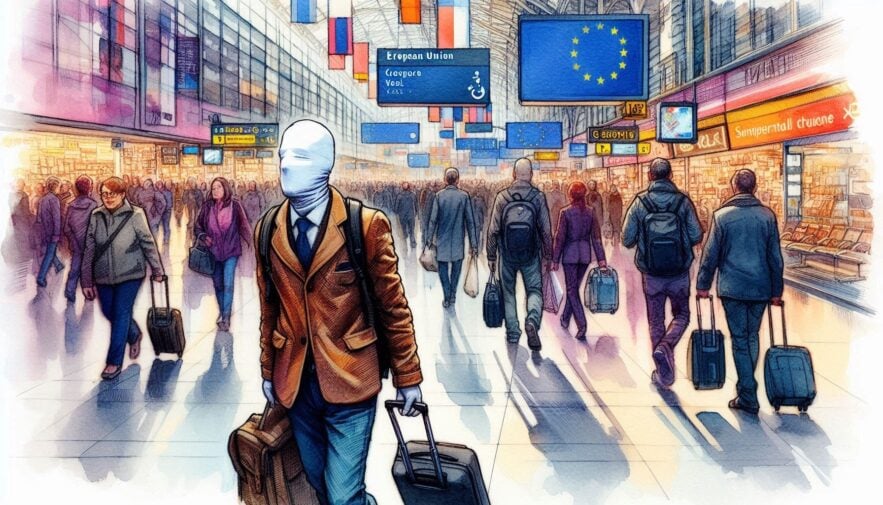
Lawful strategies for reducing digital traces during cross-border travel and relocation without creating contradictions in identity, residence, banking, or tax records.
WASHINGTON, DC
The safest way to move between countries in 2026 is not to try to erase every trace. It is to reduce unnecessary digital exposure while keeping one’s truthful legal identity consistent across travel, residence, banking, and tax systems.
That distinction matters because many people talk about leaving no digital footprint when what they really want is something more practical. They want fewer unnecessary disclosures. They want less location tracking, less account sprawl, less document duplication, and less dependence on one oversized digital identity that follows them everywhere. Those goals are reasonable. They simply have to be pursued through lawful privacy discipline rather than through concealment from systems that are legally entitled to know who you are.
The modern problem is not that people are too visible only to governments. It is that they are too visible to everyone. Airlines, hotels, payment processors, apps, data brokers, telecom providers, loyalty programs, landlords, schools, property managers, and service platforms all capture fragments of movement. One piece may seem harmless. Ten pieces begin to tell a story. Fifty pieces become a personal map. The privacy-conscious traveler or relocating family is therefore not usually trying to become invisible. They are trying to stop every ordinary transaction from becoming a permanent, shareable layer in that map.
That is why lawful low-visibility movement begins with design rather than improvisation. Before a trip or relocation starts, the traveler should decide which systems genuinely need what information, which communications channels should be used for which roles, and how the move will be managed without allowing every vendor, app, and adviser to see the whole picture. Families who approach travel and relocation this way often begin with broader planning through Amicus International Consulting, because the move itself is only one part of a much wider structure.
Start by reducing concentration before you reduce exposure.
Many people try to become less visible while still running their life through one phone, one email address, one bank, one payment profile, one loyalty stack, and one overused set of travel accounts. That rarely works. The reason is simple. Every time that one digital stack is used, more context is added to the same file. Flights, hotels, ride bookings, banking logins, local SIM activations, residential setup, and cross-border payments all reinforce one another.
A better structure begins with the separation of functions. One email may be used for travel and relocation logistics. Another may remain personal. One number may be used for service-provider contact. Another may remain private. One payment lane may support travel and move-related transactions. Another may hold reserves. This is not deception. It is ordinary compartmentalization. The goal is to avoid feeding every app, service provider, and booking platform the same full identity and behavior trail by default.
This is also why a lawful second nationality or second residence right can sometimes help reduce digital concentration. Not because it creates another self, but because it gives the same person another lawful administrative platform from which to live, bank, travel, and register locally. The official U.S. guidance on dual nationality reflects the basic principle clearly. One person may have more than one nationality, but that person still remains one continuous legal identity. The value lies in lawful optionality, not in fragmentation.
Quiet the device before the border ever sees you.
A phone is often the biggest source of unnecessary digital exposure in a cross-border move. It contains apps, location histories, contacts, payment methods, saved travel data, identity files, browser sessions, two-factor prompts, messaging records, cloud storage, and, in many cases, years of behavioral residue. If that device is over-permissioned and over-connected, the traveler is already overexposed before reaching the airport.
This is why the device should be reviewed before the trip or move. Remove unused apps. Narrow permissions. Turn off location access for apps that do not truly need it. Separate relocation-related files from general daily clutter. Review which apps still have access to contacts, camera, microphone, Bluetooth, photos, and background data. Keep only what is needed for the move. The point is not to make the device empty. It is to stop it from volunteering so much information by habit.
The quietest traveler is often the one with fewer unnecessary identifiers attached to the trip. That means fewer stale travel apps, fewer old loyalty logins, fewer saved cards across platforms, and fewer default links between unrelated services. Many people assume privacy comes from using more tools. In practice, it often comes from using fewer tools more carefully.
Treat booking systems as data systems first.
Flights, hotels, relocation vendors, short-term rentals, serviced apartments, coworking spaces, shipping companies, and telecom providers all want to make setup frictionless. The price of that convenience is usually data capture. Profiles accumulate addresses, companion names, payment cards, passport details, location habits, preferences, and recurring travel patterns. Over time, the booking system may know as much about your movement style as the trip itself.
That does not mean you should avoid digital booking systems entirely. It means you should use them deliberately. Save only what is worth saving. Avoid connecting every service to the same universal login. Decline optional marketing, app permissions, and profile expansion where it adds little value. Use one travel-focused channel for confirmations and alerts instead of letting every booking platform inherit access to the same master inbox and the same broader personal ecosystem.
This matters even more during relocation because short-term travel and long-term setup tend to overlap. One week, you are booking hotels. Next, you are activating utilities, opening local accounts, receiving deliveries, arranging moving services, and managing housing documents. If all of that runs through one heavily tracked digital lane, the move becomes easy to map. A lower-exposure move instead keeps temporary travel activity, long-term residence setup, and ordinary personal communications from collapsing into one noisy digital thread.
Use secure communication like a discipline, not a slogan.
Many privacy failures during international moves come from communication habits rather than from the move itself. People send passport scans through casual email. They forward full itineraries to too many people. They store signed lease documents in general folders. They drop local addresses into group chats. They let travel notes, banking details, and family information travel through the same chain because it is easy.
That is how ordinary movement becomes overexposed. A better model separates roles. The airline or booking side gets what it needs for transport. The housing side gets what it needs for occupancy. The moving company gets what it needs for shipping. The bank gets what it needs for account support. Not every participant needs the full itinerary, the full ID set, the full address history, and the full financial structure at the same time.
This is especially important for families, principals, and business owners because they often have more than one layer of activity running simultaneously. One person is coordinating transport. Another is arranging local property access. Another is handling banking. Another is keeping track of children, schools, or staff. The move gets quieter only when each channel sees the minimum necessary information for its role.
Keep the travel story lawful and boring.
The strongest privacy structure in cross-border movement is still a boring one. The booking name matches the document. The document matches the lawful route. The residence basis makes sense. The trip’s purpose is ordinary and explainable. The payment lane is appropriate to the activity. The support structure is narrow. That is what low-friction movement looks like now.
This is also why the tax and residence story cannot be treated as separate from travel. A person may lawfully live in one country, bank in another, and travel under a status connected to a third, but those pieces still need to fit together coherently. For U.S.-linked people, the IRS guidance for international taxpayers remains a reminder that moving abroad does not automatically erase reporting obligations. A quieter cross-border life, therefore, depends on making sure residence, banking, and reporting logic align before the move gets complicated.
When that broader logic is not aligned, every trip becomes louder. Banks ask more questions. Service providers request more explanation. Account openings slow down. Local setup feels improvised. The problem is not only legal. It is digital too, because every workaround generates more messages, more records, more identity sharing, and more people seeing more context than necessary.

Use role-based payment lanes during travel and relocation.
One of the easiest ways to make a move traceable in a broad commercial sense is to run every expense through one card or one account. Flights, lodging, transport, deposits, utilities, hardware, meals, telecom, local services, and longer-term housing costs then form one clean timeline in one place. That may be convenient, but it also creates a comprehensive movement profile.
A better model separates routine spending from reserves and separates travel or relocation operations from longer-term planning where practical. The point is not to hide lawful transactions. It is to prevent one account from becoming the complete behavioral log of the entire move. When roles are separated properly, a hotel charge looks like a hotel charge, a housing deposit looks like a housing deposit, and a local setup expense does not automatically expose the whole financial architecture behind the move.
This is part of why low-visibility travel and lawful offshore banking often overlap in practice. The issue is not secrecy. It is concentration. The more functions are collapsed into one digital financial trail, the easier the move becomes to reconstruct commercially.
Plan for disruption before disruption multiplies your exposure.
A relocation or international trip often becomes most revealing when something goes wrong. A phone is lost. A flight changes. A bank card fails. A hotel booking falls through. A document is temporarily inaccessible. Under stress, people forward too much, disclose too much, and let too many new parties into the file.
That is why the strongest privacy-conscious moves are designed with boring backups. The traveler should know where secure copies of the essential file live. The right people should know how to access only the necessary parts if needed. Core contact routes should be verified in advance. Lawful identity and residence documents should already line up, so no improvisation is needed when a plan changes.
This is another reason a truthful administrative spine matters so much. Backup systems should support the same lawful person, not create opportunities for contradictory storytelling. The quieter structure is the one that answers problems with preparation rather than invention.
The practical rule is simple.
You are not going to move between countries with no digital footprint at all, and trying to do that invites exactly the kind of behavior that creates more risk, not less. The lawful goal is narrower and more realistic. Reduce unnecessary permissions. Reduce unnecessary sharing. Reduce unnecessary concentration. Reduce the number of platforms, providers, and people holding the full map of the move.
That is what modern low-visibility cross-border movement looks like. One truthful identity. One coherent travel and residence story. Role-based communications. Role-based payments. Cleaner devices. Narrower booking habits. Better alignment between mobility, banking, and reporting.
That does not make a traveler invisible. It makes the traveler much less exposed than the default digital model of modern travel and relocation.