

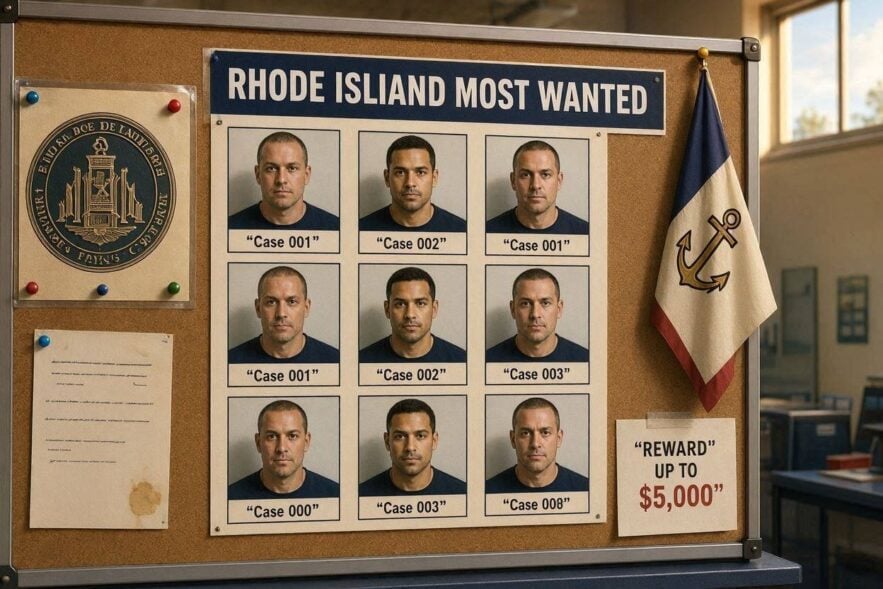
Ronald L. Fischer remained prominently listed because Rhode Island possessed an enforceable violent-crime conviction, active flight-related warrants, an identifiable fugitive profile, and a continuing public-safety interest that did not disappear merely because two decades passed without an arrest.
WASHINGTON, DC
Ronald Fischer stayed on Rhode Island’s most wanted list for years because his disappearance did not leave authorities with an unresolved rumor, but with a convicted defendant, an unserved life sentence, additional flight-related warrants, and a documented history of deliberate evasion.
Fischer vanished during his 2005 first-degree sexual assault trial after sending his attorneys a farewell email explaining that he intended to leave the United States rather than accept even a little possibility of conviction and severe punishment.
The court continued without him, the jury convicted him in absentia, and Rhode Island retained the authority and responsibility to enforce that judgment whenever investigators finally established a current identity and location capable of supporting lawful custody.
His profile remained especially suitable for a state most-wanted list because authorities could provide photographs, physical characteristics, a last known Rhode Island address, seventeen reported aliases, serious charges, and distinctive descriptions concerning his medical background, international connections, and sailing expertise.
A detailed NBC 10 investigation into Fischer’s twenty-year disappearance reported during April 2025 that he remained on the Rhode Island State Police list while a detective continued monitoring and following information associated with open cases.
That public visibility ultimately outlasted countless unsuccessful possibilities, surviving until newly developed intelligence connected Fischer with the alias Richard Graydon and the fifty-six-foot sailboat Silver Lining, where federal and maritime personnel arrested him offshore on July 16, 2026.
How state wanted lists keep older cases active
A state wanted list gives an older case a durable public location where photographs, aliases, charges, physical descriptions, and reporting instructions can remain accessible after the original courtroom coverage, television broadcasts, and newspaper stories have faded from everyday attention.
Rhode Island’s system also connects publicity with an operational structure because the state’s violent fugitive task force combines police, federal, and analytical resources while directing members of the public to official reporting channels instead of confrontation, speculation, or amateur surveillance.
For Fischer, continued listing preserved the difference between an old historical story and a current enforcement matter, reminding viewers that the conviction, sentence, failure-to-appear warrant, and federal flight warrant remained active regardless of elapsed time.
Most-wanted pages function partly as institutional memory because officers, journalists, marina workers, landlords, travelers, former acquaintances, and ordinary residents can retrieve a standardized profile without relying upon imperfect recollections of a television segment broadcast many years earlier.
That function becomes particularly important when a fugitive uses alternate names, because someone encountering Richard Graydon, Ron Stevenson, Jeff Fisher, or another identity might recognize Fischer’s face, profession, age range, maritime knowledge, or personal history even when the presented name differs completely.
The archived profile reportedly listed seventeen aliases and described Fischer as a master yachtsman, world traveler, and internationally connected individual, giving the public several recognition pathways beyond one aging photograph or one legal name.
Such descriptions are not decorative biography because specialized knowledge and recurring interests can remain recognizable when hair color, weight, grooming, residence, and identifying documents change during a prolonged period of evasion across jurisdictions.
A wanted list also allows agencies to update information gradually, replacing photographs, revising aliases, correcting addresses, adding warrant details, or removing a person after capture without forcing the entire case to depend upon one outdated press release.
Fischer’s profile was removed from the active list after his arrest, but the current Rhode Island page still demonstrates the system’s purpose by presenting wanted individuals, their known aliases, alleged offenses, originating agencies, status, and explicit warnings against personal intervention.
The list therefore operates as both an alert and a boundary, inviting information while emphasizing that residents should contact trained officers rather than follow, approach, detain, threaten, or publicly identify someone based only upon resemblance.
That caution matters because old fugitive photographs can produce mistaken identifications, especially when decades have passed, and the wanted person’s appearance may have changed substantially while innocent people share common names, ages, occupations, or physical features.
Investigators must corroborate every serious report through records, photographs, relationships, addresses, travel history, assets, or other independent information before transforming a public tip into surveillance, interstate deployment, or physical arrest supported by lawful investigative procedures.
State lists also help journalists revisit neglected cases responsibly because one official profile supplies a concise foundation for examining court history, victim impact, investigative developments, and unresolved questions without presenting social-media rumor as authenticated fact.
The 2025 NBC 10 investigation performed that role for Fischer by interviewing the survivor, a retired detective, the former prosecutor, and the survivor’s son while reviewing the farewell email, failed geographic leads, aliases, and continuing state-police commitment.
That report renewed public attention without claiming that authorities possessed a current location, illustrating how responsible media can sustain awareness while acknowledging that possible connections involving Canada, Brazil, Costa Rica, and upstate New York had not produced an arrest.
An Amicus International Consulting analysis of how authorities locate wanted fugitives explains generally that old cases can regain momentum when public records, aliases, relationships, specialized habits, and transportation choices connect a historical warrant with a contemporary person or asset.
Fischer’s list placement supported exactly that kind of delayed recognition because the public profile preserved his medical and maritime background until current information eventually associated a new identity with a substantial sailboat operating near the northeastern coastline.
The wanted list did not solve the investigation independently, but it helped ensure that Fischer’s identity remained organized, searchable, and publicly recognizable while law enforcement retained responsibility for evaluating confidential information and acting only after independent verification.
Why his case remained a priority
Fischer’s case remained a priority because Rhode Island was attempting to enforce a completed first-degree sexual assault conviction rather than locate someone wanted merely for an interview, preliminary inquiry, or accusation that had never reached a jury.
The jury’s verdict followed testimony concerning an assault aboard Fischer’s yacht Lion King during a 2003 first date, and the court later imposed a reported life sentence with parole eligibility after twenty-five years.
That judgment gave the search lasting legal weight because voluntary flight had delayed physical custody without reversing the verdict, extinguishing the sentence, or removing the state’s obligation to bring the convicted defendant under correctional authority.
The additional failure-to-appear and unlawful-flight matters strengthened the enforcement interest because Fischer had not simply relocated before learning about a warrant, but had left during an active trial after explaining his decision directly through counsel.
His farewell email reportedly stated that he expected acquittal while refusing to accept even a small risk of harsh punishment, providing unusually clear evidence that the courtroom disappearance represented a calculated choice rather than an accidental absence or misunderstood scheduling problem.
The case also remained important because Cheryl Gingerich had testified publicly, endured cross-examination, and obtained a guilty verdict without seeing the convicted defendant enter custody, leaving the sentence unenforced while the personal consequences she described continued for decades.
Long-term pursuit can communicate to survivors that the justice system has not abandoned an adjudicated case merely because apprehension becomes difficult, although continued listing cannot itself restore lost years, eliminate trauma, or guarantee emotional closure.
Fischer’s previous medical career and reported international experience also increased the investigative complexity because professional knowledge, social confidence, travel familiarity, and access to sailing communities could support movement and relationships far beyond Rhode Island’s immediate geographic reach.
His numerous aliases widened the search further, forcing investigators to distinguish legitimate people from possible identity use while comparing names across state, federal, private, maritime, and potentially international information systems over many years and jurisdictions.
Sailing expertise created another priority consideration because a capable yachtsman could operate through coastal jurisdictions, live aboard vessels, change marinas, and reduce dependence upon the fixed residential patterns that frequently expose other fugitives more quickly.
Those characteristics did not make Fischer uniquely dangerous in every encounter, and the public record does not justify inventing violent incidents during flight, but they did make conventional location methods less reliable and justified continued specialized attention.
The case’s appearances on America’s Most Wanted reinforced the priority by expanding recognition nationally, while Rhode Island’s state profile ensured that television exposure remained connected with an official, locally maintained enforcement record after individual broadcasts disappeared.
Media exposure can generate useful tips, but it also produces rumor, requiring investigators to preserve patience when confident sightings, foreign possibilities, and remembered encounters fail to produce the independent corroboration necessary for lawful action.
The state police reportedly kept a detective assigned to monitor and follow information in open cases, demonstrating that priority does not always appear as constant visible pursuit because much fugitive work involves quiet review, elimination of false leads, and preservation of institutional knowledge.
A standing assignment also protects continuity when investigators retire, prosecutors change, databases evolve, and archived evidence must be understood by personnel who did not participate during the original trial or immediate post-flight investigation.
The United States Marshals Service account of Fischer’s arrest showed why that continuity mattered because newly developed leads were analyzed rapidly, connected with Silver Lining, and converted into a coordinated interstate and maritime operation within approximately forty-eight hours.
Without an active warrant package, updated case history, functioning task force, and established agency partnerships, even strong contemporary information could have been delayed while officials reconstructed authority, identity records, photographs, and jurisdictional responsibilities from fragmented archives.
Fischer’s case remained a priority because the state understood that difficult capture does not reduce the seriousness of an existing violent-crime judgment, while the passage of time can make readiness more important rather than less important when a rare opportunity finally appears.
What the long run says about fugitive tracking
Fischer’s twenty-one-year flight demonstrates that fugitive tracking is rarely continuous physical pursuit, because most long cases consist of alternating periods of public appeals, confidential review, false leads, administrative research, technological change, and sudden operational urgency.
The public often sees silence and assumes inactivity, yet investigators may be comparing aliases, reviewing old associates, checking new records, receiving unverified tips, coordinating with other jurisdictions, and deciding repeatedly that available information remains insufficient for enforcement.
Long cases also expose the limitations of technology because databases cannot automatically identify someone when records use unfamiliar names, jurisdictions restrict access, historical information was entered inconsistently, or the person avoids transactions clearly connected to the wanted identity.

Fischer reportedly remained associated publicly with seventeen aliases before Richard Graydon emerged during the final investigation, illustrating how one additional identity can create an entirely separate trail that older keyword searches and public profiles do not capture immediately.
Identity switching still creates burdens for the fugitive because alternate names must interact with assets, relationships, communications, repairs, registrations, housing, travel, and ordinary services, producing inconsistencies or connections that become discoverable as years accumulate.
Silver Lining became especially important because the vessel attached Graydon to a large, observable asset requiring specialized operation and recurring administrative or commercial contact, allowing analysts to compare the contemporary identity with Fischer’s longstanding maritime profile.
The breakthrough also shows that behavior can outlast documentation because a person may change names and residences more easily than deeply developed skills, preferred environments, professional vocabulary, recreational interests, and social stories repeated across new relationships.
An Amicus International Consulting examination of how fugitives evade capture over long periods describes generally how mobility, aliases, fragmented jurisdictions, and changing records can delay discovery, while repeated routines gradually create vulnerabilities investigators can exploit lawfully.
Patience remains central because agencies cannot force decisive information to appear on a predictable schedule, but they can preserve records, maintain public profiles, update photographs, retain partnerships, and ensure warrants remain ready for immediate operational use.
Fischer’s final forty-eight hours as a fugitive demonstrate the value of that preparation because Rhode Island personnel could evaluate the new intelligence against two decades of accumulated knowledge and deploy toward New York without rebuilding the entire case from the beginning.
The operation then required regional marshals, Federal Bureau of Investigation analysts, Rhode Island State Police, Portsmouth police, and Coast Guard personnel, showing that fugitive tracking succeeds through complementary institutional capabilities rather than one investigator possessing unlimited authority everywhere.
Interstate and offshore geography complicated the arrest because Rhode Island held the historical judgment, New York and New Jersey partners controlled regional operational support, and Coast Guard resources were necessary to reach a fifty-six-foot sailboat approximately one hour offshore.
The arrest without incident demonstrates that effective tracking aims for controlled custody rather than theatrical pursuit, using verified intelligence and positioning to reduce uncertainty before officers approach a potentially mobile target in a specialized environment.
The long run also reveals why public wanted lists must remain accurate and restrained because exaggerated claims, unsupported aliases, outdated charges, or sensational danger labels can generate harmful mistakes and weaken trust when residents encounter legitimate future alerts.
Rhode Island’s list warned people not to act independently, reflecting the principle that publicity should expand observation while leaving identification, surveillance, arrest, and evidence handling with trained personnel accountable to courts and agency procedures.
Removal after capture is equally important because an outdated active profile can continue generating false sightings, harassing unrelated people, and confusing readers about whether a person remains at large after custody has ended the immediate public-search phase.
Fischer’s disappearance also demonstrates that public recognition alone cannot guarantee arrest because America’s Most Wanted exposure, local reporting, survivor recollections, family connections, and several geographic possibilities remained insufficient until investigators obtained current, corroborated information.
Conversely, the arrest demonstrates that an old case can move faster than a new case once credible information appears because the legal authority, fugitive profile, and interagency structure have already been developed and preserved through years of continued attention.
The most-wanted designation therefore operated as a bridge between historical accountability and present operational readiness, keeping Fischer visible enough for recognition while allowing investigators to act decisively when Graydon and Silver Lining created a verifiable contemporary location.
The long search does not prove that every investigative decision was perfect because the public still lacks a complete chronology of tips, records, missed opportunities, foreign possibilities, and reasons Fischer remained undetected through numerous technological advances.
It does show that no publicly confirmed location was knowingly abandoned, while the surviving record describes repeated review, unsuccessful leads, maintained publicity, and a detective assigned to monitor information associated with the open case.
For state agencies, the lesson is that older violent-fugitive files require structured ownership, updated analytical review, and partnerships extending beyond local geography, because a person missing for decades may appear suddenly in another district or specialized environment.
For the public, the lesson is that wanted lists remain informational tools rather than invitations to participate physically, and any apparent recognition should be reported through official channels with specific observations rather than accusations posted publicly.
For journalists, the lesson is that prolonged silence should be examined critically without being equated automatically with abandonment, while official claims of persistence should be tested against available records, staffing, public updates, and eventual operational results.
Ronald Fischer stayed on Rhode Island’s most wanted list because his conviction remained enforceable, his flight remained deliberate, his identity remained recognizable, and the state retained both a public-safety interest and a moral obligation to pursue lawful accountability.
His capture aboard Silver Lining finally changed his status from at large to in custody, but the twenty-one-year listing remains instructive because it shows how institutional memory can survive failed leads, fading publicity, aliases, geography, and prolonged uncertainty.
The broader conclusion is that fugitive tracking depends less upon constant visible pursuit than upon disciplined preservation, credible public communication, analytical patience, and immediate coordination when one current lead finally connects an old warrant with a real person and place.