

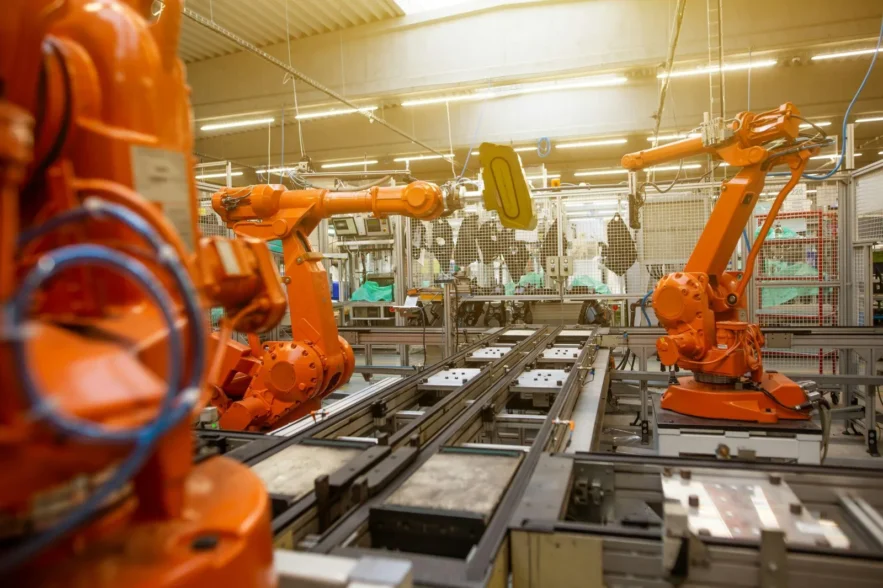
Photo: Simon Kadula
America’s manufacturing comeback is bringing new investment, new facilities and new production capacity. But behind the expansion is a less visible question: can manufacturers build the knowledge and competence required to operate all that capacity at the same speed?
That may become one of the defining execution challenges of the next phase of the manufacturing rebound. A factory can be funded, constructed and equipped against a relatively predictable schedule. Training a workforce to run it consistently is harder to put on a calendar.
“The execution problem is that a company can add capacity far faster than it can make anyone competent to run it,” said Garth Coleman, CEO of Canvas Envision.
The difference comes down to how manufacturing has traditionally transferred knowledge. Capital projects have deadlines. Competence does not. Manufacturers can order tooling, pour concrete and install equipment according to a project plan, but creating sufficiently detailed instructions for someone without years of experience requires considerably more time.
As a result, documentation often becomes the minimum required to get a process moving.
“What gets written is a thin procedure produced as fast as the schedule demands, and the gaps get filled by experienced people standing next to new hires,” Coleman said.
That system can work when hiring is gradual and experienced employees have enough time to train new workers individually. A rapid expansion changes the equation. More people need to become competent at once, precisely when the experienced workers are needed to keep production moving.
When Growth Outruns Knowledge Transfer
The consequences of that gap may not appear immediately. Production numbers can remain strong while experienced employees compensate for incomplete instructions, answer questions and intervene when something begins to go wrong.
But that makes the process increasingly dependent on individual workers rather than the system itself.
“Quality stops being a property of the process and becomes a property of who is on shift,” Coleman said.
The problem compounds as more employees enter the operation. If the method exists primarily in one experienced worker’s head, each new employee has to reconstruct it through observation and interpretation.
“The method exists in one person’s head, and asking four new people to reproduce it gets you four approximations of it,” Coleman said.
Variation may begin quietly. A different sequence here, a slightly different interpretation there. Over time, those differences can become rework, scrap and quality problems that eventually reach the customer.
The lag makes the problem particularly difficult to diagnose. The underlying cause can exist for months before the consequences become visible in quality data.
“By the time the quality data turns, three shifts have learned the job wrong and you are retraining rather than training,” Coleman said.
Why Old Documentation Struggles With New Workers
The obvious response might be to update the documentation. But Coleman argues that the problem is deeper than the age of the documents.
“No, and not because the documents are old,” he said. “They were written against a deadline, so they carry the minimum that could be produced in the time available, and reading that minimum correctly requires the experience a new hire does not yet have.”
That creates a mismatch between what a document contains and what a worker needs at the moment of execution.
A visual layer can address that gap by putting the work itself in front of the employee. Rather than asking a new hire to interpret a paragraph describing an assembly, a visual instruction can show the relevant geometry and current step directly at the station.
“A visual layer puts the work itself on a screen at the station, showing the actual geometry of the part at the size and angle the job is done from, with the current step filling the view rather than sitting in a paragraph on page twelve,” Coleman said.
The worker can then interact with the information rather than simply read it.
“The worker controls the view, rotating the assembly to see the fastener they are reaching for, hiding the surrounding structure that is in the way, and calling back the detail when they want it.”
The value extends beyond helping someone understand a single step. The same workflow can capture information from the work itself, while engineering changes can be carried through the instruction process.
“Because the content is generated from the engineering data rather than drawn alongside it, a design change flows into the instruction for review and republication instead of being discovered on the floor,” Coleman said.
That connection becomes particularly important as manufacturers expand across shifts, production lines and facilities. Consistency depends on workers receiving the same current information regardless of who happens to be available to train them.
The Factory Floor Can Reveal the Problem
Manufacturers do not necessarily need sophisticated analytics to identify an execution gap. They can start by observing where workers go when they need an answer.
“The clearest sign is where people go when they have a question,” Coleman said. “If the answer is another person, the knowledge lives in that person rather than in the system, and you have just met the constraint on the whole operation.”
Physical workarounds can provide another clue. Binders, annotated drawings and handwritten notes may seem like ordinary parts of a factory, but they can also represent workers correcting information that does not fully reflect how the job is actually performed.
“Then look at the paper, because binders at the station, a printed drawing with notes in the margin and a sticky note taped to the machine are all the workforce correcting an instruction that is wrong or incomplete, and none of those corrections are reaching engineering.”
There is also a basic operational metric manufacturers should know: how long it takes a new employee to perform a job independently at production rate.
A company that cannot answer that question accurately may have difficulty predicting how quickly a new facility or production line can reach its intended capacity.
Engineering changes offer another test. If the design has changed but the instruction at the workstation has not, the production floor may still be operating against yesterday’s information.
“If the change is not on the screen in front of the worker, the floor is building to whatever was printed last, and nobody can tell you how many units have already gone out that way,” Coleman said.
The Cost of an Expansion That Cannot Scale
The stakes extend beyond training efficiency. If manufacturers cannot execute at the required speed, the immediate consequences can affect both revenue and cost.
“Getting it wrong means missing the quantity you committed to, the quality you promised, or both,” Coleman said.
A manufacturer that cannot meet an order risks losing revenue and potentially the next program. Quality problems create another set of costs through scrap, rework, inspection and warranty claims, while also consuming engineering and quality resources.

Beneath both problems is the fixed cost of the facility itself. A plant operating below its intended rate still carries the cost of the building, equipment and infrastructure.
And the consequences can persist beyond a single production cycle. Customer relationships are built over years, while a handful of missed deliveries or quality failures can influence future purchasing decisions.
The broader manufacturing expansion therefore rests on a crucial assumption: that companies can increase volume and headcount without sacrificing execution.
“That only works if knowledge moves as fast as hiring does,” Coleman said.
Today, that knowledge can still move one experienced person at a time, supported by documentation assembled from disconnected sources.
Turning Expertise Into Infrastructure
The manufacturers that benefit most from the current expansion may ultimately be those that change how they think about expertise itself.
“The separation will come down to which companies treated knowledge as an asset with a system behind it and which kept treating it as paperwork,” Coleman said.
The challenge is particularly acute when experienced workers are already scarce. Adding more employees does not solve a knowledge bottleneck if the people capable of teaching them are themselves the constraint.
“A plant trying to train its way through a ramp hits the same wall, because expertise does not scale by hiring more experts when the experts are the scarce input,” Coleman said.
The alternative is to capture expertise in a form that can be reused. “It scales by capturing what one expert knows into something that works when they are not standing there,” Coleman said.
AI is beginning to make that process more practical. Existing recordings, manuals and engineering data can provide source material for structured drafts, which experienced employees can then review and refine using their own judgment.
“AI has changed the calculus, so an expert can point a system at a recording of themselves running the job, or at the legacy manuals and engineering data already in the business, get a structured draft back in minutes rather than days, then apply their own judgment and publish.”
The larger opportunity is not simply to produce instructions faster. It is to connect expertise with engineering information and the people actually performing the work.
“The companies that use that window will have their methods captured, connected to engineering and reaching the floor on the current revision,” Coleman said.
America’s manufacturing rebound may ultimately be measured by more than the number of factories built or jobs created. The harder test will be whether manufacturers can make their operations capable of absorbing that growth.
Capacity can be added on a project schedule. Expertise has to be built, captured and transferred.
For the next generation of American manufacturing, the companies that solve that knowledge problem may be the ones best positioned to turn new capacity into reliable production.
“Knowledge moves as fast as hiring does.”