

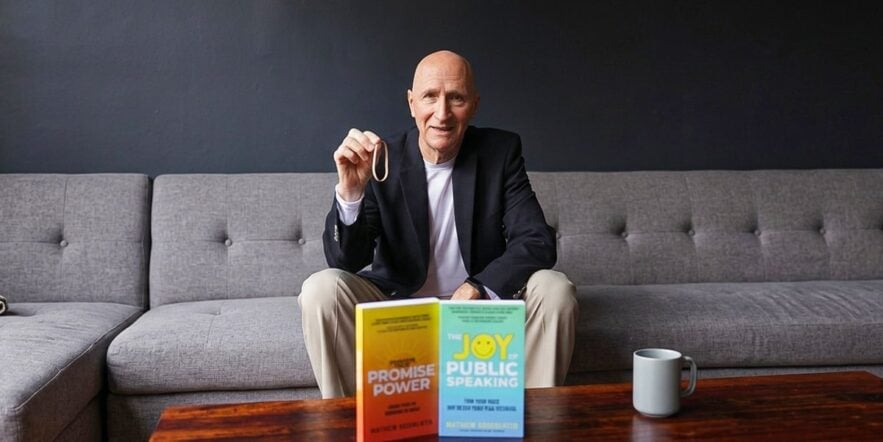
Matthew Cossolotto – a former NATO speechwriter whose executive communications career spans the corridors of power and influence on both sides of the Atlantic – is an author, keynote speaker, workshop leader, and speech coach. In his Personal Empowerment Programs (PEPTalks), he starts with a problem that many people only begrudgingly recognize. He asks how many participants feel they are falling short of their potential. Almost every hand reluctantly goes up. He calls the distance between present performance and self-assessed potential “the GAP.”
Minding The GAP Is Where Personal Change Begins
That GAP gives his personal empowerment work a clear target. Before people can change a habit, improve as speakers, or reach goals and keep their promises, they need to understand what may be causing them to fall short of their potential. He calls this “minding the gap.” It means facing their existing collection of habitual thoughts and mindsets without excuses. That’s where his concept of HabitForce comes in.
PEPTalks Put the “Technology of Personal Change” Into Practice
His services are organized around the Triad Empowerment System: Habits, Speaking, and Promises. Each topic can stand alone as a keynote, workshop, or coaching program. The three can also be combined into a customized PEPTalk program. The Six Axioms and Empower-Me Band concepts run across the full Triad system.
His books and speaking lineup mirror those three topic areas. The Joy of Public Speaking addresses the shift from stage fright to stage delight, urging readers to play the Inner Game of public speaking to win. Harness Your PromisePower, released in 2026 with a foreword by Jack Canfield, focuses on turning important goals into heartfelt promises for sustained emotional commitment. The forthcoming Harness Your HabitForce centers on SUCCESS and FAILURE habits, the Three Rs, and the Six Axioms.
The three topics address different performance problems, yet they use the same underlying methodology. Joyful speaking asks people to convert fear-based thought patterns into more positive mindsets. PromisePower raises the level of emotional commitment behind an important objective. HabitForce focuses on the repeated mental habits that can support progress or hold a person back. That shared conceptual structure fuels the Triad System’s GAP-closing power across different topics. All of this constitutes what Cossolotto calls the “Technology of Personal Change and Achievement.”
HabitForce and the Personal Operating System: Success is an inside job!
HabitForce is Cossolotto’s big-picture concept for repeated thought patterns and mindsets acquired over time. He compares it to a software program or personal operating system, much of which runs below conscious awareness. That helps explain why someone can realize they’re falling short of their potential but feel stuck, powerless to change. The GAP-causing problem is not always missing information. More often than not, it is the mental software program running underneath.
What is the solution? Cossolotto’s answer is succinct: “Success is an inside job.” That tagline is another conceptual thread that runs through his books and PEPTalks. He places HabitForce beside PromisePower and joyful speaking. The HabitForce program highlights the Three Rs, the Six Axioms, and the habits of SUCCESS and FAILURE. All designed to close the gap between performance and potential.
Matthew Cossolotto’s Six Axioms of Personal Empowerment
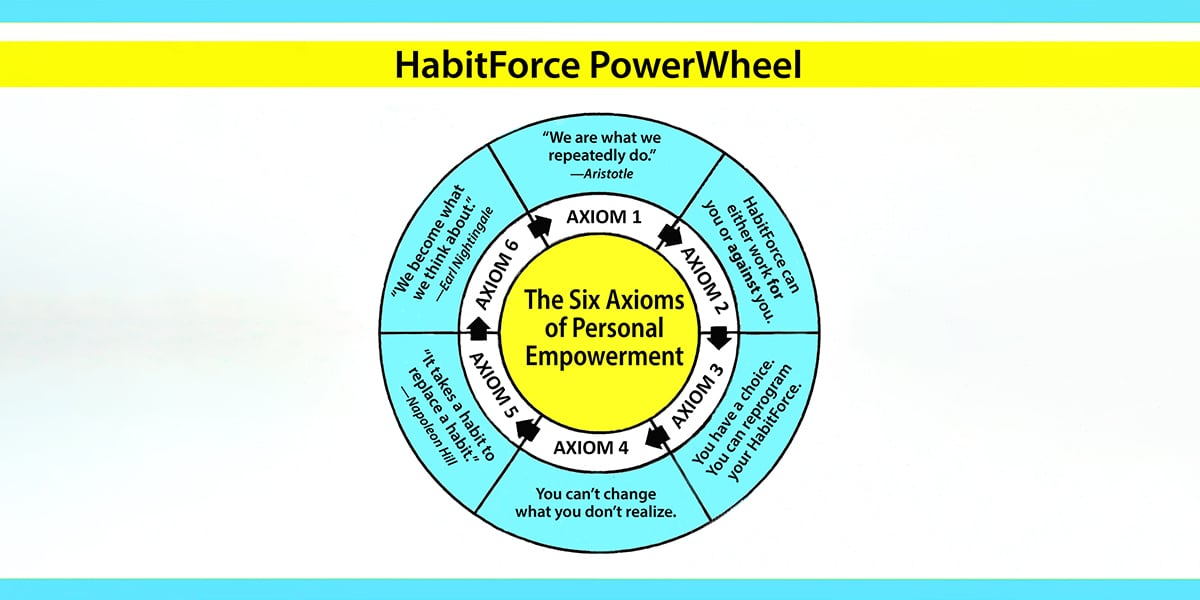
The Six Axioms – or six truisms – give closing the GAP a practical structure. They focus attention on self-awareness and internal dialogue as key elements in the technology of personal change.
-
Axiom 1: “We are what we repeatedly do.” This Aristotle quote highlights how repeated thoughts and behaviors shape performance. Excellence can become habitual, and so can underperformance.
-
Axiom 2: HabitForce can either work for you or against you. HabitForce is neutral like a force of nature. Its effect depends on whether the patterns it keeps running are positive or negative.
-
Axiom 3: You have a choice: You can reprogram your HabitForce. This is the good news. This is where the Three Rs come in: Recognize, Reject, and Replace. The process names an unwanted habit, rejects it with a SNAP of the Empower-Me Band, and replaces it with an empowering SUCCESS habit.
-
Axiom 4: You can’t change what you don’t realize. This truism about self-awareness makes personal change possible. Through meditation, self-reflection, and other awareness exercises, negative self-talk rises up to conscious awareness. This step is essential to the change process.
-
Axiom 5: “It takes a habit to replace a habit.” This quote from Napoleon Hill makes clear that simply stopping an unwanted habit isn’t possible. Becoming aware is the first step. The next step is to replace the negative habit with an empowering one.
-
Axiom 6: “We become what we think about.” This observation from Earl Nightingale makes clear that thoughts are powerful things. Thoughts become self-fulfilling prophecies, determining actions, habits, and overall direction. This axiom encourages people to monitor their internal dialogue and choose their thoughts more carefully. A SNAP from the Empower-Me Band can help to keep thoughts on a positive track.

The HabitForce PowerWheel depicts how one axiom flows into the next in an ongoing virtuous cycle of personal empowerment. This is the Technology of Personal Change and Achievement in perpetual motion.
The SNAP: Turning Awareness Into Immediate Action
The Empower-Me Band gives the system a physical cue. Worn on the wrist, it is a constant reminder of a goal or promise. The band also works as an important metaphor for HabitForce. In a relaxed state, it represents the comfort zone of existing habits. Stretching it creates tension, much like the discomfort created during the change process. There is also a warning inherent in a stretched band: it can snap back unless changes are made in the desired direction. Finally, there is the intentional SNAP effect. When a disempowering or negative thought surfaces, the wearer gives the band a gentle SNAP on the wrist. The aim is awareness, not punishment. This SNAP creates a mental pause for a pivot, a moment to Recognize and Reject the negative thought and Replace it with a positive alternative. That’s how the Three Rs process works. Small steps like these add up to big changes over time.
Cossolotto likes to introduce the Empower-Me Band with humor, calling it “perhaps the greatest tool for personal change and achievement ever devised in human history.” He then adds, “Maybe I’m exaggerating, but only slightly.” The playful claim draws attention, while the band’s purpose remains practical, clear, and empowering. A small physical action gives an internal process a visible trigger, another part of the technology of personal change in action.
Closing the GAP, One SNAP at a Time
Cossolotto’s GAP and SNAP concepts connect insight and action. The GAP identifies the distance between current performance and potential. The Six Axioms demonstrate why repeated thoughts and mindsets matter, give hope that change is possible, and provide practical insights into the change process. Snapping the Empower-Me Band interrupts a disempowering pattern and creates the opportunity to pivot in a more positive direction. For leaders and aspiring leaders — for anyone seeking higher levels of performance in their careers or in life generally — the message is clear: Personal change starts by noticing repeated GAP-inducing patterns. Progress depends on replacing disempowering mindsets with those that promote successful outcomes. Cossolotto’s closing phrase echoes Yoda’s famous blessing from the “Star Wars” movies: “May the HabitForce be with you!”

Connect with Matthew Cossolotto on LinkedIn or visit his website to learn more about his trilogy of personal empowerment books and PEPTalks.