

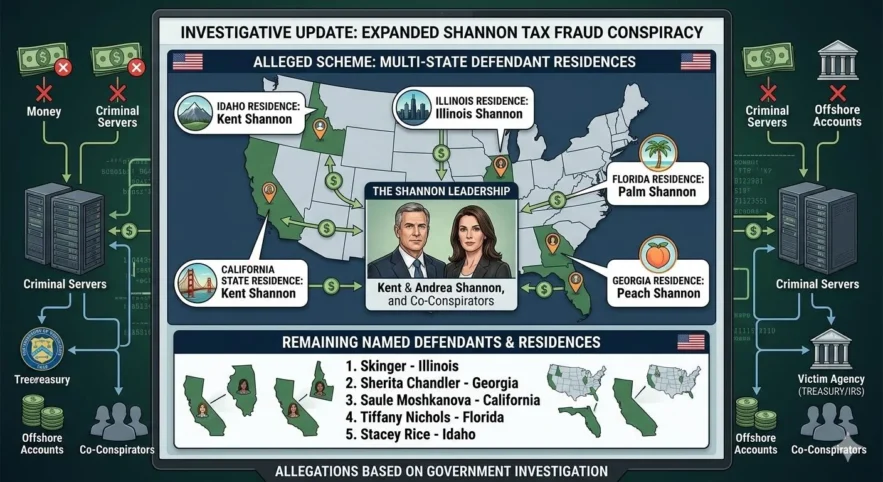
All seven defendants named in the superseding indictment were charged with conspiracy to commit wire fraud, while Andrea and Kent Shannon also face additional allegations and Monika Skinger has since pleaded guilty and received a prison sentence.
WASHINGTON, DC, October 3, 2026
A conspiracy to commit wire fraud charge connects the seven defendants identified in an expanded federal tax refund prosecution, providing the common accusation underlying a case that also includes additional charges against Andrea and Kent Shannon of Kuna, Idaho.
The Justice Department’s September charging announcement identifies the shared conspiracy charge while distinguishing newly charged defendants from previously charged participants, making the allocation of allegations important to understanding the prosecution’s structure and each person’s role.
The government alleges that participants assisted one another in seeking fraudulent refunds through false filings and financial instruments, but a shared charge does not establish identical conduct, equal financial involvement, or the same eventual outcome for every defendant.
The procedural picture has also changed since the expanded indictment became public, because prosecutors subsequently announced Skinger’s guilty plea and sentence, requiring her established disposition to be distinguished from unresolved allegations concerning other people named in the case.
One Charge Connects a Geographically Dispersed Group
The seven-person announcement names the Shannons, Skinger, Sherita Chandler, Saule Moshkanova, Tiffany Nichols and Stacey Rice, describing defendants whose reported residences span Idaho, Illinois, Florida, California and Georgia within the government’s account of the alleged scheme.
That geographic spread identifies where the defendants were described as residing, but it does not explain how they allegedly met, communicated or divided responsibilities, leaving those connections to evidence beyond the list of names and locations.
The common conspiracy allegation supplies the government’s asserted connection among them, focusing on alleged assistance in obtaining refunds rather than treating every filing as an isolated event unrelated to the activities of other participants.
For readers, the distinction is between an accusation that people acted together and proof of the specific conduct attributable to each person, which remains necessary to understand individual responsibility within a broader prosecution involving multiple defendants.
The September Announcement Identifies Three Newly Charged Defendants
The government specifically identified Moshkanova, Nichols and Rice as each charged with one count of conspiracy to commit wire fraud, while stating that the Shannons, Skinger and Chandler had previously been charged with that offense.
That wording explains what changed in the announcement without suggesting that all seven people were charged for the first time together, which would erase the earlier proceedings involving several defendants already associated with the prosecution.
It also does not establish that every person was arrested or first appeared in court on the unsealing date, because those procedural events require their own records rather than being inferred from a public announcement.
The sources therefore support a distinction between newly announced charges and previously existing charges, while leaving a complete procedural calendar for each defendant outside the information supplied in the government’s summary of the expanded case.
The Alleged Coordination Concerns Refund Claims
CBS12 reported that prosecutors accused participants of seeking more than $57 million and receiving more than $8 million through conduct allegedly involving false individual and trust returns and more than 100 fictitious financial instruments submitted during 2023 and 2024.
Those allegations describe the activity that prosecutors say linked the defendants, but they do not provide a complete account of who prepared each document, supplied its information or directed the handling of every requested refund.
The distinction matters because preparing a return, transmitting an instrument, receiving a payment and spending funds describe different activities, even where the government alleges that those activities formed part of a coordinated effort.
A complete account of the alleged conspiracy would need to connect people with those activities through the relevant evidence, rather than relying solely on the fact that their names appear together in a charging announcement.
A Group Allegation Does Not Establish a Uniform Role
The shared charge should not be read as proof that each defendant performed every task, understood every document, or participated throughout the entire period described in the government’s account of the alleged refund activity.
Likewise, the public summaries do not establish a complete hierarchy identifying who directed every decision, making labels such as leader or subordinate inappropriate unless supported by specific allegations or findings about the individual concerned.
A defendant’s prominence in news coverage also does not establish a larger role, since reporting may emphasize local connections or recognizable details without providing a comprehensive comparison of the evidence concerning all named participants.
The useful inquiry remains both individual and collective, examining how the government connects each person to the alleged conduct while preserving the distinction between the broad accusation and the specific facts offered to support it.
The Shannons Face Additional Allegations
The charging summaries identify additional wire fraud and false claims allegations involving Andrea and Kent Shannon, while specifically identifying a money laundering charge against Kent Shannon, making careful attribution essential when describing the couple’s position.
Those additional accusations should not automatically be assigned to Chandler, Moshkanova, Nichols or Rice merely because they appear alongside the Shannons in the same public account, which describes different charges for different people.
The government also alleges that some refund proceeds were used for personal purchases involving the Shannons, linking accusations of obtaining money to allegations about how particular funds were used after receipt.
That spending allegation provides context for the additional charges, but it does not establish that every defendant made those purchases, controlled the relevant accounts or received the same kind of personal benefit from the alleged activity.
Conspiracy and Additional Offenses Should Remain Distinct
A shared conspiracy charge and separately described offenses answer different questions about the prosecution’s structure, so an accurate summary should preserve both the common allegation and the additional accusations attributed to particular defendants within the case.
Separate charges also do not mean every allegation concerns wholly separate money, because several accusations can involve different aspects of related transactions without creating a new financial receipt each time a charge is mentioned.
For the same reason, the number of charges should not substitute for an accounting of the funds, which requires records of requests, payments, and transactions rather than a tally of legal labels.
A clear description therefore identifies who faces which allegations while leaving the financial relationships to the evidence, avoiding the assumption that a more extensive charging description independently establishes a larger personal receipt or benefit.
Documents Form a Central Part of the Government’s Account
The prosecution describes false individual and trust returns alongside fictitious financial instruments, placing the asserted basis for refund requests within the same narrative as the requests themselves and the payments authorities say participants ultimately received.
The alleged relationship concerns representations that supported claims to money, making the documents’ accuracy and the existence of the financial events they purported to describe separate but connected questions within the government’s theory.
A document can state that a payment occurred without independently establishing that money moved, so familiar terminology or apparently complete paperwork does not by itself resolve whether the underlying financial assertion is accurate.
That distinction helps explain the role of supporting instruments without assuming that every document had identical contents, received identical treatment or produced a refund, matters the public summaries do not establish for each submission.
The Use of Trust Returns Does Not Resolve Personal Responsibility
A trust return identifies a category of filing, but it does not independently establish who supplied the information, prepared the document, or knew whether the financial assertions were accurate when the return was submitted.
The allegation that a return was false also does not, by itself, establish that the associated trust never existed or lacked any legitimate purpose, since those are different propositions requiring their own factual support.
An individual account would need to distinguish the subject of the filing from the person responsible for particular representations, avoiding assumptions that ownership, administrative involvement, and knowledge necessarily answer the same question.
That approach preserves the significance of the government’s allegations while keeping attention on the conduct and evidence relevant to each defendant, rather than allowing a filing category to stand in for proof of criminal responsibility.
Scheme-Wide Figures Do Not Establish Equal Financial Involvement
The amounts allegedly requested and received concern the broader scheme, leaving each defendant’s financial position to be established through records connecting that person with particular filings, payment destinations, and subsequent transactions.
Dividing those figures equally among seven people would produce an arithmetic average rather than an evidence-based allocation, potentially obscuring substantial differences in the number, size, and outcome of requests associated with individual participants.
The same caution applies to the instrument count, because the published aggregate does not show how many documents each person allegedly prepared or submitted, and a document count does not necessarily correspond to a payment count.
A detailed reconstruction would need to connect the records rather than distribute the totals by assumption, preserving the difference between the government’s description of collective activity and the evidence establishing individual financial involvement.
Requested Refunds and Receipts Describe Different Stages
The larger financial figure concerns refunds allegedly sought, while the smaller figure concerns money authorities say was paid, so the amounts measure different stages in the alleged sequence rather than interchangeable descriptions of completed government disbursements.
They should not be added together as independent losses, because payments issued in response to requests belong within that sequence rather than necessarily constituting a separate pool of claims outside the amount originally sought.
Nor does their difference establish an exact amount the IRS rejected, since the public account uses qualified totals and does not explain the disposition of every request included in the government’s description.
Those limits matter when evaluating a conspiracy allegation, because a collective financial narrative still requires precise labels and supporting records before conclusions can be drawn about individual receipts, outstanding losses or potential recovery.
Skinger’s Guilty Plea Changes Her Procedural Position
The Justice Department announced September 11 that Skinger pleaded guilty to conspiracy to commit wire fraud and received 27 months in prison, establishing an individual outcome after the earlier public announcement identifying the seven defendants.
The same release reported three years of supervised release and $303,672.44 in restitution, while describing her submission of at least 16 fictitious financial instruments and false returns involving both individual and trust filings.
That development means she should no longer be described simply as a defendant awaiting a determination of guilt on the shared charge, because her admitted offense and sentence materially change the procedural picture.
Her disposition does not resolve the allegations against other defendants, however, and it does not establish that their knowledge, conduct or financial involvement matched the circumstances described by the government when announcing her sentence.

One Sentence Does Not Predict the Others
A sentence imposed on one participant cannot reliably forecast another defendant’s outcome, because the charges, evidence, personal circumstances and procedural position relevant to a separate case may differ in ways the public summaries do not explain.
The same limitation applies to restitution, since a monetary order concerning one person does not automatically establish the amount another person would owe or provide a complete accounting of the broader scheme’s remaining financial consequences.
An order to pay also differs from confirmation that money has been collected, leaving actual recovery to be established through payment records or other reliable information beyond the announcement of the obligation itself.
For readers following the common conspiracy charge, Skinger’s outcome provides a clear individual development while showing why procedural status and financial consequences must still be tracked separately for each person named in the broader prosecution.
Potential Penalties Remain Conditional for Unresolved Charges
The government identifies a maximum prison term of 20 years for the conspiracy charge if a defendant is convicted, but that statutory ceiling does not establish a likely sentence or predict the result of unresolved proceedings.
Adding maximum penalties across several charges would likewise fail to provide a reliable forecast, because possible legal limits differ from the individualized decision a court would make after a conviction in a particular case.
The seriousness of the allegations should therefore be explained through their substance and potential consequences, without presenting a theoretical maximum as an expected outcome for everyone connected by the shared charge in the indictment.
For defendants whose cases remain unresolved, the presumption of innocence continues to apply, and their responsibility must be established through the applicable proceedings rather than inferred from the size or publicity of the alleged scheme.
The Public Announcements Do Not Reproduce the Full Evidence
The government identifies IRS Criminal Investigation as the investigating agency, but its public summaries do not disclose every communication, record comparison or interview through which investigators developed the allegations about coordination among the defendants.
Without those details, attributing the case to a particular witness, automated detection method or communication platform would introduce an investigative explanation that the available sources do not establish as the actual basis for the charges.
The announcements also do not provide a complete response from every defendant, so the absence of such material should not be treated as agreement with the government’s allegations or as evidence against an individual.
A sound account can describe the prosecution’s theory while leaving those unanswered questions open, distinguishing the allegations announced publicly from the complete evidentiary record relevant to resolving each person’s case.
Financial Identification and Verification Serve Different Purposes
The alleged use of financial documents has broader relevance to legitimate administration, where identifying the correct person or entity and verifying the substance of a financial claim are related tasks that still require separate attention.
Amicus International Consulting provides information about tax identification numbers, an administrative subject associated with financial records, although an identifier does not independently prove the accuracy of a return or the legitimacy of a claimed payment supporting a refund request.
An identifying number can help associate documents with their subject while leaving the financial assertions inside those documents subject to examination, making administrative consistency useful without treating it as confirmation of the underlying transaction.
A substantive review would therefore distinguish evidence about whose record is being examined from evidence supporting what the record claims, preserving the different questions answered by identification information and actual financial documentation.
Banking Records Need Their Own Context
Amicus also describes offshore banking services, where ownership and supporting financial information are relevant administrative subjects, although the public sources reviewed here do not establish an offshore banking component to the alleged refund conspiracy.
The broader connection concerns accurate records, because evidence that an account exists differs from evidence explaining its funds, and neither automatically resolves the validity of a separate filing or a request for government money.
When several people or institutions handle different portions of a financial history, the records need to remain understandable in relation to one another without assuming that every document independently verifies all the other information.
These general observations do not establish any defendant’s guilt, which must be determined through the applicable evidence and proceedings rather than through broad assumptions about financial administration, banking arrangements or the appearance of paperwork.
A Common Charge Still Requires Individual Case Tracking
The conspiracy charge provides the common accusation linking the seven people identified in the September announcement, while the Shannons’ additional charges and Skinger’s later disposition show that their legal positions cannot be treated as identical.
Further developments could clarify individual roles, disputed filings and financial transactions, supplying detail that cannot be reliably reconstructed from a shared charge, an aggregate monetary figure or a list of defendants residing in different states.
For unresolved allegations, the central questions remain what the government can establish about each person’s participation and knowledge, with the broader alleged scheme providing context rather than a substitute for the evidence applicable to that defendant.
The prosecution is therefore connected by a common charge but divided by individual facts and procedural outcomes, requiring careful attention to who is accused of what and which matters the court has actually resolved.
Related coverage: Colorado Home Sale Added to Expatriated Fund Manager’s Tax Evasion Case.