

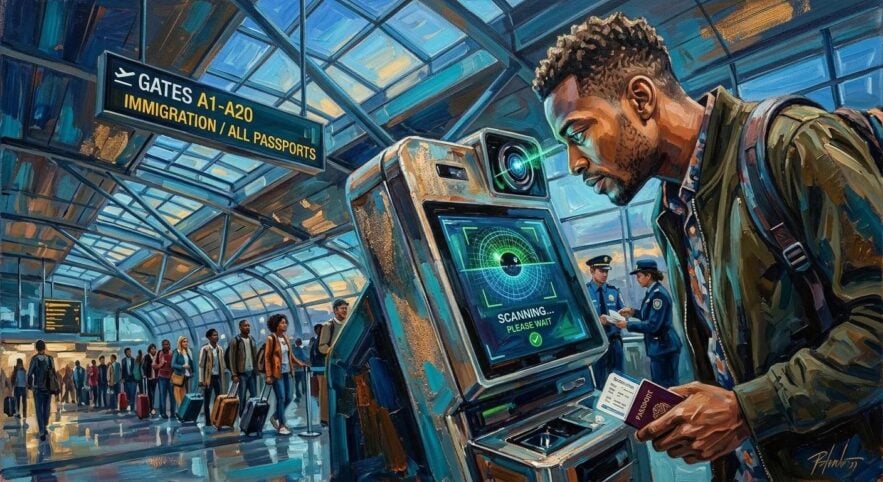
Travelers must distinguish the collecting agency, record type and processing purpose to understand what happens to their information, because a photograph deleted from an airport terminal within minutes can still be associated with other government records retained for years under completely different legal and operational rules.
WASHINGTON, DC, October 23, 2026. You can’t understand airport biometric privacy with a single question about when a photograph is deleted, because modern border systems can generate live facial images, mathematical templates, declaration records, travel histories, and immigration files that follow separate retention schedules after one brief interaction with a camera.
A Single Airport Transaction Can Produce Several Different Records
When travelers approach an automated border gate, customs kiosk or biometric inspection terminal, the visible process may involve little more than scanning a passport and looking toward a camera, yet several distinct pieces of information can be created or accessed during those few seconds.
The system can temporarily hold a newly captured facial photograph, generate a mathematical representation for biometric comparison, retrieve an authoritative passport portrait, record the traveler’s crossing and update another immigration or customs database containing information whose retention has no direct relationship with the live photograph.
From the traveler’s perspective, those information categories can look interconnected because they participate in one border transaction, although governments often maintain them in different technical systems under different legal authorities, access controls, operational purposes, and deletion schedules.
A privacy statement promising to delete photographs after a certain period therefore provides useful information about one record, but it does not necessarily explain what happens to every other record produced or consulted during the same airport inspection.
The Collecting Agency Matters
Identifying the organization responsible for the camera is one of the most important steps in understanding biometric privacy, because an airline boarding camera, an airport security system, a customs kiosk and a government immigration eGate can perform facial comparisons under entirely different authorities.
A camera used for airline boarding may exist mainly to confirm that the passenger approaching an aircraft matches the expected traveler, while a government border system may collect information to document legal entry, departure, immigration status, or compliance with another statutory requirement.
Even when two cameras use comparable facial recognition technology, the photographs can therefore receive dramatically different treatment because data governance follows the organization’s purpose and legal authority rather than the underlying mathematical technique used to compare two faces.
Travelers evaluating privacy should consequently identify whether the photograph belongs to a government border agency, transportation security authority, airline, airport operator or another organization before attempting to determine what retention or deletion policy actually applies.
The United States Demonstrates Why Record Type Matters
U.S. Customs and Border Protection provides a useful example because the agency distinguishes among live photographs, temporary biometric templates, border-crossing records and longer-term biometric information maintained for certain foreign travelers under statutory entry and exit requirements.
Current CBP documentation states that once its Traveler Verification Service determines a person is a United States citizen, the agency bypasses storing the live photograph, while temporary mathematical templates used in the cloud-based matching service remain for no longer than twelve hours.
The same documentation states that facial images involving many non-U.S. citizens and lawful permanent residents can remain within the Traveler Verification Service for no more than fourteen days, while photographs associated with legally required biometric confirmation can enter separate Department of Homeland Security systems under longer retention authorities.
CBP also maintains biographical border-crossing records separately, including fifteen-year retention for United States citizens and lawful permanent residents and considerably longer periods for many non-U.S. citizens, illustrating why deleting a camera photograph does not erase the underlying travel history.
A Photograph, Template and Crossing Record Are Not the Same Thing
Facial recognition systems generally do not compare two photographs by measuring individual pixels, because software analyzes facial characteristics and converts relevant information into mathematical representations that let the system calculate similarity between the live image and an authoritative reference.
Those mathematical representations may exist only for seconds or hours while the system performs the comparison, yet the underlying photograph can follow a different retention schedule, and the resulting border-crossing record can remain available under an entirely different records-management policy.
This distinction matters because statements describing rapid deletion of photographs can be accurate while the government retains the border transaction for years, just as deleting a temporary mathematical template does not necessarily erase another authorized copy of the corresponding facial image.
A useful privacy policy therefore needs to identify the specific information object being discussed rather than relying on broad terms such as biometric data, which can encompass photographs, templates, fingerprints, passport portraits, and several other technically distinct records.
Canada Shows the Difference Between Local and Central Retention
Canada’s airport kiosks provide another clear example because the Canada Border Services Agency expressly distinguishes information that remains temporarily on the physical kiosk from information transmitted to its centralized systems during the traveler’s arrival procedure.
The Canada Border Services Agency’s airport kiosk privacy information states that information entered at a kiosk or eGate is encrypted and transmitted securely to CBSA systems, while the device itself deletes the traveler’s information after the receipt has been printed.
CBSA’s current modernization guidance goes further, explaining that airport kiosks and eGates do not store photographs and personal information long-term, while centrally transferred information can remain in CBSA systems for fifteen years under established government information-management rules.
The Canadian example demonstrates why a statement that an airport terminal deletes a photograph immediately after processing cannot answer the broader privacy question unless travelers also know whether another government system already received and retained an authorized copy.
Local Deletion Still Has Meaning
Removing sensitive information promptly from airport equipment remains valuable even when another authorized government copy exists, because preventing hundreds of publicly located kiosks from accumulating historical biometric data reduces unnecessary exposure across distributed devices.
Local terminals can therefore operate mainly as secure collection points, transmitting information to centralized government systems with stronger access controls, dedicated security monitoring, and formal records-management processes before clearing the information from the physical endpoint.
This architecture does not eliminate privacy concerns about the central database, but it can reduce cybersecurity risks associated with letting each airport workstation become a permanent repository of photographs, passport information, and historical declarations involving large numbers of travelers.
The key privacy question, therefore, is not whether local deletion matters, but whether travelers understand that endpoint deletion and central government deletion are separate events that can occur years apart.
Japan Shows That Some Photographs Really Are Short-Lived
Japan Customs takes a different approach to photographs captured during electronic customs processing, with official guidance stating that facial images used for identity verification and facial recognition at the electronic declaration gate are deleted immediately after the passenger completes the gate procedure.
The Japan Customs Electronic Declaration Gate guidance explains that the terminal and gate capture photographs to support identification and facial recognition, then delete them after the passenger passes through the automated customs process.
Japan’s integrated customs and immigration kiosks similarly state that they use photographs collected during the joint process for identification and gate recognition before deleting them, showing that some airport biometric systems deliberately treat the live facial image as a transient operational tool.
Even in that environment, however, deleting the facial photograph should not be interpreted as deleting the passenger’s immigration history, passport information or customs declaration, because those records exist for governmental purposes separate from the short-lived image used to automate identity confirmation.
Europe Uses Biometrics as Part of a Longer Border Record
Europe’s Entry/Exit System demonstrates the opposite end of the spectrum because captured facial images and fingerprints form part of a centralized immigration record deliberately designed to remain available for future crossings and calculation of authorized short-stay periods.
The system records information on eligible non-European travelers, including names, travel-document information, fingerprints, captured facial images, and the dates and locations of entries, exits, and refusals of entry across participating external borders.
European legislation generally provides three-year retention for entry, exit and refusal records, three years and one day for certain individual files and five-year retention where no departure has been recorded after the expiration of an authorized stay.
The EES example makes clear that some biometric photographs are not merely temporary airport inputs because their longer-term value lies precisely in allowing authorities to recognize returning travelers and connect later crossings with previous immigration records.
The Processing Purpose Often Explains the Retention Period
Understanding why an organization collected a photograph frequently provides more useful information than knowing only which facial recognition algorithm processed it, because the purpose of collection often determines whether the image remains necessary after the immediate comparison.
A photograph collected only to determine that the person approaching a customs gate is the passenger who completed an electronic declaration may become unnecessary immediately after passage, allowing the responsible authority to delete the image without impairing the underlying customs record.
A photograph collected as part of a statutory biometric entry and exit program serves a different purpose because the government intentionally needs the biometric information during future crossings, making longer retention integral to the design rather than an accidental consequence of using facial recognition.
Privacy analysis therefore becomes clearer when travelers ask what ongoing government function requires the image after the initial match and whether the published retention period matches that stated purpose.
Citizenship and Immigration Status Can Change the Answer
The same agency can apply different retention schedules to different people because citizens, permanent residents, visa holders, and temporary visitors can fall under different laws defining whether biometric enrollment is necessary and how long the resulting information remains relevant.
United States policy illustrates this directly through particularly limited retention of live photographs involving confirmed U.S. citizens while maintaining longer biometric records for certain foreign nationals whose entry and departure must be documented under federal immigration requirements.
European EES rules similarly apply specifically to eligible non-European short-stay travelers rather than functioning as a universal biometric registry for every individual crossing a participating border, reinforcing the role of traveler classification within biometric data governance.
A meaningful privacy explanation therefore needs to identify the traveler population covered by a deletion policy rather than presenting one retention deadline as though it necessarily applies to citizens, residents and foreign visitors identically.
Border Records Can Survive Long After Photographs Disappear
A government can legitimately keep records of when someone entered or departed even when the facial photograph used for identity verification is no longer required, creating a clear separation between biometric retention and travel-history retention.
CBP’s current documentation demonstrates that distinction through substantially longer border-crossing record schedules than the temporary periods applying to many facial images and templates processed through its biometric verification infrastructure.
Canada similarly retains centrally transmitted information after the physical airport kiosk deletes its local session, showing how the official border transaction can continue to exist after the passenger’s visible interaction with the terminal has completely ended.

Travelers therefore should not interpret a statement promising rapid photograph deletion as a promise that governments erase passport numbers, declaration information, entry dates or other records legally associated with the crossing.
Backup and Audit Records Add Further Complexity
Large government systems commonly maintain security logs and disaster-recovery infrastructure, creating additional technical records whose lifecycles can differ from ordinary operational databases even when the original facial photograph has already been scheduled for deletion.
An audit log may preserve information showing that a biometric transaction occurred without retaining an actual usable photograph, allowing agencies to investigate unauthorized access, confirm processing events and demonstrate whether systems followed established security procedures.
Backup environments can also preserve earlier database states temporarily until normal rotation schedules remove them, although ordinary operational searches may be restricted and such copies are maintained mainly for recovery after serious technical failures.
These technical distinctions reinforce why meaningful deletion language should explain whether information disappears from active systems immediately, ages out of backup infrastructure later or remains indirectly represented through security logs that no longer contain the biometric image itself.
Traveler Choice Is Another Separate Question
Retention and consent should also be considered separately because a traveler who can decline one facial recognition procedure does not necessarily possess a legal right to avoid every form of biometric processing associated with the border crossing.
Some programs offer alternatives such as officer-assisted inspection, while other immigration frameworks require specific foreign nationals to provide biometrics regardless of whether they prefer an automated gate, making the statutory collection obligation distinct from the technology used to perform it.
Similarly, declining an airline facial boarding process may simply result in conventional document inspection, whereas declining government biometric enrollment can have different consequences when immigration legislation, rather than operational convenience, drives the collection requirement.
A complete airport biometric privacy policy therefore needs to explain not only retention, but also whether participation is voluntary, whether travelers can choose alternatives, and whether choosing another processing method changes the government’s underlying biometric collection authority.
Privacy Also Depends on Who Can Access the Record
Retention duration matters substantially, but a record stored for three years under narrowly controlled access can have a different privacy profile than one kept for a shorter period but available across a wider range of systems and organizations.
Europe’s EES framework permits border, immigration and specified law-enforcement access under defined legal conditions, while national biometric programs establish their own permissions governing which officials and systems may retrieve information for authorized purposes.
Travelers evaluating biometric privacy should therefore consider the full data lifecycle, including collection, transmission, access, use, sharing, correction, retention, and eventual deletion rather than treating the final deletion date as the only meaningful safeguard.
This broader approach matters more as centralized biometric systems let information collected at one airport support identity verification or immigration administration during later encounters in completely different locations.
Passport Security and Data Retention Answer Different Questions
Modern electronic passports can provide a trusted facial reference through digitally protected chip information, but authenticating that document does not dictate whether the border authority must retain the newly captured live photograph used for comparison.
Amicus International Consulting examines the security relationship among physical document features, electronic authentication and biometric verification in its guide to how modern passports help detect counterfeits and protect identity, where each layer performs a different function within the inspection process.
A country can therefore authenticate an electronic passport, perform an accurate facial comparison and delete the live photograph immediately, while another jurisdiction using similar passport technology can retain that photograph for years because its immigration system requires a persistent biometric border record.
The difference lies primarily in legal purpose and data governance, not passport technology, showing why international technical standardization does not produce identical privacy rules among countries using comparable biometric equipment.
One Deletion Deadline Cannot Describe the Modern Biometric Border
Airport biometric privacy increasingly involves overlapping information systems rather than a single photograph in a single computer, so simplified statements such as "images are deleted after twelve hours" or "records are kept for three years" can be accurate but incomplete without context.
The United States distinguishes temporary templates, live photographs and longer border records; Canada separates kiosk deletion from fifteen-year central retention; Japan deletes certain customs facial photographs immediately, and Europe intentionally maintains biometric EES records for future border administration.
These examples show that the most useful privacy questions concern which organization collected the information, what record it created, why the government needs it, which traveler category it covers, and what happens to every relevant copy after processing ends.
As automated border systems become more sophisticated, travelers will increasingly need privacy notices that explain complete information lifecycles rather than advertising one reassuring deletion deadline that may describe only the photograph visible on the airport screen while leaving the broader government record unexplained.