

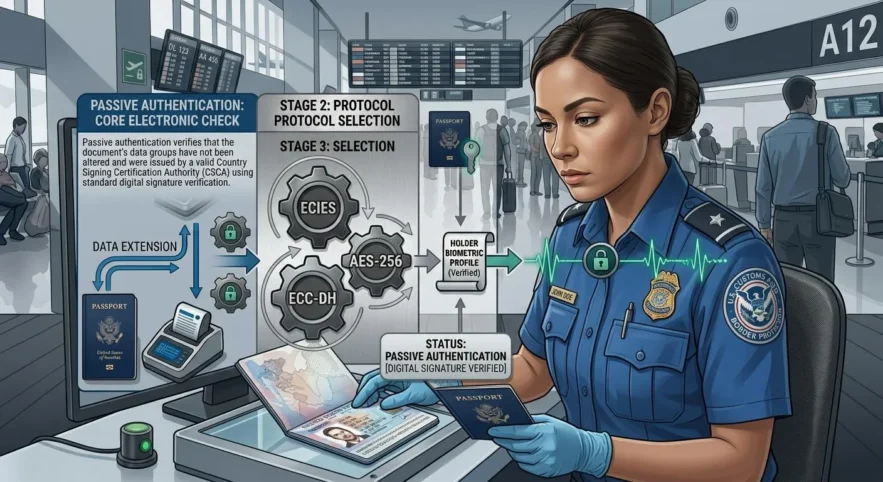
Signature and data-hash verification can detect changes to signed information, but you must interpret the results alongside certificate trust and other checks.
Washington, DC, October 19, 2026 — Passive authentication is a core electronic check used with biometric passports because it lets compatible inspection systems verify that protected chip information remains unchanged and that its digital signature links to trusted credentials issued by the issuing authority.
The process does not independently confirm every aspect of passport authenticity or traveler identity, but it provides strong evidence of the integrity of electronically signed data by comparing cryptographic hashes and validating the signature that protects the passport’s security information.
Passive Authentication Focuses on Stored Electronic Data
An electronic passport contains structured data groups holding standardized identity and biometric information, while a separate security object contains cryptographic values associated with those protected electronic records.
During passive authentication, the inspection system reads the relevant electronic files and performs mathematical checks to determine whether the retrieved information matches the data originally signed during passport personalization.
The International Civil Aviation Organization’s machine-readable travel document standards define the broader technical framework, establishing interoperable electronic structures used across participating passport systems.
This standardized architecture lets compatible readers run similar integrity checks on passports issued by different governments without requiring a completely different authentication process for every foreign document.
Cryptographic Hashes Create Data Fingerprints
A cryptographic hash function transforms electronic information into a fixed-length mathematical value that compactly represents the underlying data.
If even a small part of the protected information changes, such as a portion of a facial image or biographical field, the newly calculated hash should differ substantially from the value associated with the originally signed data.
Passive authentication uses this property by recalculating hashes from the data groups retrieved during inspection and comparing them with the protected values stored within the passport’s security structure.
A mismatch provides evidence that one or more protected records may have been modified, corrupted or otherwise become inconsistent with the information signed during legitimate document personalization.
The Security Object Protects the Expected Hash Values
The electronic passport contains a Document Security Object that brings together cryptographic information associated with the protected data groups stored inside the chip.
This security object includes the expected hashes and carries a digital signature created through the issuing authority’s document-signing infrastructure.
The inspection system must first be confident the security object is authentic before relying on its hashes, because untrusted hash values offer little meaningful protection against manipulation.
That requirement explains why passive authentication involves both data-integrity checking and certificate-based signature validation rather than simply comparing two mathematical values stored inside the same chip.
Signature Validation Connects Data to the Issuer
The public key in the document-signing certificate can be used to evaluate the digital signature protecting the security object.
If that certificate can itself be connected through an appropriate trust path to the issuing country’s recognized passport-signing infrastructure, the inspection system gains evidence that the protected security information originated within the expected governmental environment.
This trust relationship is essential because a technically valid signature created by an unknown or unauthorized key would not provide the same assurance as a signature linked to the legitimate issuing authority.
Passive authentication therefore depends upon both mathematical correctness and trustworthy certificate provenance.
Certificate Trust Determines How Much the Result Means
A signature can be mathematically valid yet still provide no meaningful governmental assurance if the reader does not trust the certificate chain tied to the signing credential.
Inspection systems must therefore maintain reliable trust anchors and certificate information for the passport issuers whose documents they expect to authenticate.
This requirement becomes particularly important at international borders, where one country routinely evaluates passports signed by many foreign governments using different national public-key infrastructures.
The ICAO Public Key Directory helps participating authorities exchange certificate information used to validate electronic machine-readable travel documents across international borders.
Passive Authentication Does Not Require a Challenge From the Chip
The term passive reflects that this form of authentication primarily evaluates signed data stored in the passport rather than requiring the chip to prove possession of a unique secret key through an active challenge-response exchange.
The reader retrieves the electronic information, checks the signature and recalculates data hashes using information that can be analyzed without asking the chip to generate a new cryptographic proof of identity.
This makes passive authentication operationally efficient and widely applicable, but it also means that other protocols can provide additional evidence concerning the physical chip or document when stronger anti-cloning protections are required.
This distinction separates data-integrity verification from later mechanisms such as active authentication or chip authentication used in some passport generations.
Access Control and Passive Authentication Are Different Processes
Protocols such as BAC or PACE govern how the reader establishes protected access to electronic passport information, while passive authentication checks whether the information retrieved during that session remains correctly signed and unchanged.
A reader can therefore establish a secure communication channel successfully without that result proving the authenticity of the signed passport data.
Likewise, passive authentication addresses data integrity without performing the same function as the access-control protocol that protected communication before the files were read.
Modern electronic passport inspection often combines these mechanisms because each one addresses a different security problem.
A Successful Read Is Not a Successful Authentication
Consumer applications and professional readers can sometimes display information from a passport chip without performing complete passive authentication or validating the full certificate chain behind the document.
Seeing the holder’s photograph, name and document number therefore demonstrates successful data retrieval, but it does not necessarily prove that the information was signed through the legitimate governmental trust infrastructure.
This distinction becomes important when users interpret smartphone results because applications can differ substantially in the cryptographic checks they perform behind the visible interface.
Travelers seeking a broader explanation of how electronic and physical checks fit together can review the Amicus International Consulting guide to modern passport security and counterfeit detection.
Hash Verification Can Reveal Electronic Changes
If someone alters protected chip data after personalization without a corresponding legitimate re-signing, the recalculated hash should no longer match the value protected inside the signed security object.
This mismatch can reveal changes even when the altered information looks entirely plausible to a human observer or appears visually identical to information printed on the physical data page.
Cryptographic integrity checking therefore gives electronic passport systems a capability visual examination cannot provide, because the reader can evaluate mathematical evidence of modification rather than relying solely on appearance.
The result becomes especially valuable when someone manipulates protected facial images or biographical records without leaving obvious physical signs elsewhere in the booklet.
Data Corruption Can Also Cause a Failure
A failed hash comparison does not necessarily prove intentional fraud because electronic corruption, chip damage or incomplete data retrieval can also produce inconsistencies during authentication.
Inspection systems must therefore interpret technical failures in context rather than assuming every unsuccessful passive-authentication result reflects deliberate manipulation.
Repeated reading attempts, document condition and the behavior of other electronic and physical checks can help determine whether the anomaly appears consistent with hardware failure or possible unauthorized modification.
This principle mirrors broader passport examination practice, where one abnormal result usually triggers further investigation rather than serving as a complete conclusion by itself.
A Valid Signature Does Not Prove the Person Is the Holder
Passive authentication evaluates the integrity and provenance of electronic data, but it does not determine whether the traveler presenting the passport is the individual represented by that data.
A legitimately issued passport with fully valid cryptographic information can still be misused by another person if identity comparison is weak or absent.
Border authorities therefore compare the traveler with the enrolled facial image, either visually or through automated biometric systems.
Electronic document authentication and traveler authentication reinforce one another, but they remain distinct analytical stages.
A Valid Signature Does Not Confirm Admissibility
A passport can pass passive authentication while the traveler still faces immigration, security or administrative issues unrelated to document integrity.
Government databases may show that the passport has been reported lost, stolen, canceled, or otherwise restricted, even though the electronic information remains perfectly signed and unchanged.
Similarly, a traveler may possess a genuine passport but lack a required visa or fail another entry condition imposed by the destination country.
Passive authentication therefore answers a narrowly defined technical question about signed electronic data rather than providing a complete border-admission decision.
Physical Inspection Remains Necessary
Cryptographic verification cannot determine whether every physical page, hologram, security fiber or stitch inside the passport booklet remains original and untouched.
A passport may contain valid, signed chip data while still showing unusual physical characteristics that warrant closer examination of the document’s materials and construction.
Authorities can therefore combine passive authentication with checks involving polycarbonate personalization, holographic effects, ultraviolet features, security paper and booklet binding.
The strongest conclusion emerges when electronic integrity and physical document characteristics both remain consistent with a genuine passport of the expected issuing-country series.
Certificate Expiration Requires Careful Interpretation
Digital certificates have defined validity periods, but a passport signed when its document-signing certificate was valid can remain legitimate long after that certificate expires for new signing operations.

Inspection systems therefore need historical trust information and validation logic, not simply to reject every document associated with a certificate whose operational period has ended.
This matters because passports can remain valid for many years, while governments may rotate signing credentials more frequently for security and operational reasons.
Proper certificate management is therefore central to reliable passive authentication across several generations of electronic travel documents.
Revocation and Trust Management Add Complexity
If a signing credential becomes compromised or otherwise requires revocation, authorities may need updated information describing which certificates should no longer be trusted.
Managing these changes across international border systems is complex because inspection environments must maintain accurate trust information while still recognizing legitimate passports signed before credential transitions.
This challenge illustrates why passive authentication is not merely a local mathematical operation performed against whatever certificate happens to accompany the document.
Reliable results depend upon ongoing trust management, certificate distribution and appropriate interpretation of the issuing authority’s cryptographic infrastructure.
Passive Authentication Supports Automated eGates
Automated border systems benefit from passive authentication because software can complete the process quickly without requiring an officer to manually evaluate every cryptographic component.
A compatible eGate can read the passport, validate signed electronic information and then use the authenticated facial image within a separate biometric comparison against the traveler.
This automated sequence enables document-integrity checks at scale while preserving a cryptographic link to the issuing authority.
The process is especially valuable in high-volume airport environments where thousands of foreign passports must be examined consistently within short processing windows.
Passive Authentication Helps Detect Unsigned Modification
One of passive authentication’s strongest security benefits appears when someone changes protected chip information without access to legitimate government signing credentials.
The altered data may look plausible and even match information printed elsewhere, but its cryptographic hash will no longer match the value protected in the original signed security object.
Creating a new internally consistent security object would not solve the problem unless the attacker could also produce a valid digital signature trusted as belonging to the issuing government.
This requirement creates a substantial barrier against undetected electronic alteration and distinguishes signed ePassport data from ordinary editable files.
Cloning Raises a Different Security Question
Passive authentication can confirm that copied electronic data remains correctly signed, but it may not always determine whether the information resides on the original chip or has been duplicated onto another compatible electronic device.
Additional anti-cloning mechanisms can address this separate question by requiring evidence tied more closely to secrets or cryptographic capabilities bound to the original chip.
The distinction demonstrates why electronic passport security includes several authentication layers rather than treating passive authentication as a universal solution for every possible attack.
Data integrity, issuing-authority trust and chip originality are related but technically distinct security concerns.
Passive Authentication Works Best Within a Layered System
Passive authentication is most meaningful when it aligns with other checks involving chip access, physical document construction, biometric comparison, and relevant government records.
Each layer addresses a different vulnerability, making it harder for a fraudulent document to remain convincing across the entire inspection process.
A cryptographically valid data set can still require physical and biometric verification, while an impressive physical document can still fail electronic integrity checks.
Modern passport security is strongest when independent systems reinforce one another rather than relying on a single successful technical test.
The Result Must Always Be Interpreted in Context
Passive authentication provides powerful evidence that electronically signed passport information remains consistent with the data protected during legitimate personalization, but its interpretation depends upon trustworthy certificates and correctly implemented verification procedures.
A green authentication result without reliable certificate trust means less than one tied to recognized issuing-country credentials, just as a failed result may require investigation before anyone concludes deliberate manipulation occurred.
The process therefore rewards careful technical interpretation over simplistic assumptions about whether an electronic check passed or failed.
For legitimate travelers, passive authentication usually occurs invisibly during electronic inspection, yet it remains one of the most important mechanisms for detecting unauthorized changes to signed passport data after issuance.