

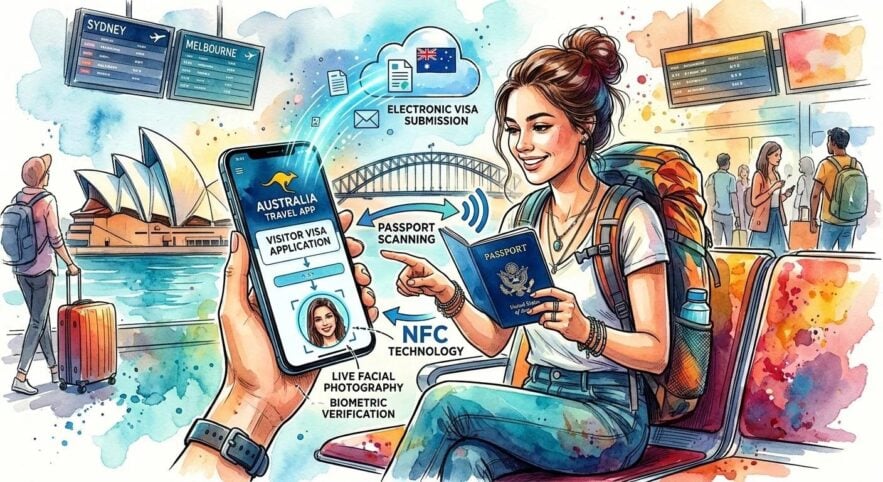
The official application process uses a mobile app, with government guidance covering passport scans, chip reading and compliant live photographs.
WASHINGTON, DC, October 25, 2026 – American passport holders planning travel to Australia must navigate a mobile application process that combines electronic visa submission with passport scanning, near-field communication technology, and live facial photography, reflecting the Australian government’s expanding reliance on digital identity verification for international visitors.
Australia’s Electronic Travel Authority, commonly known as the ETA, allows eligible United States citizens to seek permission for short-term tourism and certain business activities, but obtaining the authorization now requires using an official smartphone application that can capture passport information and read electronic identity data.
Unlike conventional online travel forms that rely primarily on manually entered personal information, Australia’s application process uses smartphone camera technology and the electronic components embedded in modern passports, adding a verification step before an applicant submits an immigration request.
The system shows how governments increasingly use mobile devices to link physical travel documents to digital identity records, while requiring applicants to understand technical procedures that can affect whether their information is captured accurately and their applications proceed successfully.
Australia’s Electronic Travel Authority Is a Formal Visa
Australia’s Electronic Travel Authority differs from similarly named authorization programs operated by other countries because the Australian permission is legally classified as a visa, specifically the subclass 601 visa established under the country’s immigration framework.
Eligible American passport holders can apply for this permission to undertake qualifying tourism, family visits, cruises, and certain business visitor activities, and it generally permits multiple entries during a twelve-month validity period.
Each qualifying visit ordinarily allows a stay of up to three months, although travelers remain responsible for complying with all applicable immigration conditions and obtaining alternative permission when their intended activities fall outside the visitor classification.
According to the Australian Department of Home Affairs’ official Electronic Travel Authority guidance, eligible applicants must use the Australian ETA application and satisfy the associated identity, documentation, and eligibility requirements before receiving the relevant immigration permission.
Immigration and citizenship Website
The government currently lists a $20 Australian dollar service charge for using the application, with no separate ETA visa charge, although travelers must still complete the application correctly and receive approval before relying on the authorization for travel.
The Official Smartphone Application Is Central to the Process
The Australian ETA application is available on supported Apple and Android devices, allowing eligible travelers to complete identity verification and the application process without routinely visiting a diplomatic mission or submitting physical passports for consular processing.
Applicants need a compatible smartphone with a working camera, near-field communication capability, enabled location services, internet access, a valid email address, and an accepted payment method for the applicable service charge.
The mobile application guides travelers through several stages, including scanning the passport information page, reading electronic passport data, capturing a live facial photograph, reviewing personal information, and answering questions relevant to immigration eligibility.
These procedures aim to improve the reliability of submitted identity information while reducing reliance on manual transcription, which can introduce errors in passport numbers, dates of birth, names, and other essential travel-document details.
The government emphasizes that applicants must submit through its designated ETA application, not the standard ImmiAccount process used for many other Australian visa categories, so selecting the official platform is essential.
Passport Scanning Begins With the Information Page
The first major identity-document step involves using your smartphone camera to capture the passport’s biographical information page, which includes the holder’s portrait, personal details, passport number, expiration date, and machine-readable information.
Australian government instructions advise applicants to open their passports to the information page and place the document on a stable, well-lit surface, ensuring fingers, protective covers, shadows, or reflections do not obstruct the relevant information.
The smartphone camera must be aligned with the frame displayed in the application, allowing the software to recognize the passport information page and capture its contents when the document is correctly positioned.
The application uses the scanned information to populate relevant identity fields, reducing the need to enter every detail manually while still requiring the applicant to examine the extracted information before proceeding.
A successful camera scan does not independently establish that the passport is genuine or that immigration permission will be granted, because subsequent electronic document reading and government assessment perform separate functions within the application process.
Machine-Readable Passport Information Supports Digital Verification
Modern American passports include a machine-readable zone on the biographical information page, with standardized characters designed to support electronic document processing by authorized systems and compatible scanning equipment.
The information includes document and identity details arranged according to international passport standards, allowing software to extract structured data more reliably than unrestricted manual transcription typically allows.
Australia’s application uses optical scanning to obtain relevant information from the document, providing a structured starting point for the electronic verification steps that follow during the identity-document submission process.
However, the machine-readable zone should not be confused with the electronic passport chip, because printed document information and electronically stored identity data represent separate technical elements that may be examined using different mechanisms.
The distinction matters when applicants successfully pass camera recognition but struggle to complete the subsequent chip-reading procedure, since the two operations depend on different smartphone components and document interactions.
Near-Field Communication Reads the Passport Chip
The second major technical stage involves near-field communication, commonly called NFC, which lets compatible smartphones communicate wirelessly over a short distance with electronic chips embedded in qualifying passports.
Modern United States electronic passports contain contactless integrated circuits that store digitally structured travel-document information, including biographical data and a facial image used to support identity verification and electronic document authentication.
Australia’s ETA application uses the smartphone’s NFC capability to communicate with the passport chip, requiring the applicant to position the device appropriately against the document while the software attempts to establish communication.
The Australian government’s official ETA video guides show how to read passport chips from different document positions, including the front cover, back cover, and information page, because chip placement and smartphone antenna configurations can affect successful communication.
Immigration and citizenship Website
Government instructions advise applicants to enable NFC, remove interfering cases or covers, and move the smartphone slowly until the application recognizes the chip; then keep the device stationary until the reading process finishes.
Successful NFC Reading Requires Correct Positioning
The physical relationship between the smartphone and passport is important because near-field communication operates over a limited distance, requiring the device’s antenna to interact with the embedded chip through an appropriate electromagnetic connection.
Depending on the smartphone model and passport construction, users may need to adjust the device’s position to establish reliable communication, especially when protective accessories or differences in antenna placement affect the interaction.
The Australian government’s instructional materials emphasize maintaining contact after the application recognizes the chip, since movement during an active reading operation can interrupt communication and require you to repeat the procedure.
A smartphone displaying an unsuccessful reading message does not necessarily mean the passport chip is defective, because device compatibility, positioning, environmental interference, and temporary software issues can also affect the outcome.
Applicants experiencing persistent problems should follow the official troubleshooting guidance and verify that their smartphone satisfies the application’s requirements rather than concluding that a failed mobile scan proves the underlying passport is invalid.
Passport Chip Reading and Authentication Are Different Technical Operations
Electronic passports can support several security functions, including transmitting stored information and performing cryptographic checks intended to help determine whether digitally recorded document data has been altered or originated from a trusted issuing authority.
Reading the chip involves obtaining accessible information through a compatible interface, while cryptographic authentication can require additional operations involving digital signatures, certificate chains, and the relevant issuing authority’s public-key infrastructure.
These distinctions matter because confirming that an application obtained information from a passport chip does not automatically establish which cryptographic authentication checks succeeded or whether every security feature of the physical document was evaluated.
Australia’s public ETA instructions describe the chip-reading procedure and the resulting review of extracted identity information, but they should not be interpreted as disclosing every internal document-authentication mechanism employed by government processing systems.
For American travelers, the practical requirement is to complete the prescribed identity-document procedure accurately and understand that passport scanning is part of a broader immigration assessment, not a replacement for all official document examination.
Live Facial Photography Adds Another Identity Requirement
Following passport scanning, applicants must provide a live photograph captured through the smartphone application, allowing Australian authorities to receive an image of the individual physically present during the identity verification procedure.
The government requires applicants to be present for the live photograph, preventing completion solely through previously stored portrait files or photographs submitted without the individual participating in the application session.
Government guidance states that the photograph helps confirm the applicant’s identity and should resemble a conventional passport portrait, with the face clearly visible and the individual positioned appropriately before the camera.
The application presents an on-screen framing guide, and the capture procedure can automatically record the photograph when the face is positioned correctly and the software determines that the necessary framing conditions have been satisfied.
This requirement is particularly important when a travel agent, family member, or other authorized person assists with an application, because the applicant must still be physically present for the necessary identity capture.
Australian Authorities Specify Clear Photograph Conditions
The Australian Department of Home Affairs recommends capturing a live image against a plain, light-colored background, using adequate lighting, and positioning the smartphone at about eye level to get a suitable facial photograph.
Applicants should face the camera directly, keep their eyes open and visible, and avoid shadows, strong reflections, or objects that could obscure the face or interfere with the image quality assessment.
The government’s instructions also advise removing glasses where practical, avoiding heavy makeup, and ensuring that unrelated individuals or objects do not appear in the background during the identity capture procedure.
These requirements aim to produce consistent facial images suitable for identity assessment, reducing issues caused by uncontrolled lighting, unusual head positions, partially obstructed facial features, and photos taken from inappropriate angles.
An unsuitable photograph can interrupt the application process even if the passport is scanned correctly, showing why document recognition and facial image capture must both meet the platform’s technical requirements.
A Live Photograph Is Not the Same as Border Facial Recognition
Australia’s application requires a live facial photograph during the visa application process, but that requirement should not be confused with any biometric screening that may occur when travelers arrive at Australian airports.
The application image supports identity verification and government processing, while border authorities may conduct additional checks using travel documents, biometric systems, immigration records, and other information permitted under applicable Australian legislation.
A successful photograph capture therefore does not establish that a passenger has completed every future identity comparison or satisfied all requirements for entry into Australia, even when the Electronic Travel Authority is later approved.
Automated facial recognition technologies can compare facial images using mathematical representations of visual characteristics, but their specific implementation, decision thresholds, and government processing arrangements depend on the systems and operational procedures involved.
Travelers should distinguish the technical act of obtaining a suitable photograph from the separate administrative decision to grant a visa and the subsequent border determination concerning admission into Australian territory.
Each Family Member Requires an Individual ETA Application
Australia requires separate Electronic Travel Authority applications for each qualifying individual, including children traveling with parents, although you can prepare and submit multiple family applications using the same compatible smartphone.
Official guidance allows applicants to receive assistance from another person, including an authorized travel industry representative, as long as the individual seeking the visa remains physically present for the required photograph and passport-capture procedures.
Parents assisting children must therefore have each child’s relevant travel document available and complete the associated identity steps separately, rather than assuming that parental permission automatically extends to accompanying dependents.
This requirement can create practical challenges for families preparing several applications shortly before departure, particularly when one device must complete passport scanning, NFC communication, and live photography for multiple individuals.
Families can reduce potential complications by preparing their applications in advance and confirming that every traveler has received the appropriate visa outcome before making arrangements that depend on entering Australia.
Application Questions Extend Beyond Technical Identity Checks
The Australian ETA process involves more than passport scanning and facial photography because applicants must also answer questions about personal details, previous names, criminal convictions, and other information relevant to the visa assessment.
These declarations let immigration authorities assess eligibility under Australian law, including whether circumstances require further review or a different immigration pathway.
Applicants should answer every question accurately and review the information before submission, since incorrect declarations or mismatched identity information can complicate processing and potentially affect immigration decisions.
A successfully scanned passport does not eliminate the need for truthful declarations, nor does possession of a biometric passport override the immigration conditions governing character, health, temporary visitor intentions, or permitted activities.

American citizens with potentially complex immigration circumstances should carefully review the relevant Australian visa requirements and seek qualified immigration advice when they are unsure about the appropriate application category or disclosure obligations.
Approval Can Be Fast but Is Not Guaranteed Immediately
Australia’s Department of Home Affairs states that many Electronic Travel Authority applications receive decisions immediately, although additional processing may be necessary when information is incomplete or government authorities require further consideration.
The department advises travelers not to finalize arrangements until their ETA is granted, as automated processing does not guarantee an immediate outcome for every application.
Applicants should therefore distinguish successful submission from formal approval, since confirmation that information has been transmitted does not necessarily mean the Australian government has issued the requested immigration permission.
The same distinction applies when the mobile application successfully reads a passport chip and captures a live photograph, because those technical stages contribute information to an application without independently determining whether a visa should be granted.
American travelers planning international connections, business appointments, or nonrefundable accommodation should account for these uncertainties and complete the application before reaching the airport departure stage.
Technical Difficulties Do Not Necessarily Indicate Passport Fraud
A failed smartphone passport scan can result from several technical circumstances unrelated to document authenticity, including inappropriate lighting, reflections on the information page, protective smartphone accessories, or unsuccessful NFC communication.
Government guidance recommends checking device settings, positioning the smartphone carefully, and repeating the prescribed scanning procedure when the application does not obtain the expected passport information.
Although physical damage to an electronic passport can sometimes affect chip functionality, an unsuccessful reading attempt alone does not establish that a passport has been altered, counterfeited, or invalidated by the issuing authority.
American passport holders who repeatedly experience technical problems should consult official application support and determine whether an alternative Australian visa pathway is appropriate under their circumstances.
Australia’s Department of Home Affairs states that individuals unable to use the ETA application may apply for another suitable visa through the appropriate government process, although eligibility and requirements differ between visa categories.
Privacy Considerations Accompany Smartphone Identity Verification
Electronic visa applications involving passport chips and facial photographs raise legitimate questions about how personal information is collected, transmitted, protected, and retained, particularly when government digital systems process identity records.
Passport data and facial images are sensitive personal information, so applicants should understand that the government may process submitted records under applicable immigration legislation and privacy arrangements.
Travelers should use official application channels and review relevant government privacy notices before submitting information, especially when another person or commercial service provider assists with the identity verification process.
The Australian ETA application should also be distinguished from the separate Australian Immi App, which supports certain biometric identity submissions under different application arrangements and has its own published data-handling procedures.
Applicants should avoid assuming that privacy statements associated with one government application automatically apply to another, because technical functions, administrative purposes, and applicable retention arrangements may differ.
Second Citizenship Can Affect Australian Travel Eligibility
American citizens who lawfully hold additional nationality may qualify for different Australian visa arrangements depending on the passport they intend to use, but immigration eligibility must always be determined under the rules that apply to that nationality.
Australia offers different electronic entry arrangements for eligible passport holders, including the subclass 601 Electronic Travel Authority and the subclass 651 eVisitor visa, with nationality representing an important factor in determining access.
A traveler holding both American and another foreign citizenship should therefore determine which passport is appropriate for the application and use the same document consistently where Australian immigration procedures require it.
Australian citizens are not eligible to apply for an ETA, while Australian permanent residents may be subject to separate travel facility requirements, showing that nationality and immigration status can substantially change the required documentation process.
Professional international mobility advisers, including Amicus International Consulting, emphasize the importance of lawful citizenship documentation, accurate identity records, and destination-specific immigration compliance when evaluating second passports and international travel arrangements.
Digital Passport Verification Is Becoming a Central Travel Requirement
Australia’s mobile ETA process shows how electronic passports and consumer smartphones are becoming interconnected parts of international immigration administration, letting governments collect structured identity information before passengers reach traditional border checkpoints.
The combination of camera-based passport recognition, NFC chip reading, and live facial photography illustrates a layered approach in which several different technologies contribute information to a single digital visa application.
However, these technological capabilities do not eliminate the importance of immigration law, because applicants must still qualify for the appropriate visa and comply with the conditions governing their activities and duration of stay.
For American travelers, understanding the distinction between successful document capture, government authorization, and eventual admission is essential, particularly when evaluating smartphone verification results or attempting to resolve application difficulties.
The broader development also reinforces the importance of keeping travel documents valid and familiarizing yourself with official electronic application procedures as other jurisdictions modernize their immigration systems.
American Travelers Should Prepare Their Passports and Smartphones Before Applying
American passport holders seeking Australian Electronic Travel Authorities should begin by confirming that their passports are valid, their intended activities qualify for the visa category, and their smartphones meet the government’s published technical requirements.
The process involves careful passport scanning, successful NFC communication, compliant live photography, accurate answers to application questions, payment of the applicable service charge, and confirmation that the requested visa has been granted.
When technical problems arise, applicants should follow official troubleshooting instructions rather than treating every failed scan as evidence of a defective passport security feature or trying to substitute unrelated commercial verification apps for the government’s required procedure.
Ultimately, Australia’s electronic visa framework shows that modern international travel increasingly requires familiarity with both immigration regulations and digital identity technologies, as governments integrate physical passports, smartphone verification, and advanced border screening into a more unified authorization process.