

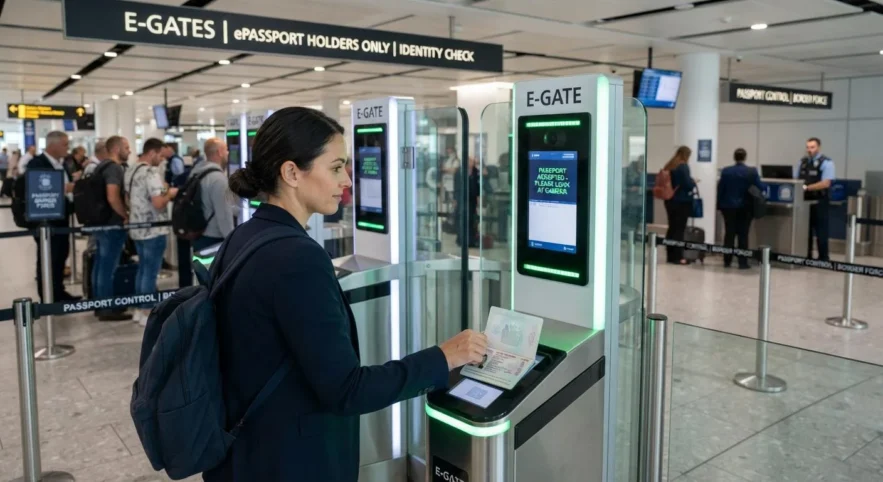
Automated systems can combine chip authentication with facial comparison to assess both the document and its holder.
WASHINGTON, DC, October 15, 2026 — Automated border-control gates increasingly let eligible international travelers complete key parts of passport inspection without starting at a staffed booth, combining electronic document reading, cryptographic verification, biometric facial comparison, and government database checks in a highly structured automated process.
Although the traveler may do little more than place a passport on a reader, look toward a camera, and wait for a gate to open, the underlying system can perform several distinct checks before deciding whether to continue automated processing or require human examination.
The Passport Usually Begins the Automated Process
At many automated border-control installations, the traveler first presents an electronic passport to a document reader that captures machine-readable information and establishes communication with the travel document’s embedded contactless chip.
The reader can retrieve standardized biographical information and the digitally stored facial image, giving the automated system an electronic identity reference that can subsequently be compared with the visible document and the person standing at the gate.
The International Civil Aviation Organization’s travel-document program sets international standards for machine-readable and electronic travel documents, providing the technical foundation that lets compatible passport systems work across national borders.
Reading the Chip Is Only One Stage
Successfully accessing the passport chip confirms electronic communication, but a well-designed inspection system can continue by evaluating whether protected information retains the cryptographic characteristics expected of a legitimate issuing authority.
This distinction matters because simply displaying a name, passport number, and facial image does not provide the same assurance as validating digitally protected information and determining whether the data correspond with trusted government signing credentials.
ICAO has emphasized that validating electronic machine-readable travel documents is a key prerequisite for reliable facial matching and subsequent government database checks because confidence in the biometric image depends partly on confidence in the document that supplies it.
Digital Signatures Help Protect Chip Information
Electronic passports contain security information that lets compatible inspection systems assess whether protected data remain consistent with what the issuing government signed when it personalized the document, providing an important defense against unauthorized electronic modification.
If someone changes protected information after legitimate issuance without possessing the appropriate government-controlled cryptographic credentials, the altered data should no longer produce the expected validation result when competent inspection equipment performs the relevant electronic checks.
This process gives automated gates a stronger foundation for biometric comparison because the system can evaluate the electronically stored portrait as protected passport information rather than treating every readable image retrieved from a contactless chip as equally trustworthy.
The Camera Connects the Passport With the Traveler
After retrieving the electronic portrait, an eGate can capture a live facial image of the traveler and use biometric comparison software to assess whether the person standing before the camera sufficiently matches the individual represented in the passport.
This comparison turns passport inspection from a document-only exercise into a holder-verification process because a completely genuine passport can still pose a security problem when someone other than its legitimate holder tries to use it.
Facial comparison therefore answers a separate question from chip authentication: electronic document checks help establish confidence in the passport data, while biometric comparison evaluates whether the live traveler matches the identity represented by that data.
Facial Comparison Is Usually a Structured Biometric Process
Automated systems analyze measurable facial characteristics rather than simply deciding whether two photographs look generally similar, allowing software to calculate a comparison result between the live camera image and the reference portrait obtained through the travel-document process.
Lighting, camera positioning, facial expression, aging, glasses, head coverings, image quality, and other variables can affect biometric comparison, which explains why systems generally include thresholds and referral procedures rather than assuming every unsuccessful automated match indicates deliberate identity fraud.
When comparison results don’t meet the system’s requirements, the traveler can be redirected for human inspection, where an officer can consider the passport, physical appearance, travel circumstances, and other information not available through a simple automated facial calculation.
eGates Can Also Examine Document Consistency
An automated system can compare information from the machine-readable zone with information retrieved from the chip, allowing it to identify inconsistencies in the passport number, date of birth, expiration date, nationality, or other standardized document fields.
Agreement between independently retrieved information strengthens confidence in document consistency, while unexplained discrepancies can stop the automated process and refer the passport for additional examination rather than allowing the traveler to proceed automatically.
This comparison shows why the machine-readable zone, contactless chip, digital signature, and facial image serve different functions, even though travelers may experience all of them as one rapid interaction at the same gate.
Government Database Checks Add Another Layer
Automated border processing can also use passport information to query relevant immigration, document-status, and security systems, depending on the jurisdiction, traveler category, legal authority, and technical architecture at the border crossing.
These database checks address questions electronic chip authentication cannot answer, including whether authorities later canceled a passport, recorded an immigration issue, established an alert, or otherwise identified circumstances that require an officer to examine the traveler personally.
A passport can therefore contain genuine, electronically signed information and still trigger a referral because document authenticity, current passport status, immigration eligibility, and traveler identity remain separate matters within the broader border-control process.
Europe Has Expanded Automated Border Processing
European border infrastructure increasingly combines biometric information with electronic travel-document data, particularly as governments deploy automated systems that can register and check eligible travelers while retaining procedures for officer intervention when automated processing flags an issue.
The European Union Entry/Exit System became fully operational across participating external border crossing points on April 10, 2026, recording document information, facial images, fingerprints, and border-crossing records for covered non-European Union travelers.
The European Commission states that the system supports wider use of automated border-control and self-service technology while helping authorities identify overstays, fraudulent identities, and suspicious travel-document use through electronically maintained border information.
Automated Gates Do Not Eliminate Border Officers
An eGate can perform routine technical checks very efficiently, but automation does not remove the need for trained officers because unusual documents, uncertain biometric matches, immigration questions, damaged passports, security alerts, or technical failures can require human judgment.
The gate therefore works best as part of a larger border environment, where straightforward cases move through standardized automated procedures while exceptions receive additional attention from personnel equipped to conduct broader inspections.
This structure lets governments gain efficiency from automation without assuming software should independently resolve every legal, technical, or identity question that arises when someone requests admission at an international border.
A Failed Facial Match Does Not Automatically Mean Impostor Use
Biometric comparison produces a technical similarity assessment, not an infallible declaration of identity, so legitimate travelers can occasionally receive referrals because their live appearance differs sufficiently from an older passport photo or because capture conditions reduce comparison quality.
Changes from aging, facial hair, weight, medical treatment, injury, eyewear, lighting, expression, or camera positioning can affect automated comparison, while an officer who examines the traveler directly may resolve the discrepancy without concluding that fraudulent use occurred.
Automated systems therefore benefit from carefully designed referral procedures because security improves when uncertain results receive appropriate human review rather than being treated as automatic proof of either legitimacy or fraud.
A Successful Facial Match Does Not Prove Everything Either
A strong biometric comparison indicates that the live traveler resembles the reference image sufficiently under the system’s criteria, but that result does not independently establish the physical integrity, legal validity, or current government status of the passport being presented.
That limitation explains why eGates combine biometric comparison with document reading, electronic authentication, immigration processing, and other checks instead of allowing facial recognition alone to determine whether the traveler should complete automated border processing.
The strongest automated systems therefore rely on several independent sources, whose agreement provides greater confidence than any single facial score, chip response, machine-readable field, or database result could provide on its own.
Physical Passport Security Still Matters
Even sophisticated eGates cannot make traditional physical passport security irrelevant because altered booklet pages, damaged binding, reconstructed personalization, unusual holograms, incorrect printing, or other physical inconsistencies can require forms of examination that automated readers cannot completely reproduce.
A passport that encounters difficulty during automated processing can therefore move to secondary inspection, where officers may examine polycarbonate construction, laser engraving, ultraviolet features, microprinting, watermarks, tactile printing, optical devices, page integrity, and other physical characteristics.
This relationship shows why governments keep investing in advanced document manufacturing even as airports deploy increasingly capable biometric and electronic border technology throughout international terminals.
The Automated Gate Depends on Trusted Passport Data
Facial comparison becomes significantly more meaningful when the reference portrait comes from electronically protected passport information whose integrity has been properly evaluated, because an untrusted reference image could undermine the reliability of the entire automated identity comparison.
ICAO has specifically linked reliable electronic travel-document validation to secure facial recognition, emphasizing that greater confidence in authenticated chip data provides a stronger foundation for comparing the passport holder with the traveler appearing before the border camera.
This sequence explains why sophisticated eGates do more than photograph passengers: the inspection system must draw the reference identity from a document and electronic environment it can reasonably trust.
Contactless Processing Can Make Border Inspection Faster
Automated gates can reduce manual document handling during straightforward inspections, letting eligible travelers complete standardized procedures while officers focus on referrals, exceptions, and cases requiring human judgment.
United States Customs and Border Protection has also tested and deployed automated biometric technologies in airport environments, including systems that use facial comparison and electronic passport information, as part of broader efforts to streamline traveler processing while retaining officer oversight.
Efficiency matters only when security checks remain reliable, so automated processing generally uses structured decision rules and referral mechanisms rather than simply opening a gate whenever a passport chip responds successfully.
The Passport Chip Is Not Making the Admission Decision
The electronic passport provides identity information and security evidence, but the chip itself does not determine whether a traveler meets immigration law, has the required authorization, or should be allowed to enter the destination country.
Those determinations depend upon government systems, applicable immigration rules, traveler status, visa requirements, border alerts, and, where necessary, decisions made by authorized officers who remain responsible for enforcing national entry requirements.

An eGate therefore acts as an automated inspection interface that connects several technologies and information sources, rather than functioning as an independent electronic immigration officer inside the airport barrier.
Privacy Remains Part of Automated Border Design
Automated border systems process sensitive identity and biometric information, so responsible eGate deployment depends on access controls, data-protection rules, authorized-use restrictions, secure communications, retention policies, and oversight.
European authorities state that biometric information within current border-management systems is subject to data-protection safeguards and authorized-access controls, reflecting the need to balance efficient identity verification with legal obligations governing sensitive personal information.
The technical ability to capture and compare a face therefore exists within a broader legal environment that determines who can use the information, why authorities may process it, and how government systems must protect it.
Automation Depends on International Standardization
Airport eGates could not operate effectively with electronic passports from numerous countries if every issuing authority stored basic identity information using entirely incompatible structures, which makes international machine-readable travel-document standards essential to automated processing.
ICAO standards provide a common foundation for machine-readable information, electronic passport data, security structures, and interoperability, while allowing individual governments to design distinctive physical passports with their own artwork, materials, optical features, and national security technologies.
Standardization therefore lets a Canadian, American, European, or other compliant electronic passport interact with compatible foreign inspection infrastructure without requiring every airport to develop separate reading technology for every issuing country.
Not Every Traveler Uses the Same Automated Process
Eligibility for automated border gates varies by jurisdiction, nationality, passport type, age, immigration status, enrollment requirements, local regulations, and the specific systems installed at individual airports or border terminals.
Travelers should follow instructions displayed by the border authority rather than assuming that having an electronic passport automatically guarantees access to every eGate during international travel.
An electronic document may be technically compatible with automated reading, but the traveler may still be ineligible for automated processing under the destination country’s operational or immigration rules.
A Referral Does Not Automatically Indicate a Security Problem
Automated systems can refer travelers for many reasons, including unreadable chips, damaged documents, biometric uncertainty, database requirements, random selection, eligibility rules, or when an officer must complete additional immigration processing.
Travelers should therefore avoid interpreting a closed gate or referral message as automatic evidence that their passport failed authentication, because the system may have stopped automated processing for reasons entirely unrelated to suspected document fraud.
Human inspection resolves those exceptions while ensuring automation does not prevent legitimate travelers from continuing simply because a particular technical stage could not be completed automatically.
Smartphones Cannot Reproduce the Entire eGate Environment
Consumer passport-reading applications can retrieve chip information and sometimes perform selected cryptographic checks, but they generally cannot reproduce the complete combination of live biometric capture, immigration databases, border alerts, authorized certificate infrastructure, and operational decision rules available at government inspection points.
A successful smartphone scan can therefore provide useful technical information without establishing that the passport would necessarily complete every stage of automated border processing successfully at an airport.
The distinction matters because an eGate evaluates the relationship among the document, electronic information, live traveler, and government systems, rather than simply checking whether an NFC chip contains readable data.
Modern eGates Assess a Relationship, Not Just a Document
The central purpose of automated passport control is not merely to decide whether a booklet contains functioning electronics, because an effective system evaluates whether trusted passport information corresponds with the traveler and remains acceptable within the government’s border environment.
Electronic document validation provides evidence about the passport, facial comparison provides evidence about the holder, and government systems provide information about document status and immigration circumstances, allowing automated processing to combine several fundamentally different questions.
Through Amicus International Consulting’s passport security resource, readers can examine how electronic chips, digital signatures, biometric comparison, polycarbonate construction, optical features, and physical inspection contribute separately to modern travel-document verification.
Airport eGates Bring Multiple Security Technologies Together
Airport eGates show how modern border inspection has evolved from simply reading printed information in a passport to coordinated systems that examine electronically protected identity data while simultaneously comparing it with a live traveler.
The automated process can combine machine-readable information, electronic passport communication, cryptographic validation, facial comparison, government database checks, and referral procedures within a workflow that often takes only a short period from the traveler’s perspective.
The gate itself therefore represents only the visible endpoint of a much larger identity-verification environment, where secure passport technology and biometric processing work together to help authorities assess both the travel document and the person presenting it.