

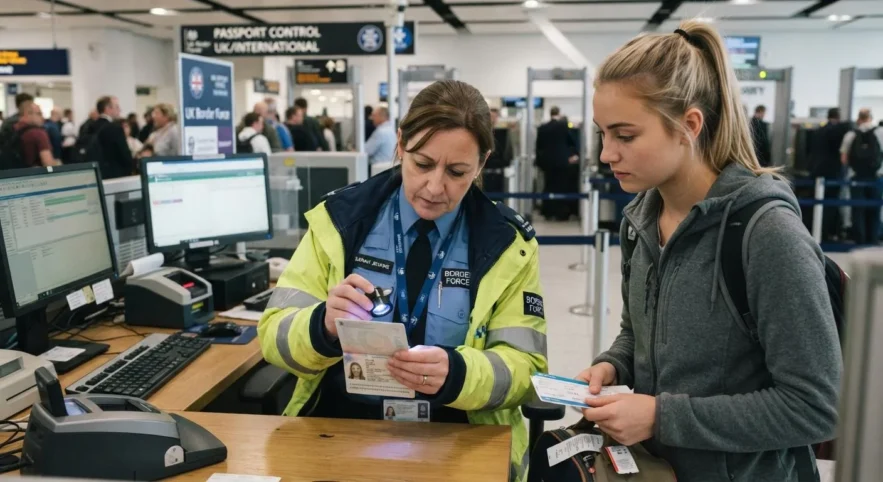
Authenticating electronic records establishes document trust, while facial comparison and other checks help connect the passport to its holder.
WASHINGTON, DC, October 2, 2026 — Modern border inspection involves two closely related but fundamentally different questions: whether authorities can trust the passport itself and whether the person presenting it is genuinely connected to the identity the document represents.
Electronic signatures, certificate validation, chip authentication, physical security features, biometric comparison, and government records provide different forms of evidence, creating a layered process in which successful document authentication does not automatically establish the identity or legal status of its current holder.
Document Authentication Begins With the Credential
Electronic passport authentication focuses first on the travel document, determining whether protected chip information remains linked to a legitimate issuing authority and whether digitally signed records have changed since the passport was personalized.
The ICAO electronic passport validation framework defines electronic passport validation as verifying the chip’s digital signature to establish authenticity and integrity, while additional supported mechanisms can provide evidence against chip cloning or substitution.
Passive Authentication Establishes Trust in Stored Information
Passive Authentication lets compatible inspection systems validate the digital signature protecting electronic passport information and determine whether the protected data remain consistent with what the legitimate issuing authority recorded during document personalization.
When the required certificate infrastructure is available, this process can provide border authorities with evidence that electronically stored information originated from the stated issuing country and has not subsequently been altered.
Trusted Certificates Connect the Passport With Its Issuer
Digital signatures become meaningful internationally because public-key certificates let receiving border authorities link passport signatures to trusted cryptographic credentials belonging to the government identified as the document issuer.
Country Signing Certification Authority certificates and Document Signer Certificates support this trust relationship, enabling inspection systems to verify electronically signed information without obtaining the private cryptographic keys foreign governments use during passport issuance.
Chip Authentication Addresses a Different Electronic Risk
Authentic signed data can theoretically be copied without altering the information, so a valid digital signature alone does not necessarily prove that genuine records remain stored on the original secure chip.
Active Authentication, Chip Authentication, and related mechanisms can provide additional evidence against substitution or cloning when supported by the particular electronic passport, adding hardware-related assurance beyond ordinary data-integrity verification.
Physical Examination Provides Another Independent Perspective
Electronic authentication cannot determine whether every physical element of a passport booklet remains intact, because cryptographic procedures do not directly inspect polycarbonate layers, laser engraving, holograms, ultraviolet artwork, microprinting, watermarks, binding, or other physical security characteristics.
ICAO guidance treats optical and electronic examination as complementary processes that contribute to an overall authentication result, reflecting the importance of comparing chip evidence with evidence visible in the physical travel document.
A Genuine Passport Can Still Be Presented by the Wrong Person
Even when digital signatures validate correctly, the chip appears genuine, and physical security features correspond with the expected document generation, the person carrying that passport may still be someone other than its legitimate holder.
This possibility creates the need for holder verification, because establishing that a government issued a genuine passport does not establish that every individual who later possesses that document is entitled to travel using the identity recorded within it.
Biometrics Connect the Credential With the Traveler
Biometric verification links the document to the person presenting it by comparing a newly captured biometric sample with a reference associated with the legitimate passport holder.
ICAO identifies the central border application of biometrics as linking the electronic machine-readable travel document holder to the document being carried, allowing authorities to determine whether the person presenting the passport matches the identity established at issuance.
Facial Verification Is Commonly a One-to-One Comparison
During routine electronic passport verification, an inspection system can capture the traveler’s live facial image and compare it directly with the facial image associated with the passport, creating a one-to-one biometric verification process.
ICAO distinguishes this verification function from identification, where a biometric sample can instead be searched against multiple enrolled records to determine whether the individual appears within a broader database.
Verification and Identification Are Not Interchangeable Terms
Biometric verification generally starts with a claimed identity already represented by the passport and asks whether the live traveler matches that specific reference, rather than asking the system to determine an unknown person’s identity from scratch.
Biometric identification involves a different type of search across multiple records, which can serve other governmental purposes but should not be confused automatically with the one-to-one facial comparison commonly associated with ordinary electronic passport holder verification.
The Reference Image Needs a Trusted Foundation
A facial comparison becomes much more meaningful when the reference image comes from authenticated passport data, because the inspection system then has evidence that the stored portrait remains linked to legitimate government issuance.
If a biometric system compared the traveler against an untrusted or manipulated reference photograph, a technically accurate facial match could still support the wrong identity, demonstrating why document authentication logically precedes reliance upon stored biometric information.
Authentication Strengthens the Biometric Reference
The integrity of the electronic passport therefore supports holder verification because validated chip information gives the inspection system greater confidence that the facial portrait used for comparison matches the image protected during legitimate issuance.
ICAO notes that authenticating chip information lets border authorities rely more confidently on electronic biographical and biometric data when comparing it with the printed information and facial image in the physical passport.
A Facial Match Cannot Authenticate the Passport
A traveler can resemble the portrait on a suspicious or manipulated document, so a successful facial comparison does not independently establish whether the passport was genuinely issued, electronically authenticated, physically intact, or currently valid.
The biometric system evaluates similarity between the traveler and the reference image, while document authentication evaluates whether the credential supplying that reference deserves trust, making the two results complementary rather than interchangeable.
Document Authentication Cannot Authenticate the Traveler
The reverse limitation matters just as much: an unauthorized person can carry a completely genuine passport that passes digital signature verification, chip authentication, physical examination, and other document checks.
The document can therefore be authentic even when its current use is illegitimate, illustrating why border authorities need holder-verification procedures in addition to increasingly sophisticated passport-security technology.
Two-Way Biometric Checking Connects Person and Passport
ICAO describes a two-way biometric check in which a current biometric sample from the traveler is compared with biometric information associated with the travel document, helping establish the connection between the individual and the credential being presented.
The ICAO biometric deployment specifications describe additional multi-source verification approaches in which passport biometrics, live traveler information, and appropriately available government records can contribute complementary identity evidence.
More Sources Can Produce Stronger Identity Evidence
ICAO also describes three-way approaches that compare the traveler’s current biometric, biometric information from the travel document, and data maintained in an appropriate central source, allowing authorities to compare several representations of the same claimed identity.
Such checks can strengthen confidence when independent records agree, although the exact databases, biometric systems, legal authorities, and operational procedures available during border inspection vary considerably among jurisdictions and traveler categories.
Physical Portrait Comparison Still Has a Role
Even in highly automated environments, the portrait printed or laser-personalized on the passport identity page remains important because officers can compare it with both the traveler and the authenticated electronic portrait when circumstances require human review.
ICAO describes comparing the traveler with the digitized photograph on the passport data page as another confirmatory element within broader biometric and document-verification processes.
Biometric Matching Produces a Comparison Result
Facial verification systems evaluate measurable characteristics and calculate similarity rather than delivering infallible declarations concerning identity, meaning governments must establish operating thresholds that determine when an automated result is sufficient and when additional inspection becomes necessary.
ICAO states that receiving authorities select their own biometric verification software and determine scoring thresholds for identity-verification acceptance and referral, acknowledging that practical biometric systems require operational criteria rather than treating every comparison result as absolute.
Appearance Changes Can Complicate Holder Verification
Passport photographs can remain valid for many years, while a traveler’s hairstyle, facial hair, body weight, eyewear, skin appearance, or other visible characteristics can change considerably over time.
These changes can affect automated comparison without making the passport fraudulent, which is why uncertain biometric results benefit from referral procedures that allow trained personnel to examine the document, traveler, and surrounding circumstances together.
A Referral Does Not Automatically Mean Impostor Use
An automated facial comparison can fail or become inconclusive because of image quality, lighting, camera positioning, expression, aging, or other capture conditions rather than because the person deliberately presented somebody else’s passport.
A referral therefore indicates that automated processing did not meet the required criteria, leaving human examination or additional procedures to determine whether a technical limitation or a genuine identity concern explains the result.
Government Status Checks Answer Another Question
Neither document authentication nor biometric holder verification determines automatically whether the issuing authority later canceled, revoked, or reported the passport lost or stolen after legitimate issuance.
A passport can remain cryptographically authentic and continue matching its rightful holder even after an administrative event makes the document unsuitable for further travel, requiring separate status information from appropriate government systems.
Immigration Eligibility Is Separate From Identity Verification
A traveler can present an authentic passport, match the stored biometric perfectly, and still be ineligible for admission because visa requirements, residence restrictions, entry rules, or other immigration conditions raise legal questions outside the document-authentication process.
Passport authenticity establishes trust in the credential, and biometric comparison links it to the holder, while immigration authorities separately determine whether that verified individual meets the destination country’s current entry conditions.
Automated eGates Combine Distinct Checks Behind One Interface
Airport eGates can make several separate verification stages appear to the traveler as one continuous event because passport reading, chip authentication, facial capture, biometric comparison, database consultation, and automated decision rules can operate within seconds.
The simplicity of that interface should not obscure the underlying architecture, because the gate coordinates several systems that independently examine the document, electronic information, traveler, and government records before deciding whether automated processing can continue.
A Green Result Can Represent Several Successful Checks
When an eGate opens, the result may reflect agreement among document data, electronic authentication, facial comparison, eligibility rules, and government systems rather than one universal technology declaring the traveler authentic.
Understanding this distinction helps explain why a traveler can be referred even when the passport itself is genuine, because another stage involving biometrics, legal eligibility, or operational requirements can still require additional examination.
Electronic and Optical Checks Reinforce Each Other

ICAO guidance states that optical and electronic passport examination should be treated as complementary processes that converge on an overall assessment, particularly when inspectors compare chip data with information captured from the physical document.
This comparison can expose discrepancies neither side reveals independently, such as authenticated electronic information that conflicts with altered visible personalization, or physical data that remain correct while electronic information creates an integrity problem.
Authentication Establishes Document Trust, Not Human Intent
Cryptographic verification can establish that protected information remains associated with legitimate issuing credentials, but it cannot determine why a particular traveler possesses the passport or whether that person intends to misuse the credential.
Questions involving possession, entitlement, identity, immigration status, and traveler behavior therefore require additional evidence rather than being inferred automatically from successful electronic authentication of the underlying document.
Holder Verification Establishes Similarity, Not Every Legal Fact
Similarly, a strong biometric match provides evidence linking the traveler to the reference identity but cannot independently establish that the passport remains valid, that no physical tampering occurred, or that immigration requirements have been satisfied.
Biometric verification is most useful when authorities treat it as one component within a wider inspection process rather than replacing document examination and government verification with facial recognition.
Passport Security Benefits From Independent Evidence
Modern border inspection is stronger partly because technologies fail differently; a weakness that defeats one form of verification may still be exposed by another independent check.
An impostor can present a genuine passport that passes document authentication but fails biometric checks, while a manipulated document with a convincing portrait can pass superficial facial comparison yet fail cryptographic or physical examination.
Consistency Across Checks Creates Stronger Confidence
When trusted electronic data match the physical passport, the live traveler matches the authenticated portrait, the document remains valid in government systems, and immigration requirements are met, authorities receive several independent, mutually reinforcing forms of evidence.
No single result provides the complete picture, but agreement among several systems can create substantially greater confidence than relying exclusively upon appearance, chip readability, facial similarity, or another isolated characteristic.
Consumer Passport Apps Usually Examine Only Part of the Process
Smartphone applications can read electronic passports and sometimes validate digital signatures, but they generally don’t replicate the full border environment, including official biometric capture, government databases, immigration records, operational thresholds, and trained officer review.
A successful consumer passport scan should therefore be interpreted as evidence of whatever electronic checks the application actually performed, not proof that the user would necessarily complete every official identity and border-verification stage successfully.
Remote Images Also Provide Limited Evidence
Photographs or scans of a passport can support a preliminary visual review, but they cannot replicate the full combination of chip authentication, dynamic optical inspection, biometric holder verification, tactile examination, and real-time government status checks available during a professional inspection.
Likewise, a photograph of the traveler cannot reproduce every aspect of controlled biometric capture, making remote comparison fundamentally different from an inspection in which authorities possess both the original document and the individual presenting it.
Authentication and Identification Should Remain Conceptually Separate
Precise terminology matters because calling every successful electronic or biometric procedure "identity verification" can obscure what the technology actually tested and what questions remain unresolved.
Document authentication examines the credential, holder verification examines the relationship between the credential and traveler, and broader identification procedures can involve searching biometric information against multiple records rather than validating one claimed identity.
The Distinction Improves Interpretation of Failed Checks
When a border system reports an unsuccessful result, knowing which stage failed helps authorities interpret the problem more accurately because document authentication failure and biometric mismatch suggest very different investigative questions.
A cryptographic failure points to electronic integrity or certificate issues, while a facial mismatch points to holder identity, capture quality, appearance changes, or possible impostor use.
Modern Passport Verification Is a Chain of Questions
A comprehensive inspection can ask whether the physical document appears genuine, whether the chip data remain signed and unchanged, whether the chip itself is authentic, whether the traveler matches the protected portrait, and whether the document remains currently valid.
Additional systems can then determine whether the verified traveler meets applicable visa, immigration, security, and border requirements, completing a chain in which each technology contributes evidence for a specific question.
Separating the Checks Prevents Overconfidence
Through Amicus International Consulting’s passport security resource, readers can examine how electronic authentication, physical document security, biometric comparison, cryptographic trust, and government verification each provide distinct forms of evidence in modern passport inspection.
Understanding these distinctions prevents a successful chip scan or facial comparison from becoming an overly broad conclusion about authenticity and provides a clearer picture of how authorities evaluate modern travel documents in practice.
Passport Trust and Traveler Identity Must Ultimately Converge
Passport verification establishes confidence that the credential and its protected information deserve trust, while traveler identification procedures determine whether the person presenting that credential corresponds with the identity the passport represents.
Neither process can fully replace the other because an authentic passport can be misused by an impostor, while a strong facial resemblance can accompany a document whose physical or electronic integrity remains questionable.
Modern border inspection therefore becomes strongest when document authentication and holder verification converge with consistent physical evidence, current government records, and applicable immigration checks, creating a layered assessment of both the passport and the person presenting it.