

How mindful travelers maintain privacy while honoring responsibilities, safety rules, and the working culture that makes cargo ship travel possible.
WASHINGTON, DC, Ethical freighter travel begins with a simple understanding that the passenger is not entering a cruise product, but a working maritime environment where cargo, crew welfare, safety, and ship operations must come before personal preference.
The ethical passenger understands that the ship exists for cargo first.
A freighter may offer a cabin, meals, deck access, and rare quiet, but the vessel’s main purpose is moving goods safely and efficiently through a complex global transport system.
That reality should shape every passenger’s expectation, because the ship’s schedule, route, port activity, restricted areas, and social rhythm are governed by cargo operations rather than leisure demands.
Mindful travelers do not treat schedule changes, limited shore leave, or operational boundaries as poor service, because those conditions are normal parts of commercial shipping.
The ethical passenger understands that every container, vehicle, machine part, or shipment on board belongs to a broader chain of people, businesses, deadlines, and community needs that extend beyond the traveler’s personal journey.
Respect begins when the passenger accepts that cargo is not background scenery, but the reason the voyage exists and the reason civilian travel is possible at all.
Respect for crew is the foundation of ethical freighter travel.
Cargo ship crews live and work inside demanding environments shaped by long contracts, watch schedules, maintenance duties, port pressure, fatigue, weather, and distance from family.
Passengers may experience the vessel as a retreat, but crew members experience the same vessel as a workplace, residence, responsibility, and professional obligation for weeks or months at a time.
That difference matters because the traveler’s peaceful journey depends on people who are navigating, cooking, cleaning, maintaining engines, handling cargo coordination, and managing safety systems while the passenger rests.
An ethical passenger never treats crew members as entertainers, tour guides, personal assistants, or unpaid storytellers, even when they are friendly, generous, and willing to share their experiences.
The best social exchanges happen when passengers listen with humility, respect working hours, and remember that every conversation aboard occurs around duties that matter more than curiosity.
Ship rules are not suggestions, because safety is shared.
A commercial freighter contains working decks, restricted machinery spaces, cargo zones, mooring equipment, ladders, bridge areas, and operational systems that can become dangerous when passengers ignore instructions.
Mindful travelers attend safety briefings, learn muster procedures, follow alarms, respect restricted areas, and ask before entering unfamiliar spaces, because personal curiosity should never pose a risk to the crew.
The U.S. State Department’s guidance on maritime travel safety reinforces the point that international sea travel requires preparation, caution, and awareness of changing conditions.
Ethical passengers understand that safety cooperation is not merely self-protection, because one careless act can force crew members to interrupt important duties or manage avoidable passenger risk.
The quietest and most welcome passenger aboard is often the one who does everything properly, because good conduct allows the ship’s ordinary rhythm to continue undisturbed.
Privacy should be practiced without becoming secrecy or suspicion.
Freighter travel attracts passengers who value privacy, solitude, and reduced exposure, especially because the voyage avoids many crowded spaces associated with airports, hotels, tourist districts, and high-volume passenger terminals.
A thoughtful guide to freighter travel, privacy and slow mobility explains how cargo ship travel can support lawful discretion when passengers use accurate documents and realistic planning.
That privacy value should never be confused with invisibility, because freighter passengers still travel through manifests, carrier approval, customs processing, immigration review, port security, and destination-country entry rules.
Ethical privacy means keeping personal details limited, avoiding unnecessary public exposure, respecting other people’s information, and remaining fully compliant with all legal requirements associated with the voyage.
The mindful traveler does not hide from lawful systems but moves quietly through them with documentation, courtesy, and a clear understanding of the responsibilities that accompany privacy.
Other passengers deserve the same quiet the traveler came to find.
Freighter voyages often carry very few passengers, which means social behavior matters more than it might aboard a large cruise ship or crowded aircraft.
A person seeking solitude must also respect the solitude of others, because fellow passengers may be using the crossing for rest, grief, writing, burnout recovery, relocation reflection, or private life planning.
Ethical travelers avoid intrusive questions, loud conversations, unnecessary personal commentary, and assumptions that shared meals or deck time create a duty to socialize.
They also avoid monopolizing common spaces, spreading belongings across lounges, or treating quiet areas as private property simply because the ship has few people aboard.
A respectful passenger understands that privacy at sea is mutual and that everyone aboard deserves enough room to experience the voyage in their own way.
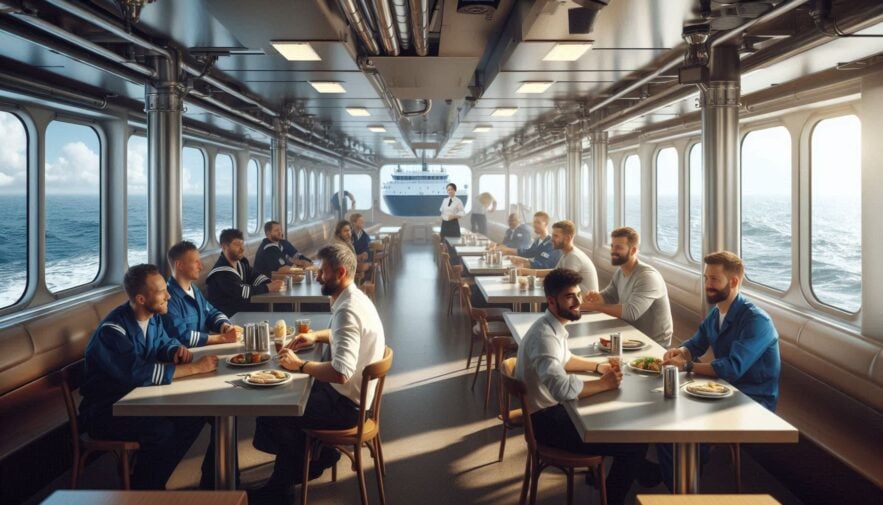
The mess room calls for warmth, restraint and gratitude.
Shared meals often become the social center of a freighter voyage, because passengers repeatedly encounter crew members, officers and fellow travelers inside the same small shipboard routine.
The ethical passenger arrives on time, follows meal customs, thanks the people preparing food and avoids demanding cruise-style flexibility from a galley built around crew needs.
Conversation should remain courteous and balanced, because the mess room is not the place to interrogate crew members, discuss sensitive personal matters loudly, or turn every meal into a performance.
The food may be practical rather than luxurious, but regular meals carry emotional importance because they structure days that might otherwise feel vast and shapeless.
Gratitude belongs at the table because every meal reflects work done by people whose responsibilities extend far beyond the passenger’s comfort.
Cargo operations should be observed respectfully, not treated as entertainment.
Watching cranes, containers, trucks, pilots, and deck operations can be one of the most fascinating parts of freighter travel, especially for passengers who rarely see global logistics at close range.
However, cargo handling is serious work, and passengers must observe only from permitted locations while avoiding photography, questions, or movement that distracts crew or terminal workers.
Industrial port areas can be dangerous, loud and tightly regulated, with safety rules that exist because heavy equipment, moving lines, and restricted zones leave little room for casual wandering.
Ethical travelers remember that the cargo deck is not a viewing platform arranged for their education, even when the sight of working trade becomes unforgettable.
The best approach is quiet observation from approved spaces, allowing the passenger to learn from the ship’s work without interfering with it.
Photography requires consent, caution and common sense.
Freighter travel offers dramatic images, including vast decks, containers, sunsets, port cranes, bridge equipment, and rare views of maritime life, but ethical photography must respect people, operations and security.
Passengers should ask before photographing crew members, avoid restricted areas, follow port rules, and never publish real-time details that reveal vessel movements, cargo operations, or the presence of other passengers.
In a small shipboard environment, careless photography can feel intrusive because people cannot easily disappear into crowds or avoid being included in another traveler’s story.
Photography should preserve memory without turning the crew, ship or other passengers into content created for an outside audience.
The ethical traveler understands that the best travel record may be private, delayed, and selective, especially when the voyage was chosen partly for quiet.
Digital conduct is part of shipboard ethics.
Limited connectivity can make freighter travel feel like a digital detox, but passengers still need disciplined online habits before departure, during shore leave and after arrival.
Travelers should avoid real-time posting, unnecessary location sharing, public commentary about crew members, or casual publication of vessel details that could undermine privacy or security.
Coverage of cargo travel’s limited passenger revival has shown that this niche form of travel depends on trust between operators, ships and civilians, making passenger behavior important to the future availability of such voyages.
Ethical passengers use digital tools carefully, keeping essential contacts informed while avoiding public visibility that affects others aboard or reveals operational information without justification.
The quiet of the ship should extend into digital behavior, because low-profile travel loses meaning when the passenger turns every private moment into public proof.
Ethical travel means preparing enough not to burden others.
A mindful passenger boards with proper documents, medication, insurance, personal supplies, offline materials, layered clothing, and realistic expectations, because poor preparation can create unnecessary work for crew or agents.
This does not mean passengers should never ask questions or request help, because safety and communication remain important in a maritime environment.
It does mean travelers should avoid becoming needlessly dependent on crew for problems that could have been anticipated before departure.
Passengers should bring necessary prescriptions, spare glasses, printed confirmations, emergency contacts, port instructions, and enough personal comfort items to manage long sea days quietly.
Self-sufficiency is a form of respect because it allows crew members to focus on the vessel rather than solving avoidable passenger issues.
Shore leave should honor both the ship and the port.
When passengers are allowed ashore, they enter communities and port areas that may not be designed for tourism, making respectful conduct especially important.
Travelers should follow immigration rules, carry proper identification, return early, avoid risky excursions, and remember that the ship cannot casually delay departure for someone who misjudged time or distance.
A short shore window is not an invitation to force a city into a rushed checklist, as ambitious sightseeing can create stress for passengers and operational problems for the vessel.

Ethical shore leave means choosing modest plans, respecting local rules, using reliable transport, and avoiding behavior that reflects poorly on the ship or operator.
The responsible passenger treats every port as a place where people live and work, not merely as a background for the traveler’s personal adventure.
Crew welfare should remain visible to passengers.
Freighter guests often benefit from the ship’s quiet, but ethical travel requires remembering that seafarers may face long separations, demanding schedules, and limited personal space while keeping global trade moving.
International maritime organizations have repeatedly emphasized the importance of crew welfare, safe working conditions, and respect for seafarers as essential parts of a functioning shipping system.
Passengers can honor that reality by being courteous, patient, undemanding, and aware that crew members may not always have the time, energy, or language comfort for extended social exchange.
A quiet thank-you, respectful distance during work periods, and ordinary kindness can matter more than exaggerated praise or intrusive fascination.
The ethical traveler leaves the ship with deeper respect for seafarers, not only with photographs of horizons and ports.
The ship’s hierarchy deserves respect.
A cargo vessel operates under a hierarchy because safety, navigation, engineering, cargo handling, and emergency response require clear lines of responsibility and decision-making.
Passengers should understand that the captain’s authority, officer instructions, and crew procedures are not optional parts of the experience, because the ship cannot function through passenger debate.
This hierarchy may feel unfamiliar to travelers accustomed to consumer service environments, where requests, complaints, and personal preferences are often treated as central.
On a freighter, good travel ethics require accepting that the vessel is governed by maritime responsibility before customer satisfaction.
The mindful passenger follows instructions promptly, asks questions respectfully, and understands that the ship’s chain of command exists to protect everyone aboard.
Privacy planning should remain lawful after the voyage ends.
Some passengers choose freighter travel as part of a broader low-profile lifestyle, relocation plan, or private international travel strategy, but the ethical standards remain the same once the ship docks.
For travelers seeking lawful discretion beyond a single voyage, anonymous living planning can support privacy, residence strategy, and compliant mobility without confusing discretion with evasion.
That distinction matters because privacy becomes ethically strong only when it respects immigration, tax, banking, customs, and identity rules in every jurisdiction involved.
A freighter can reduce unnecessary public exposure, but it cannot erase obligations or replace valid residence, financial compliance, or personal accountability after arrival.
The ethical traveler uses privacy to protect dignity and security, not to shift burdens onto institutions, crew, communities, or other people.
The best freighter guest is quietly memorable for the right reasons.
Crew and operators are more likely to remember a passenger positively when that person is calm, prepared, respectful, punctual, grateful, and easy to integrate into shipboard life.
The passenger who demands less often receives more, because trust grows naturally when crew members see that a traveler understands boundaries and respects the working environment.
That can lead to warmer conversations, smoother social moments, and a more comfortable voyage for everyone involved.
The passenger who complains constantly, ignores rules, overshares, photographs carelessly or treats crew as entertainment damages the experience not only for themselves but for future civilian passengers.
Ethical freighter travel is therefore both practical and moral, because good passenger behavior helps preserve a rare and fragile form of slow travel.
The bottom line is that ethical freighter travel depends on humility.
Freighter travel can offer privacy, quiet, social warmth, and rare access to the working world of global shipping, but those benefits depend on the passenger’s ability to behave with respect.
Mindful travelers honor crew responsibilities, cargo priorities, safety rules, fellow passenger privacy, port requirements, and the legal framework that governs international sea movement.
They practice discretion without secrecy, curiosity without intrusion, self-sufficiency without isolation, and gratitude without treating the ship as a leisure product designed around them.
The freighter passenger is a guest inside a serious maritime workplace, and that status should shape every decision from packing and photography to meals and shore leave.
For the public record, ethical travel on freighters is not complicated, but it is demanding in the best sense, because it asks travelers to move quietly, respect deeply, and remember that the privilege of the voyage depends on everyone else doing their work.