

Most entrepreneurs dream about the exit. The big payday. The moment where the years of grinding, building, and betting on yourself finally convert into something tangible. John Chmela had that moment. And what he did next surprised almost everyone who knew him.
He bought a horse farm.
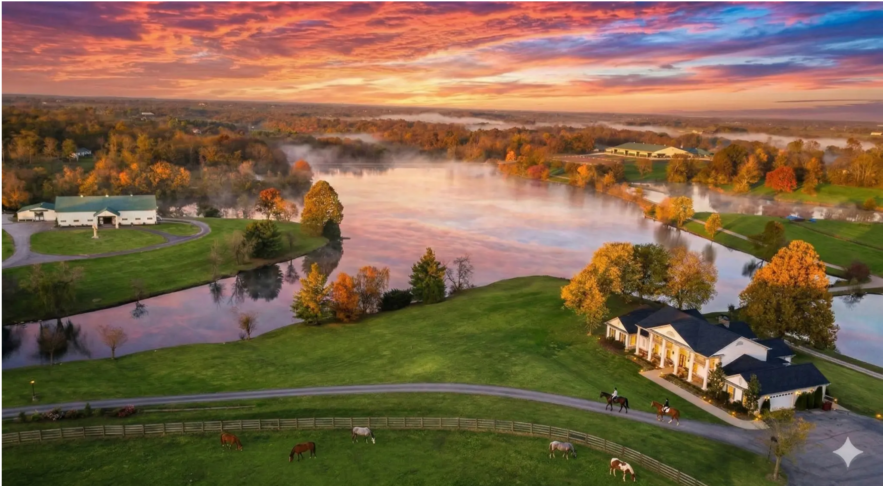
Not a vacation property. Not a passive investment. A working, breathing, chaotic 140 acre farm in Georgetown, Kentucky, complete with 70 horses, goats, pigs, ducks, chickens, a bed and breakfast, a wedding venue, and a lake so large it holds the title of the biggest privately owned lake in the state. It was his wife’s dream and, by his own admission, what he initially called a really bad idea.
He was wrong. And the story of how he got there tells you everything you need to know about what John Chmela actually values.
What He Built Before the Farm
To understand the pivot, you have to understand what came before it. In 2015, Chmela invented something called the Social Media Mat. The concept was elegant in its simplicity. Small and medium sized businesses needed a way to turn their existing customers into advocates. Word of mouth was still the most powerful marketing tool on the planet, but nobody had figured out how to systematize it at scale without it feeling forced.
The Social Media Mat solved that problem. It was a physical rubber mat that sat on a point of sale counter or a trade show booth. A customer would place their phone on the mat and a landing page would wake up instantly. Logo, contact links, social profiles, review pages, everything a business wanted a customer to have access to in one tap. But the real innovation was what sat right across the middle of the mat.
The best compliment you can give us is to tell your friends.
Businesses could pre write endorsements, testimonials, and recommendations. When a customer clicked to share on Facebook or Twitter or LinkedIn, the platform opened with the message already filled in. All the customer had to do was hit post. Multiply that across thousands of customers and you had thousands of authentic looking social endorsements going out to thousands of personal networks every single day.
The margins were almost offensive in how good they were. The mats sold for a thousand dollars each. The overhead per mat was three dollars. Within eighteen months, Chmela had seventy thousand customers. The money followed accordingly.
What Money Actually Buys You
Here is what most exit stories leave out. The part that comes after. The part where you have the resources to do anything and you have to figure out what anything actually means to you.
For Chmela, that question had a surprisingly clear answer. He was not interested in the next venture purely for financial upside. He had already proven he could build and scale a business. He had already taken a product from concept to tens of thousands of paying customers in under two years. The scoreboard question had been answered.
What he wanted next was meaning. And meaning, it turned out, came in a very specific form for him.
“God has given me more than I ever dreamed I would have,” he says. “I am in the gratitude stage of life.”
That is not a line from a motivational poster. It is a genuine operating principle that now drives every decision he makes. The farm is not a retreat from ambition. It is where his ambition landed after he stopped measuring it in dollars.
A Farm That Does More Than Board Horses
Queenslake Horse Farm is not a simple operation. On any given week it functions as a boarding facility for horses, an event venue for weddings and celebrations, a bed and breakfast for guests, a summer camp for kids, and a gathering place for charities that need a space but cannot afford one.
That last part is not a side note. Chmela has a horse arena on the property that seats a thousand people. He opens it for free to any charity, local or otherwise, that wants to host a fundraiser, a dinner, or a silent auction. The Humane Society has used it. Veterans groups have used it. Women’s advocacy organizations have used it. His only requirement is that the cause is real and the need is genuine.
This is what the exit actually bought him. Not the farm itself, though the farm is extraordinary. It bought him the freedom to say yes to things that do not have a financial return and mean it.

The Lesson That Only Comes After
There is a version of John Chmela’s story that gets told as a straightforward success narrative. Guy builds product. Product takes off. Guy sells. Guy profits. But that version misses the most important chapter.
The most significant thing Chmela built was not the Social Media Mat. It was the life that came after it. The clarity about what he actually wanted once the pressure of proving himself was removed. The willingness to listen to his wife when she told him her dream even when his instinct said it made no financial sense. The decision to plant himself on 140 acres in Kentucky and build something that serves his family, his community, and his values rather than just his bank account.
Tony Robbins has a line that Chmela references directly. You are either growing or you are dying. Chmela believes that is true at every level of success, not just the beginning. The game does not stop when you win a round. It just changes what winning means.
What He Would Tell Every Entrepreneur
For anyone still in the building phase, still grinding toward an exit or a milestone or a number that feels like it will finally be enough, Chmela’s story carries a quiet but important message.
Know what the farm is before you need it.
Not literally a farm. But know what the life looks like that you are actually trying to fund. Know what matters to you beyond the business. Know who you want to be when the pressure of proving yourself is gone. Because the exit, if it comes, arrives faster than you think. And if you have not thought about what comes next, you will spend the most resource rich season of your life figuring out a question you could have answered years earlier.
John Chmela figured it out. It just took a horse farm, a very persuasive wife, and seventy thousand customers to get him there.