

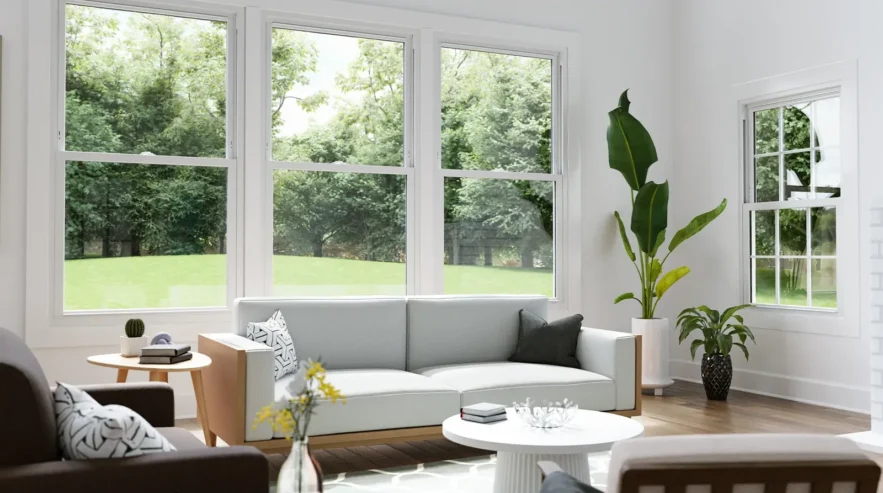
Vinyl window styles — the operating configuration of the window rather than its aesthetic appearance — determine how a window functions, how it ventilates, how it’s cleaned, and how well it seals against air infiltration. Most homeowners approach replacement window decisions focused on energy efficiency ratings and appearance while treating the operating style as a secondary decision that gets defaulted to whatever was already installed. That default often makes sense, but understanding what the different style options actually deliver — and where each one performs best — allows homeowners to make intentional choices that improve on the existing configuration rather than simply replicating it.
Double Hung: The Most Common and Most Versatile
The double hung window — where both the upper and lower sashes slide vertically and both can be opened independently — is the most common residential window configuration in American homes for good reasons. Its operational flexibility allows ventilation from the top, the bottom, or both simultaneously, which creates convection airflow that single-sash alternatives don’t achieve. Both sashes on quality double hung windows tilt inward for cleaning from inside the home, eliminating the need to clean exterior glass from outside — a practical advantage that matters significantly for second-floor installations.
From an air sealing perspective, double hung windows have more potential infiltration points than single-sash configurations because the meeting rail where upper and lower sashes meet is an additional seal location. Energy-efficient vinyl windows in double-hung configurations address this with quality weatherstripping and robust meeting-rail seals that minimize infiltration without compromising the operational flexibility the style provides.
Double hung works well in virtually any room and any architectural style — its versatility is what makes it the default in most residential applications.
Casement: Maximum Ventilation and Seal
Casement windows — hinged on one side and swinging outward like a door — deliver two distinct advantages over double hung configurations that make them the better choice in specific applications. First, ventilation: a fully open casement presents the entire window opening to airflow rather than half of it, and the outswing sash acts as a scoop that channels breezes into the home — making casements significantly more effective ventilators per square foot of opening than double hung windows in the same location.
Second, air sealing: casement windows compress against their frame when closed and locked, creating a compression seal rather than the sliding seal of a double hung. That compression seal is inherently tighter than sliding seal configurations — which is why casements consistently outperform double hung windows in air infiltration testing and why they’re the preferred style for applications where maximum thermal performance is the priority.
The practical limitation of casements is the outswing — exterior obstacles, walkways beneath the window, or locations where an outswinging sash would be problematic rule out casement configurations regardless of their performance advantages. Custom vinyl windows in casement configuration are particularly well suited to kitchen installations where ventilation over a sink or cooking area is a priority, and to bedroom applications where nighttime airflow matters more than the convenience of double-sided ventilation.
Sliding Windows: Simplicity and Wide Openings
Horizontal sliding windows — where one or both sashes slide left and right rather than up and down — offer a simplicity of operation that double hung windows don’t quite match, particularly for larger window openings where the weight of a vertical sash would make operation effortful. They work well in contemporary and ranch-style architecture where wide horizontal proportions suit the aesthetic, and in locations where an outswinging casement isn’t practical but maximum opening width is a priority.
The air sealing characteristics of sliding windows are similar to double hung — a sliding rather than compression seal — which means their thermal performance is comparable to double hung rather than matching the advantage that casements achieve.
Picture Windows: When Views Matter More Than Ventilation
Fixed picture windows — those with no operable sash — deliver the best thermal performance of any window style because they have no operational hardware, no weatherstripping, and no moving parts that can develop infiltration over time. A fixed insulated glass unit in a quality vinyl replacement window frame is simply glass and frame — the most thermally efficient configuration possible.

The obvious limitation is no ventilation — which makes picture windows appropriate only for locations where ventilation isn’t needed or where an adjacent operable window handles that function. Large views, architectural feature windows, and applications where the window is above usable height all suit fixed picture configurations. Combining a central picture unit with flanking casements or double hung units provides the view expanse of a large fixed window alongside the ventilation capability that the fixed unit can’t provide.
Choosing by Room Function
The most practical framework for choosing between vinyl window styles is matching the operating configuration to the room’s specific needs. Kitchens benefit from casements — maximum ventilation and easy operation with one hand when the other is occupied. Bedrooms work well with either casements or double hung depending on the specific location. Living rooms with picture-window views often suit fixed units with operable flanking windows. Bathrooms typically need ventilation more than view, which favors casements or awning windows that can be left open during rain.
Consulting with a dealer through the where to buy resource about which configurations work best for specific locations produces selections that serve each room’s function rather than a uniform style applied throughout regardless of fit.