

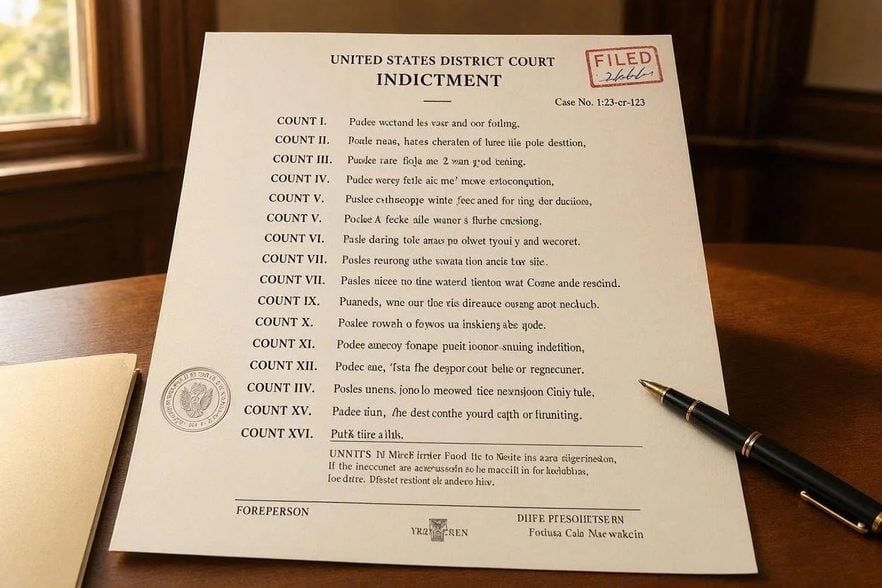
The June 2026 indictment includes conspiracy, healthcare fraud, aggravated identity theft, alleged kickback payments, a criminal-proceeds transaction, and the alleged sale of Medicare beneficiary identification numbers
WASHINGTON, DC — Oren David Shachar faces sixteen federal charges in Los Angeles arising from an alleged Medicare hospice fraud operation that prosecutors say combined false clinical records, unlawful patient recruitment, identity misuse, kickbacks, and luxury spending.
The indictment, returned on June 16, names Shachar in every count and alleges that four hospice companies under his control submitted approximately $27.731 million in false claims, from which Medicare paid approximately $26.908 million during the charged period.
Federal prosecutors describe a scheme involving living beneficiaries who allegedly were not terminally ill, deceased beneficiaries whose identities allegedly supported invented services, marketers who allegedly supplied referrals, and company money allegedly directed toward a Rolls-Royce lease arrangement.
Shachar, Jeannie Choi, and Abraham Shin remain presumed innocent, and the indictment represents accusations approved for prosecution by a grand jury rather than findings established through a guilty plea, trial verdict, or final judicial determination.
Understanding the prosecution requires separating the sixteen-count charging document into its component offenses, because Shachar faces every count while Choi and Shin face only the narrower conspiracy, healthcare-fraud, and aggravated-identity-theft allegations assigned to them.
The sixteen counts form six distinct charge groups
The government’s sixteen-count federal indictment charges Shachar with one conspiracy count, eight substantive healthcare-fraud counts, three aggravated-identity-theft counts, one monetary transaction involving allegedly criminal proceeds, two alleged kickback payments, and one alleged sale of Medicare identifiers.
That structure matters because each count is a separately alleged statutory offense, while the lengthy narrative preceding the counts describes the broader manner and means prosecutors expect to use to explain intent, relationships, claims, payments, and concealment.
The sixteen-count total does not mean prosecutors identified only sixteen disputed Medicare submissions, because eight substantive fraud counts present selected executions while the indictment attributes approximately $27.731 million in aggregate claims to the wider alleged operation.
Nor should sixteen charges automatically translate into sixteen convictions or a predetermined sentence, since prosecutors must prove every element separately and courts address dismissal, acquittal, grouping, consecutive terms, restitution, and forfeiture through different legal rules.
Count One alleges a five-year healthcare-fraud conspiracy
Count One charges Shachar, Choi, and Shin with conspiracy to commit healthcare fraud, alleging that Shachar participated from no later than approximately February 2021 through at least March 2026 with other known and unknown participants.
The indictment places Shin’s alleged participation as beginning no later than March 2025, while Choi’s alleged participation began no later than May 2025 and continued through at least November 2025, creating materially different periods of alleged involvement.
A conspiracy charge focuses upon an alleged agreement and knowing participation rather than requiring every participant to perform every act, but prosecutors must still establish that each defendant intentionally joined the unlawful objective attributed to that person.
Defense lawyers can therefore challenge whether ordinary referrals, administrative coordination, payments, messages, or access to patient information actually demonstrated criminal agreement, particularly when licensed clinicians and separate employees retained independent responsibilities throughout the hospice process.
Counts Two through Nine identify eight claim executions
Counts Two through Nine charge substantive healthcare fraud through eight representative claims submitted between August 2023 and November 2025, with billed amounts ranging from approximately $220 to approximately $6,270 across the four hospice companies.
Shachar alone is named in Counts Two through Six, covering five claims associated with Gentle Touch Hospice, Oxford Hospice, Art of Hospice, and Holly Trinity Hospice before the indictment’s later joint-defendant examples presented separately.
Shachar, Choi, and Shin are jointly named in Counts Seven through Nine, which concern three claims submitted during September and November 2025 for beneficiaries whose identity information also underlies the aggravated-identity-theft charges that immediately follow.
The eight listed claims total approximately $32,360, representing only a small fraction of the aggregate $27.731 million allegation and confirming that the public count table is illustrative rather than a complete beneficiary-by-beneficiary accounting.
Counts Ten through Twelve allege aggravated identity theft
Counts Ten through Twelve charge all three defendants with knowingly transferring, possessing, using, or causing the use of another person’s identifying information without lawful authority during and in relation to the healthcare-fraud offenses charged in Counts Seven through Nine.
The identifying information allegedly included each beneficiary’s name, Social Security number, and Medicare identification number, while the charged dates were August 14, August 25, and November 3 during calendar year 2025 in Los Angeles.
Aggravated identity theft demands more than proof that information was inaccurate or mishandled, because prosecutors must establish knowing use without lawful authority, knowledge that the means of identification belonged to another person, and the required relationship to a qualifying felony.
Those counts carry particular sentencing significance because a conviction ordinarily requires a two-year term consecutive to the sentence for the underlying predicate offense, although statutory and judicial sentencing rules still govern the ultimate treatment of multiple identity counts.
Count Thirteen follows an alleged Rolls-Royce payment
Count Thirteen charges Shachar alone with knowingly conducting a monetary transaction exceeding $10,000 in property allegedly derived from healthcare fraud, focusing upon a precisely dated $15,000 wire sent on September 20, 2024.
Prosecutors say the wire moved from Holly Trinity Hospice’s JPMorgan Chase account to a Wells Fargo account as a partial payment toward the down payment on a lease-to-own Rolls-Royce Phantom arrangement described by investigators.
The count does not say that $15,000 represented the vehicle’s full price, the entire down payment, or unrestricted ownership, and it does not charge Choi or Shin with authorizing, receiving, or benefiting from that transaction.
To obtain a conviction, the government must connect the transferred property with specified unlawful activity and prove Shachar’s required knowledge, while the defense can dispute tracing, account control, legitimate revenue, authorization, purpose, and contractual context.
Counts Fourteen and Fifteen allege two referral payments
Counts Fourteen and Fifteen charge Shachar alone with knowingly and willfully offering and paying remuneration to induce hospice beneficiary referrals for services reimbursable through Medicare, using two alleged $300 transactions as the charged examples.
Count Fourteen concerns an alleged September 16, 2025, payment to Choi connected with one beneficiary referral, while Count Fifteen concerns an alleged January 29, 2026, payment to Shin connected with a different beneficiary referral.
The Anti-Kickback Statute allegations require proof of a prohibited purpose behind the remuneration, meaning a payment-and-referral relationship can be powerful evidence but does not eliminate questions about intent, context, legitimate work, or statutory protections.
The indictment separately alleges broader payment practices, including approximately $700 per living referral for every month a beneficiary remained billable and between approximately $1,000 and $3,000 for each deceased-beneficiary referral ultimately enrolled in hospice.
Count Sixteen alleges the sale of nine Medicare identifiers
Count Sixteen charges Shachar alone with knowingly and willfully selling, arranging for the sale, and distributing nine Medicare beneficiary identification numbers to an unnamed physician for approximately $12,500 on March 6, 2025.
This offense appears under the Anti-Kickback Statute’s prohibition involving the unauthorized purchase, sale, or distribution of beneficiary identification numbers and unique health identifiers, making it legally distinct from the three aggravated-identity-theft allegations presented elsewhere.
The indictment identifies nine beneficiaries by initials but does not explain in Count Sixteen how their numbers were obtained, whether claims followed the transaction, or what the unnamed physician allegedly intended to do with them.
Prosecutors must prove unauthorized, knowing, and willful conduct surrounding the sale, while the defense may examine whether the payment, records, relationship, transfer, or identification-number attribution has been accurately characterized and supported through admissible evidence.
Four hospice companies anchor the alleged operation
The indictment identifies Gentle Touch Hospice Care in Valley Glen, Oxford Hospice Care in Montclair, Art of Hospice in Encino, and Holly Trinity Hospice in Glendale as companies Shachar allegedly owned, controlled, or operated during relevant periods.
Although the businesses maintained separate names, addresses, Medicare enrollment histories, provider identifiers, and financial records, prosecutors group them as the Shachar hospices when describing the alleged scheme and its combined billing and payment totals.
That multi-company structure may allow investigators to compare ownership applications, employees, marketers, beneficiaries, physicians, electronic records, bank transfers, and claim histories, searching for recurring relationships that could appear less conspicuous within each provider individually.
The defense can insist upon company-specific proof, however, because common ownership does not automatically make every claim fraudulent, establish that every employee shared unlawful intent, or permit disputed conduct at one provider to be attributed mechanically across all four.
Prosecutors allege three principal categories of false claims
The first alleged category involves beneficiaries whom Shachar and others supposedly knew were not terminally ill, despite Medicare hospice eligibility generally requiring certification of a life expectancy of six months or less if illness follows its normal course.
The second category involves services allegedly represented as occurring before beneficiaries died, although prosecutors claim personal information was acquired after death and used to create backdated nursing assessments, physician certifications, elections, and clinical records.
The third category involves services allegedly rendered non-payable because beneficiaries were enrolled through kickbacks, including payments to marketers, monthly cash for patients who remained enrolled, referral bonuses, and noncash goods described as inducements.
These theories overlap within the charging narrative, yet each raises different proof questions concerning medical judgment, service performance, informed consent, document timing, data provenance, payment purpose, materiality, and the defendants’ individual knowledge and intent.
Medicare allegedly paid nearly every challenged dollar
Prosecutors allege that Shachar and others caused approximately $27.731 million in false claims to be submitted through the four hospices, covering services described as medically unnecessary, ineligible, unprovided as represented, or tainted by unlawful remuneration.
Medicare allegedly paid approximately $26.908 million on those submissions, producing an arithmetic reimbursement ratio of roughly 97.03 percent and a difference of approximately $823,000 between the amount billed and the amount paid.
Those figures describe the government’s case-wide allegation rather than a final judicial loss calculation, and they should not be represented as money personally retained by Shachar or divided equally among Choi, Shin, employees, clinicians, marketers, and beneficiaries.
Later proceedings may examine legitimate services, offsets, repayments, causation, forfeitable proceeds, restitution, and defendant-specific responsibility, preventing the dramatic aggregate payment figure from resolving every financial question before the evidence is tested publicly in open court.
The alleged identity method depended upon authentic data
Prosecutors say Choi obtained information through employment at an unnamed funeral home business, while Choi and Shin allegedly transmitted identification images, death details, physician names, relatives’ names, Social Security numbers, and Medicare identifiers through messages.
Shachar allegedly preferred recently deceased people who died at home, had not been enrolled with another hospice, and came to marketers’ attention within five days, conditions prosecutors say were designed to reduce contradictory records and regulatory scrutiny.
An Amicus International Consulting analysis of identity crimes and social-engineering schemes explains how authentic personal information obtained through trusted access can be redirected into unauthorized transactions whose valid fields initially conceal the absence of genuine consent.
In this hospice prosecution, a correct name, genuine Medicare number, real physician history, accurate death time, and actual relative could allegedly surround an invented clinical encounter, demonstrating why identity matching alone cannot validate service performance.
The financial count depends upon tracing and attribution
Bank statements, Medicare remittance records, corporate ledgers, account-signature documents, wire instructions, lease contracts, invoices, device logs, and testimony may collectively establish who controlled the Holly Trinity account and why the $15,000 transfer occurred.
An Amicus explanation of Tax Identification Numbers and anti-money-laundering compliance describes how financial identifiers connect regulated accounts and transactions with particular people or entities, supporting attribution without independently proving that the underlying money was criminally derived.
Commingled accounts can complicate analysis because legitimate and disputed reimbursements may enter the same operating account before payroll, vendor payments, distributions, transfers, and personal expenditures leave through different channels over an extended period.
The government may present an accepted tracing methodology and surrounding evidence of knowledge, while defense experts can challenge assumptions concerning balances, revenue sources, transaction sequencing, accounting treatment, and the vehicle arrangement’s actual business or personal purpose.
Choi and Shin face seven counts rather than sixteen
Choi and Shin are each named in Count One, Counts Seven through Nine, and Counts Ten through Twelve, producing seven charges apiece and materially narrower exposure than the sixteen counts directed against Shachar.
Neither co-defendant is charged in the five earlier representative fraud claims, the Rolls-Royce transaction, the two substantive kickback-payment counts, or the alleged $12,500 sale of nine beneficiary identification numbers to a physician.
Their inclusion in the overall indictment does not permit every dollar billed since 2021 to be assigned to them, particularly because prosecutors allege their participation during later, shorter periods beginning in calendar year 2025.
Accurate coverage must distinguish Shachar’s alleged ownership and direction from the marketers’ alleged referral and information-supply roles, while recognizing that conspiracy and aiding-and-abetting theories can still create liability beyond personally committed acts when legally proven.
The June arrests moved the allegations into federal court
Shachar, then identified by authorities as 59 and residing in Van Nuys, and Shin, then identified as 66 and residing in Corona, were arrested on June 18 and arraigned in federal court in Los Angeles.

Choi, then identified as 57 and residing in Torrance, was arrested several days later, completing the initial arrest sequence described when federal authorities publicly announced the Southern California healthcare-fraud cases on June 23.
A federal magistrate judge ordered Shachar and Shin released on bond, a pretrial decision addressing appearance and safety under release conditions rather than determining whether the indictment’s medical, identity, payment, or financial allegations are true.
Authorities initially announced an August 11 trial date for Shachar and Shin, although federal criminal schedules frequently change through later orders concerning discovery, motions, negotiations, severance, witnesses, expert preparation, and courtroom availability in Los Angeles.
Sixteen charges do not produce a simple sentencing total
Healthcare-fraud conspiracy, substantive healthcare fraud, the criminal-proceeds transaction, kickback payments, and the unauthorized sale of Medicare identifiers each carry their own statutory requirements and potential penalties if the government secures qualifying convictions at trial.
The aggravated-identity-theft counts introduce consecutive-imprisonment rules, while multiple convictions can also raise questions about guideline grouping, loss calculation, role adjustments, obstruction, acceptance of responsibility, criminal history, and judicial discretion within lawful limits.
Restitution seeks compensation for legally established victim loss, forfeiture targets property connected with qualifying offenses, and imprisonment punishes criminal conduct, meaning those outcomes cannot be collapsed into one headline calculation based exclusively upon the number of counts.
The Justice Department has said the defendants could face decades in federal prison if convicted of all applicable charges, but no responsible prediction can be made before verdicts, sentencing findings, individual histories, and judicial rulings resolve contested issues.
Electronic evidence could connect the charge groups
Messages may reveal whether participants discussed beneficiary eligibility, death timing, identification documents, referral prices, monthly retention, prior hospice enrollment, relatives, physicians, record preparation, or the alleged five-day window governing deceased-beneficiary opportunities during 2025.
Claims data can supply a second timeline identifying provider numbers, beneficiary histories, service dates, billing amounts, reimbursements, recertifications, discharges, and death dates, while bank records can show whether alleged payments followed particular referrals or claim periods.
Electronic medical-record metadata may identify when charts were opened, edited, signed, copied, or backdated, while device extractions and institutional access logs can reveal when defendants or witnesses first obtained the underlying personal information.
The prosecution’s case may become strongest where independent records converge around the same beneficiary, although defense lawyers can challenge device attribution, incomplete conversations, late but lawful documentation, witness incentives, legitimate payments, and ambiguous account entries.
Medical judgment remains a central defense issue
Hospice prognosis is not mathematical, and a patient’s survival beyond six months does not automatically prove that an earlier terminal certification was fraudulent, particularly when illness trajectories can improve, stabilize, or depart from reasonable clinical expectations.
Defense attorneys may argue that physicians, nurses, administrators, and billing personnel independently reviewed eligibility and documentation, leaving Shachar without knowledge that any particular certification, encounter, claim, signature, or electronic entry contained a material falsehood.
They may also contend that marketers referred genuinely eligible people, relatives lawfully provided information, records were completed retrospectively for legitimate reasons, and disputed payments represented lawful services, comfort support, compensation, loans, reimbursements, or unrelated transactions.
Prosecutors may answer with repetition, timing, communications, referral compensation, account flows, impossible chronology, and testimony demonstrating knowledge, but jurors must evaluate those inferences separately for each defendant and each count beyond a reasonable doubt.
The prosecution formed part of a national takedown
FOX 11 Los Angeles reported that the Shachar hospice allegations emerged during the Justice Department’s 2026 National Health Care Fraud Takedown, which involved hundreds of defendants and billions of dollars in alleged false claims across numerous unrelated cases.
Those nationwide figures provide enforcement context but cannot be assigned to Shachar, Choi, Shin, or the four Los Angeles-area hospices, whose case-specific allegations remain approximately $27.731 million billed and approximately $26.908 million paid.
The broader operation reflects increased federal coordination among criminal prosecutors, the Federal Bureau of Investigation, health-program investigators, claims analysts, and administrative authorities, yet nationwide scale does not reduce the individualized burden of proof in Los Angeles.
Public reporting has understandably emphasized deceased beneficiaries and luxury spending, while the complete count structure reveals a more technical prosecution connecting alleged agreements, selected claims, identifiers, payments, bank activity, provider records, and statutory intent requirements.
Hospice compliance programs can learn from the charge map
Legitimate providers should prohibit compensation tied to beneficiary volume or billing duration, independently review marketer agreements, verify fair-market-value services, document payment purposes, and monitor whether compensation stops immediately after discharge, death, or reimbursement changes.
Intake teams should verify how each patient reached the provider, whether anyone offered money or goods, whether terminal eligibility was assessed independently, and whether the beneficiary understood that hospice election changes coverage for treatment related to the terminal illness.
Operators controlling affiliated companies should consolidate analytics across provider numbers, marketers, physicians, bank accounts, addresses, employees, live-discharge rates, death patterns, claim timing, and electronic-record creation, because fragmented oversight can conceal recurring relationships across entities.
Access to Social Security numbers, Medicare identifiers, death records, and identification images should be limited, logged, and audited, with personal-device photography and unapproved messaging prohibited whenever sensitive beneficiary data enters a healthcare workflow.
The indictment begins the litigation rather than ending it
Shachar’s sixteen charges present a broad federal theory in which alleged hospice fraud generated claims, identity information supported selected transactions, kickbacks supplied beneficiaries, and a corporate bank account carried disputed proceeds toward luxury spending.
The defense retains the right to test searches, messages, witnesses, clinical opinions, claims methodologies, account tracing, corporate ownership, document metadata, statutory interpretations, forfeiture theories, and every proposed connection among the six charge groups.
Until a jury returns verdicts or a court accepts a guilty plea, accurate reporting must use allegation language, preserve the presumption of innocence, distinguish the defendants’ different counts, and avoid treating aggregate Medicare payments as established personal theft.
The Los Angeles case will ultimately turn upon evidence rather than charge volume, because prosecutors must transform a sixteen-count accusation into count-specific proof while the defense may separate lawful hospice activity from conduct the government portrays as one coordinated scheme.
Verification completed after sentence-level auditing confirms that this article contains 3,017 audited prose words across 85 complete prose sentences, every complete prose sentence contains at least 33 words, and exactly four hyperlinks appear in the required distribution of one government source, one news source, and two Amicus sources.