

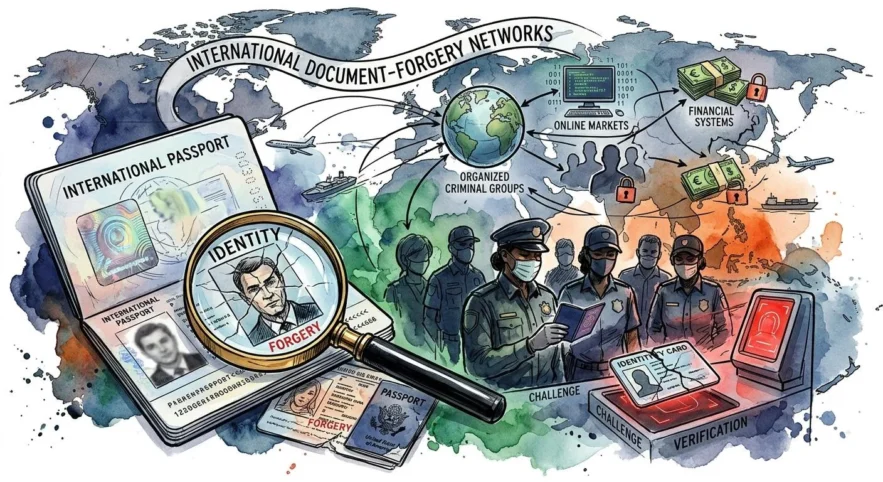
Counterfeit passports, identity theft, and international document-forgery networks challenge border authorities as organized criminal groups exploit online markets, financial systems, and weaknesses in travel document verification.
WASHINGTON, November 11, 2026 — Counterfeit passports continue to challenge U.S. border officials as sophisticated criminal networks exploit forged travel documents, stolen identities and international fraud operations to facilitate unlawful movement, financial deception and other activities that threaten border security.
Investigators increasingly view fake passports as more than a document-security problem, recognizing their potential importance to human-smuggling operations, financial fraud networks and transnational organized crime groups seeking to conceal identities and move individuals between jurisdictions.
The threat is pushing enforcement agencies to rely more on intelligence sharing, electronic passport authentication, biometric screening, and coordinated investigations designed to identify fraudulent documents while preserving efficient international travel for legitimate passengers.
Recent criminal prosecutions in the United States and investigations across Europe show how counterfeit passports can link border-security concerns to financial crime, illegal migration networks, and identity theft operations that span national boundaries.
Counterfeit Passports Support a Wider International Criminal Economy
The illegal production and distribution of counterfeit passports represents one component of a broader criminal economy in which stolen personal information, fraudulent identification documents and deceptive financial arrangements can support multiple offenses across different countries.
Criminal networks may exploit forged travel credentials to establish misleading identities, create apparently legitimate banking relationships, facilitate unauthorized travel or complicate investigations into individuals whose documented histories do not accurately reflect their identities.
These operations do not always involve completely fabricated passports, because fraudulent applications, altered genuine documents, stolen passport booklets and authentic documents presented by unauthorized holders can create substantially different challenges for enforcement authorities.
This distinction matters because detecting a physically counterfeit passport requires different investigative capabilities than identifying an authentic government-issued document obtained through deception or presented by someone whose identity does not match its legitimate owner.
For law enforcement agencies, the central concern is that fraudulent documents may provide an appearance of legitimacy that supports other criminal activities, especially when financial institutions, transportation companies and government agencies rely on passports as trusted identity credentials.
U.S. Passport Fraud Prosecutions Reveal Financial Crime Connections
Federal prosecutors in Nevada highlighted the link between counterfeit passports and alleged financial fraud in August 2026, when authorities announced charges involving a counterfeit Spanish passport and an online vehicle sales scheme.
According to the U.S. Department of Justice’s August 27, 2026, announcement, a defendant allegedly used a counterfeit foreign passport to open a bank account used to process proceeds from fraudulent vehicle transactions.
The investigation involved alleged conduct affecting victims across several American states, including Pennsylvania, California, Louisiana, Ohio, New York, and Massachusetts, showing how document-related financial offenses can reach people far from an investigation’s central location.
Prosecutors alleged that the defendant represented himself as a seller of restored vintage vehicles and equipment, received payments through financial accounts and subsequently removed funds without intending to deliver the advertised merchandise.
The allegations illustrate how counterfeit passports can enable financial deception, providing identification that may help criminals obtain banking services or create misleading commercial relationships without approaching an international immigration checkpoint.
The case remains subject to judicial determination, and the allegations do not establish guilt, but the prosecution shows why investigators treat suspicious identity documents as potentially significant evidence in broader criminal investigations.
European Investigations Expose International Passport Forgery Networks
European governments have also identified passport forgery as an important component of organized migrant-smuggling operations, particularly when criminal groups arrange transportation, provide misleading identity documents and facilitate movement through several jurisdictions.
In July 2025, Britain imposed sanctions on individuals and a company linked to people-smuggling activities, including alleged document suppliers whose operations formed part of broader networks supporting irregular migration into the country.
As Reuters reported in its coverage of Britain’s sanctions campaign, the measures included eight individuals from the Balkans whom British authorities accused of supplying fraudulent passports to people-smuggling networks.
The enforcement measures illustrated a strategy extending beyond arrests at border crossings, with authorities seeking to disrupt the financial arrangements, document suppliers and logistical infrastructure that enable organized criminal activity.
British authorities subsequently announced additional sanctions in October 2025 against suspected passport-forgery networks operating in the Western Balkans, showing ongoing concern about suppliers that can distribute false identification across multiple countries.
These developments emphasize that passport fraud is not confined to any single migration route, with criminal organizations potentially adapting their activities as enforcement priorities, transportation opportunities and international travel requirements change.
Online Document Markets Create Additional Enforcement Challenges
Digital communications have expanded opportunities for criminal intermediaries to advertise fraudulent identification services, communicate with prospective customers and coordinate international transactions without maintaining the traditional physical infrastructure associated with document-forgery operations.
Online advertisements, encrypted messaging services and fraudulent commercial websites can provide opportunities for illegal document suppliers, although investigators must distinguish genuine criminal operations from unrelated internet scams and lawful immigration services.
The international character of these arrangements complicates investigations because criminal participants may reside in different countries, use identities that conceal their actual locations and direct customers toward documents purportedly issued by distant governments.
Electronic evidence can become particularly important when investigators examine communications, financial transactions and relationships among suspected participants, requiring cooperation between agencies operating under different legal systems and evidentiary requirements.
Such investigations also show why authorities cannot rely solely on physical inspection of passports at border crossings, since criminal conduct involving fraudulent identity documents may begin long before anyone attempts international travel.
Modern Passport Security Features Help Identify Counterfeits
Governments have introduced increasingly sophisticated passport security features to reduce opportunities for document alteration and counterfeiting, incorporating specialized materials, protected identity information and authentication mechanisms into modern travel credentials.
Contemporary passports commonly combine secure printing, ultraviolet elements, optically variable devices, laser-engraved identity pages, and machine-readable information, giving trained inspectors several independent ways to verify a document’s authenticity.
Polycarbonate identity pages can offer additional resistance to certain forms of alteration because specialized production techniques may embed personal information in the document structure rather than on the surface.
Electronic passports add another security layer through embedded contactless chips containing digitally protected information, allowing compatible inspection systems to check data integrity and, when appropriate, verify issuing-authority signatures.
As explained in Amicus International Consulting’s analysis of modern passport security and counterfeit detection, effective authentication requires understanding how physical security features, electronic information and identity verification contribute to evaluating whether a travel document is genuine.
However, no individual security feature should be treated as conclusive proof of every aspect of a traveler’s identity, since genuine passports can be stolen, obtained through deception or presented by unauthorized individuals.
Biometric Screening Changes How Border Authorities Verify Identity
Biometric identity verification has become a key component of modern border inspection systems, allowing authorities to compare travelers’ physical characteristics with reference information linked to their identity documents.
Facial recognition technology can help determine whether the person presenting a passport resembles the individual in a trusted reference photograph, addressing risks that ordinary document authentication cannot resolve on its own.
This distinction matters because a perfectly authentic passport may nevertheless be used improperly when its legitimate holder has lost control of the document or another person attempts to impersonate its owner.
Automated biometric comparisons can support inspection decisions, but image quality, environmental conditions, appearance changes, and other factors may produce uncertain results that require additional examination by appropriately trained personnel.
Border authorities consequently need procedures that distinguish a preliminary biometric discrepancy from confirmed identity fraud, ensuring that technological screening results are interpreted within broader legal, operational and evidentiary frameworks.
Effective systems must also address accuracy, data protection and the treatment of travelers whose biometric comparisons require further review, recognizing that security improvements should not eliminate appropriate safeguards against erroneous decisions.
Electronic Passport Authentication Provides Additional Protection
The electronic chip in many contemporary passports supports authentication through internationally standardized data structures and cryptographic protections designed to help inspection equipment detect certain unauthorized modifications.
Passive Authentication allows compatible systems to examine digital signatures associated with protected passport information, helping determine whether the data corresponds to information signed by an authorized issuing authority.
Additional electronic security mechanisms may protect against particular forms of chip misuse, although their availability depends on the passport’s design, technical specifications, and the capabilities of the inspection equipment.
A successful electronic authentication result does not automatically establish that a passport remains under the control of its rightful holder, nor does it independently resolve questions about the person’s admissibility.
Similarly, unsuccessful electronic reading attempts cannot automatically establish counterfeit status because technical limitations, damaged components, equipment compatibility, and ordinary scanning difficulties may interfere with access to protected passport information.
The continuing importance of trained document examiners reflects these limitations, since sophisticated verification equipment is most effective when its results are evaluated alongside physical evidence and reliable identity information.

Airlines and Border Agencies Share Responsibility for Document Screening
International airlines play an important role in passport-security systems because travelers often present identification documents to transportation companies before arriving at immigration checkpoints run by destination-country authorities.
Carrier personnel may examine travel documents and entry requirements before boarding, creating opportunities to identify discrepancies early and seek assistance from government authorities when documentation appears suspicious or incomplete.
U.S. Customs and Border Protection supports international carriers through document-awareness training and technical guidance intended to improve recognition of fraudulent credentials, impostor travel and improperly documented passengers.
Such cooperation can strengthen international border controls without transferring final immigration decisions to airlines, since government authorities remain responsible for determining admissibility under applicable immigration laws and procedures.
Training programs must also recognize the limitations of commercial screening environments, where employees may encounter unfamiliar foreign documents, changing entry requirements and considerable passenger volumes while performing other operational responsibilities.
Intelligence Sharing Helps Investigators Connect Criminal Networks
International intelligence cooperation can help authorities connect fraudulent documents, suspected criminal participants, and separate investigations that might otherwise appear unrelated when examined within individual national jurisdictions.
Information sharing may include relevant travel records, verified identity details, document-theft notifications and investigative findings, subject to applicable domestic laws, international agreements and safeguards governing sensitive personal information.
The value of such cooperation becomes especially apparent when authorities investigate networks distributing fraudulent identification across multiple countries, because suppliers, intermediaries and suspected customers may operate under different legal jurisdictions.
Investigators must still distinguish verified evidence from unconfirmed allegations, ensuring that information exchanged between agencies remains accurate enough to support legitimate enforcement decisions without unnecessarily affecting innocent individuals.
For border-security planners, the challenge is to develop dependable mechanisms to identify significant criminal threats while preserving the lawful movement of travelers whose documents and personal circumstances meet relevant requirements.
Fraudulent Passports Can Affect Banking and Commercial Transactions
Passport-related identity fraud also presents risks outside transportation and immigration systems because financial institutions routinely rely on official identification documents when assessing customers and establishing regulated banking relationships.
A counterfeit passport can undermine customer verification when an institution accepts misleading identity information without detecting discrepancies, creating opportunities for fraudulent transactions or accounts linked to criminal activity.
Financial institutions therefore benefit from risk-based document authentication, appropriate customer due diligence and reliable escalation procedures when presented identification contains inconsistencies that cannot be adequately resolved through ordinary verification.
The Nevada prosecution illustrates this wider vulnerability, showing why investigators may follow financial transactions and commercial representations when determining whether suspected passport fraud contributed to a broader alleged criminal scheme.
For legitimate customers, stronger identity verification can also help reduce exposure to impersonation and financial fraud, although banks must apply authentication procedures consistently and within applicable privacy and consumer-protection requirements.
Passport Security Requires More Than Advanced Technology
The continuing development of counterfeit passports creates a sustained challenge for governments investing in stronger identity documents, modern inspection systems and coordinated responses to transnational organized crime.
Technological improvements can make certain forms of document fraud harder, but their effectiveness depends on consistent implementation, trained personnel, updated procedures, and reliable cooperation among participating authorities.
Governments must also recognize that document forgery is only one component of identity-related criminal activity, making accurate issuance records, secure identity enrollment and effective investigation of fraudulent applications equally important.
For U.S. border officials, the strategic objective remains identifying individuals who misuse travel credentials without subjecting legitimate travelers to unnecessary disruption, unsupported suspicion or inconsistent treatment during ordinary inspections.
The most durable response combines stronger passport issuance controls, effective international cooperation, biometric identity verification and professional document examination, recognizing that criminal networks can exploit weaknesses extending far beyond passport booklets.
As counterfeit documents continue to intersect with financial fraud, human smuggling and international organized crime, border security will increasingly depend on the integrity of the wider systems responsible for establishing and verifying identity.