

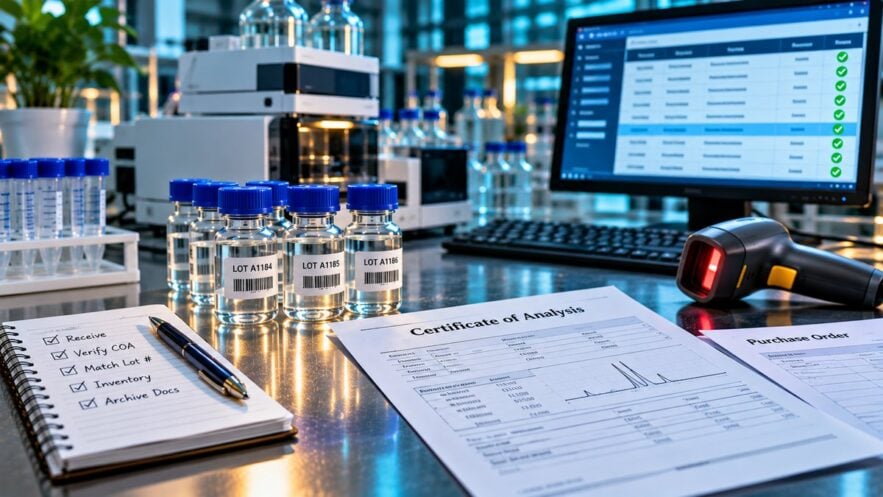
The research material arrived on schedule. Its packaging was intact, the purchase order matched the invoice, and the laboratory team was ready to begin its planned analysis. Everything appeared to be moving according to schedule until a researcher opened the accompanying documentation.
The analytical report carried a different lot number from the container. Nobody could immediately establish whether the report belonged to the material that had arrived.
This hypothetical situation illustrates a common operational vulnerability in scientific procurement. A laboratory may have the correct physical material but lack sufficient evidence to connect that material to its associated analytical records.
For small research businesses, the consequences extend beyond inconvenience. Incomplete documentation can interrupt experiments, create uncertainty about materials already in inventory, complicate internal reviews and consume valuable staff time.
Reliable purchasing therefore involves more than selecting a supplier and receiving a package. It requires an organized process for establishing what was purchased, what was received, which records apply and whether unresolved discrepancies prevent the material from being used in a particular research activity.
Why Scientific Procurement Is Different From Ordinary Business Purchasing
Many business purchases can be evaluated primarily through price, quantity, delivery time and whether the product meets a visible specification. Research materials introduce additional questions because their suitability may depend on chemical properties that cannot be assessed through appearance alone.
Two containers may look identical while containing different substances, different lots or materials with different analytical histories.
Consequently, a successful delivery confirmation does not establish that the laboratory has all the information necessary to evaluate the received material.
Scientific procurement should connect the commercial transaction with the technical records needed for the intended work.
That connection may involve a purchase order, supplier information, product identification, lot or sample identifiers, available analytical reports and the laboratory’s own receiving records.
Not every research project requires the same documents. The appropriate requirements depend on the material, intended application, institutional procedures and applicable legal obligations.
However, deciding which evidence is necessary before ordering is generally more efficient than discovering missing requirements after a shipment arrives.
The Lot Number Is the Link Between the Container and Its Records
A lot number or comparable identifier can connect a physical material to records concerning its production, preparation, testing or packaging history.
Without a reliable identifier, a laboratory may struggle to determine which analytical report applies to a particular container.
Consider a hypothetical shipment containing several containers of the same research compound from different lots.
The product names may be identical, but the analytical reports could contain different test dates, results or observations.
If the receiving team records only the product name, later researchers may be unable to determine which lot was used in a specific experiment.
This becomes particularly problematic when scientists attempt to understand inconsistent results or compare experiments conducted at different times.
A practical receiving process records the identifying information available on the physical material and compares it with the accompanying documentation.
For peptide-related research materials, educational resources from USA Peptide Depot discuss the importance of linking physical material identifiers with available analytical records.
The general principle is useful across research procurement: documentation is meaningful only when it can be connected to the material being evaluated.
Why a Certificate of Analysis Should Not Be Treated as a Decorative Attachment
A Certificate of Analysis, commonly called a COA, reports analytical information about a specified material or sample.
Its usefulness depends on the information provided and the relationship between the reported testing and the material actually received.
A COA may identify the tested substance, sample or lot number, issuing laboratory, analytical method, testing date and reported results.
Some reports include chromatograms or other instrumental data. Others provide more limited summaries.
The presence of a certificate does not establish that every relevant property has been measured.
For example, chromatographic purity information does not automatically prove molecular identity, concentration, sterility, stability or suitability for a particular scientific experiment.
Each property requires an appropriate measurement and supporting interpretation.
Laboratory purchasing teams can benefit from understanding how to read a Certificate of Analysis before evaluating the documentation associated with research materials.
The first question should not be whether the report displays an impressive numerical result. It should be whether the report identifies the intended material, corresponds to the relevant lot and explains what was actually tested.
Once that relationship has been established, the laboratory can assess whether the analytical information is suitable for its intended research purpose.
What Happens When Purchasing and Laboratory Records Live in Separate Systems?
Small research organizations frequently use several independent tools to manage their operations.
Purchasing information may be stored in accounting software. Receiving records may be maintained in spreadsheets. Analytical documents may arrive as email attachments. Experimental records may be stored in a laboratory notebook or separate information-management system.
Each system can function adequately on its own while the overall process remains vulnerable.
A researcher trying to reconstruct the history of a material might need to locate the original order, determine which delivery contained the relevant lot, identify the corresponding report and confirm where the material was used.
When that information is scattered across multiple locations, a relatively simple investigation can become time-consuming.
The problem is not necessarily a lack of software. It is the absence of consistent identifiers and clear relationships between records.
Research businesses can address this by establishing a practical record structure that connects each received material with its purchasing and technical documentation.
The structure can be simple, provided that it remains consistent and supports accurate retrieval.
Receiving Procedures Should Identify Discrepancies Before Research Begins
The moment a shipment arrives creates an opportunity to establish its documentation history.
A receiving procedure can identify the material, inspect the available records and document any unresolved differences.
For example, staff might compare the product description on the purchase order with the identification on the received container.
They might then record the lot number, quantity, receiving date and location of the associated analytical documentation.
If a report contains an identifier that does not match the container, the discrepancy should be clarified before the report is relied upon.
This is different from automatically concluding that the material is defective.
A mismatch may result from an administrative error, incorrect attachment, labeling inconsistency or a more substantial documentation problem.
Only an appropriate review can establish its significance.
Educational guidance on verifying laboratory documentation describes the importance of checking product identifiers, lot numbers, laboratory information, testing dates and analytical methods.
These checks can help prevent the wrong report from becoming part of a research record.
Business Growth Can Expose Weaknesses in Small Laboratory Processes
A research organization handling a limited number of materials may initially manage its purchasing through informal conversations and a small collection of spreadsheets.
As activity expands, the same approach can become difficult to maintain.
More suppliers introduce additional document formats. More personnel create opportunities for inconsistent naming. Additional research projects increase the number of samples and analytical records that must be connected.
The challenge is particularly apparent when experienced employees have relied on personal knowledge to explain where information is stored.
If that employee changes roles or leaves the organization, other team members may struggle to reconstruct decisions that were never formally documented.
Growing research businesses can reduce these dependencies by defining responsibilities for purchasing, receiving, record review and discrepancy resolution.
Processes should be understandable to staff who were not involved in the original transaction.
The objective is not to create unnecessary bureaucracy. It is to ensure that normal operations do not depend on someone remembering where a file was saved months earlier.
Supplier Evaluation Should Include Documentation Capability
Price and delivery speed are legitimate considerations when selecting research suppliers.
However, purchasing teams may also need to evaluate how suppliers identify materials and provide technical information.
Relevant questions include whether available reports identify the tested material, whether lot-specific documentation can be matched to physical containers and whether discrepancies can be investigated through a clear communication process.
Some suppliers publish analytical documentation online. Others provide reports upon request or through institutional purchasing channels.
Document availability varies by material and supplier.
Purchasers should avoid assuming that every advertised product has undergone the same testing or that one laboratory report covers all lots.
A supplier’s description of its own procedures can provide useful background, but independent analytical evidence must be evaluated on its merits.
For a purchasing team, consistent documentation practices can reduce uncertainty during receiving, technical review and subsequent research.
The relevant question is whether the supplier’s available evidence meets the requirements of the intended work, not whether its website uses reassuring quality terminology.
What Pharmaceutical Recordkeeping Rules Can Teach Research Businesses
Regulated pharmaceutical manufacturing provides a useful example of how strongly documentation is emphasized in certain scientific operations.
Under 21 CFR 211.194, applicable pharmaceutical laboratory records must include information such as sample identification, methods, complete testing data, calculations and results evaluated against established standards.
The regulation also addresses records concerning reference standards, calibration and analytical method changes.

These are specific legal requirements within the scope of the applicable current good manufacturing practice regulations. They should not be presented as universal legal obligations for every independent research organization or supplier of research materials.
Nevertheless, they illustrate an important principle: scientific conclusions must be traceable to the data and procedures used to produce them.
Smaller organizations can apply that general principle in ways proportionate to their research activities, institutional requirements and risks.
A laboratory that can connect a sample to its records is better positioned to explain its own findings than one that relies on an isolated summary document.
Document Control Matters When Reports Are Corrected or Replaced
Scientific documentation is not necessarily static.
A report may be corrected to address a clerical error, updated to clarify analytical information or superseded after further review.
When multiple versions exist, researchers need to understand which document is current and why a change occurred.
Otherwise, different members of the same organization may rely on conflicting versions of a report.
Good document-control practices establish a record of revisions, preserve relevant earlier versions where required and identify which report should be used for current decisions.
A meaningful version history also helps distinguish an administrative correction from a substantive change to a scientific result.
Simply overwriting an earlier document can erase information that may later be needed to understand an experimental decision.
For small research teams, consistent filenames, revision dates and document identifiers can improve clarity without requiring elaborate systems.
The appropriate level of control depends on the work and applicable retention obligations.
Why Quality Reviews Should Focus on Risk Rather Than Paperwork Volume
A procurement process becomes less useful when employees are rewarded for completing forms rather than resolving important questions.
Not every material creates the same level of uncertainty or carries the same consequences for a research project.
For example, a missing administrative field may be easier to resolve than a mismatch involving the identity of a material critical to an experiment.
A risk-based approach helps organizations prioritize issues that could influence scientific interpretation, operational continuity or compliance with relevant requirements.
Reviewers can consider the intended research use, availability of supporting records, reliability of material identification and the consequences of an unresolved discrepancy.
Such an approach does not justify ignoring documentation requirements.
Instead, it makes the review process more purposeful by connecting each check with a question that matters.
Businesses should also distinguish internal quality expectations from external legal obligations, which may depend on the material, activity and jurisdiction.
The Best Procurement Checklist Connects Materials to Decisions
A practical procurement review should make it possible for laboratory personnel to understand what arrived and whether the available evidence supports its intended research use.
The following questions provide a useful starting point:
- Does the received material match the purchase order and container label?
- Is the lot or sample identifier recorded accurately?
- Can the analytical document be matched to that specific material?
- Is the testing laboratory identifiable?
- Does the report identify the analytical method and testing date?
- Do the reported measurements address the properties relevant to the planned research?
- Are limitations, inconsistencies and missing records documented?
- Who is responsible for resolving discrepancies?
- Can a later researcher retrieve the relevant records without relying on personal memory?
The value of these questions lies in their connection to practical research decisions.
A checklist should help prevent unsupported assumptions, rather than merely generate another file for the organization to store.
Better Procurement Records Protect the Integrity of Research
Research organizations depend on reliable materials, appropriate analytical methods and records that explain how experiments were conducted.
When purchasing and technical documentation remain disconnected, researchers may lose time resolving discrepancies or struggle to establish which materials contributed to a particular result.
Those difficulties can become more significant as a laboratory adds suppliers, personnel and projects.
Clear material identifiers, suitable analytical records, defined receiving procedures and consistent document control create a stronger operational foundation.
They also support more responsible scientific communication by allowing researchers to distinguish what was actually tested from what has merely been assumed.
The lesson for small research businesses is straightforward: a successful purchase is not complete simply because the right package reaches the laboratory.
The organization must also understand what it received, which evidence accompanies it and whether that evidence supports the planned work.
Reliable research procurement begins when physical materials and scientific documentation remain connected from the receiving bench to the final research record.