

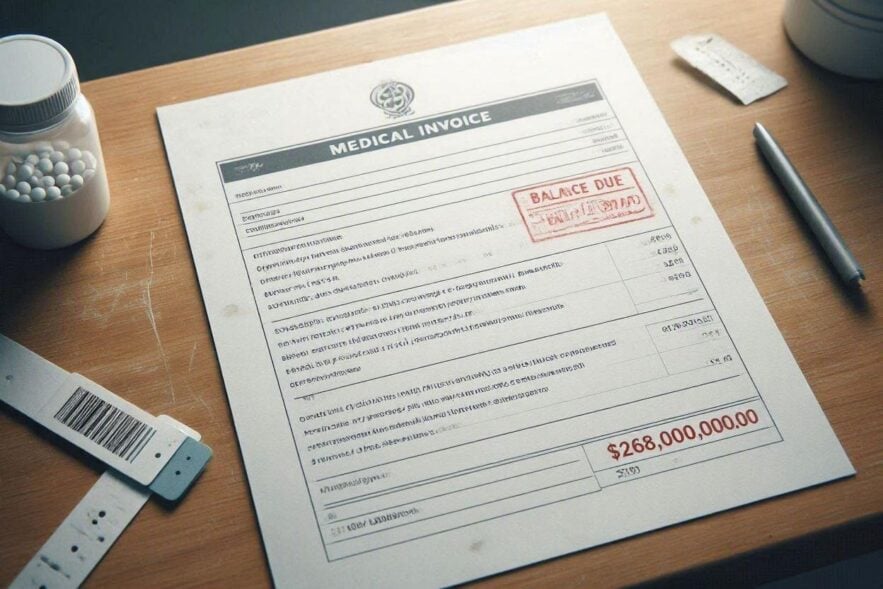
The indictment alleges that McMillan built provider profits around successful government reimbursement for skin-substitute products, as federal officials intensified their response to rapidly rising allograft payments, suspicious billing patterns, and financial incentives that can distort wound-care decisions.
WASHINGTON, DC — Federal prosecutors have charged Las Vegas businessman Michael McMillan in an alleged $268 million healthcare fraud and kickback operation that now stands among the largest wound-care cases announced during the Justice Department’s expanding 2026 National Health Care Fraud Takedown.
The indictment portrays McMillan’s business model as inseparable from government reimbursement, alleging that participating providers earned thousands of dollars whenever Medicare or another federal healthcare program approved a skin-substitute claim, while Protectus companies collected the larger remaining portion.
That reimbursement-dependent structure places the prosecution inside a wider federal campaign examining why public spending on costly wound products increased dramatically, how vendors and clinicians divided the proceeds, and whether unusually generous margins encouraged medically or economically improper treatment decisions.
McMillan has not been convicted; the indictment represents allegations rather than evidence, and he remains presumed innocent unless prosecutors prove every charged element beyond a reasonable doubt at trial or the proceeding concludes through another lawful resolution.
A Major Case Inside the 2026 Federal Crackdown
McMillan, 55, was charged in the Northern District of Texas with conspiracy offenses involving healthcare fraud and illegal remuneration, alongside seven allegations that he conducted substantial monetary transactions using property prosecutors contend originated from criminally derived healthcare proceeds.
According to the Northern District of Texas case announcement, McMillan owned Protectus LLC and related businesses that allegedly marketed skin substitutes through arrangements guaranteeing providers a substantial profit whenever federal programs reimbursed their associated claims.
Federal authorities say approximately $268 million was paid through the challenged wound-care claims, with roughly $174 million allegedly flowing to Protectus entities after medical providers retained their negotiated portions under transactions characterized publicly as rebates, discounts, or pricing adjustments.
The government’s theory therefore goes beyond whether a product was physically delivered, because prosecutors contend the underlying financial arrangement corrupted purchasing decisions, concealed providers’ true acquisition cost, and turned reimbursement into the trigger for distributing alleged kickbacks.
Protectus Allegedly Connected Profit Directly to Payment
The indictment identifies Protectus LLC, Protectus Technologies LLC, Protectus Consulting LLC, Prestige Medical Consultants LLC, Velare Wound Care LLC, and Amnio ReGen Solutions LLC as companies McMillan allegedly owned or controlled from approximately May 2019 through February 2026.
Prosecutors say those companies supplied skin-substitute products without requiring clinicians to pay before treatment, then invoiced providers only after Medicare, TRICARE, or another government healthcare program approved and paid the corresponding wound-product claim in full.
When a claim was denied, the provider allegedly owed Protectus nothing for the supplied product, but when reimbursement arrived, the provider commonly paid Protectus between 60 and 70 percent while retaining approximately 30 to 40 percent.
That arrangement allegedly removed much of the provider’s ordinary inventory risk while preserving an immediate financial reward for every paid application, creating what prosecutors describe as a powerful inducement to order, apply, and bill federally reimbursed skin substitutes.
Why the Reimbursement Trigger Matters
In an ordinary commercial purchase, a medical practice generally negotiates its acquisition price independently from whether an insurer later approves the resulting claim, leaving the provider responsible for contractual payment even when reimbursement is delayed, reduced, disputed, or denied.
The Protectus model allegedly reversed that relationship by making the invoice contingent upon successful reimbursement and calculating its amount as a percentage of the government payment, thereby aligning the vendor’s revenue, the provider’s profit, and the sales representative’s compensation around claim approval.
Prosecutors will likely argue that this shared financial dependence demonstrates unlawful intent because every participant allegedly benefited from larger or more frequent reimbursements, while the defense may contend that the transactions reflected lawful risk allocation, legitimate discounts, and customary commercial support.
The legal dispute will consequently depend upon documents, communications, witness testimony, billing rules, and transaction-level evidence showing whether the economic substance involved protected discounts or prohibited remuneration intended to induce federally reimbursed orders, purchases, or recommendations.
Alleged Rebates Left Providers with Millions
Across the alleged scheme, prosecutors estimate that participating medical providers retained about $94 million, the difference between government payments on affected claims and the approximately $174 million Protectus allegedly received after invoicing its contracted shares.
The indictment describes one October 2022 transaction in which a provider allegedly received $53,625.60, retained $16,087.68, and owed Protectus Technologies $37,537.92, reflecting a precise 30-to-70 division of reimbursement rather than a conventional fixed product price.
In another cited exchange in July 2023, a provider employee reportedly questioned an invoice because a newer agreement promised the clinician a 40 percent profit, while the accompanying calculation allowed only 35 percent, prompting McMillan to request a correction.
Those examples matter because prosecutors are presenting the retained amounts as rewards linked to claims, while the defense could challenge whether percentage-based calculations alone establish criminal purpose when healthcare contracting often includes rebates, credits, financing, and performance-related commercial terms.
Claim Prices and the Importance of Box 19
The government also alleges that Medicare claim submissions did not accurately disclose the providers’ effective acquisition price after discounts, rebates, refunds, and other adjustments, information prosecutors say belonged in Box 19 when billing these particular skin-substitute products.
According to the indictment, McMillan or Protectus personnel submitted claims, helped providers submit them, or counseled them to report prices higher than what clinicians ultimately paid, allegedly preventing administrators from seeing the reimbursement-contingent reductions embedded in the transactions.
One May 2024 episode allegedly followed a $9,024 payment on a provider’s claim and denial of another claim, after which a Protectus employee identified missing Box 19 information, suggested resubmission, and issued a $5,865.60 invoice representing 65 percent.
The claim-form allegations could become central because prosecutors must connect any inaccurate disclosure to McMillan’s knowledge and fraudulent purpose, while defense lawyers may examine ambiguous guidance, provider responsibility, employee communications, and whether each disputed statement materially influenced payment.
A Business Presentation Described the Economics
During a March 2024 meeting described by prosecutors, McMillan allegedly explained that Protectus offered providers an average rebate of approximately 35 percent, illustrating that a practice collecting $180,000 monthly from Medicare could retain about $63,000 under the proposed arrangement.
The indictment further attributes to McMillan a statement that he reviewed Medicare submissions to ensure Protectus products were billed above the amount providers actually paid, an allegation whose wording, context, reliability, and interpretation will likely receive extensive courtroom attention.
If authenticated and accepted by jurors, such statements could support the government’s assertion that Protectus deliberately organized pricing around reimbursement and understood the significance of acquisition-cost reporting, although the defense retains the right to challenge both context and meaning.
The meeting evidence also shows why investigators increasingly examine sales presentations, spreadsheets, invoice corrections, reimbursement reports, and informal messages: documents created to explain profitability can later become evidence of intent when commercial practices draw criminal scrutiny.
Sales Commissions Allegedly Followed the Same Formula
Prosecutors allege that representatives recruited clinicians by describing the profit opportunity, then received commissions calculated from amounts Protectus collected after government programs reimbursed providers, extending the same payment-dependent structure from the clinic relationship into the sales network.
Protectus allegedly paid approximately $27 million to sales representatives connected with participating providers, while commission reports tracked whether insurers had paid underlying claims before the company released compensation associated with those reimbursed transactions to its marketers.
A November 2022 email exchange cited in the indictment reportedly concerned a commission calculation totaling $44,035.92 and an alleged omission exceeding $6,400, with an employee explaining that payment depended upon confirmation that the provider had received insurance reimbursement.
Those commissions may become important under the federal Anti-Kickback Statute because independent sales compensation tied to federal healthcare business can create substantial exposure when payments are designed to reward referrals, orders, or recommendations rather than permissible employee activity.
A National Surge Put Skin Substitutes Under Scrutiny
McMillan’s prosecution followed federal analysts’ identification of a dramatic increase in payments for wound allografts, prompting investigators to compare provider utilization, product prices, patient profiles, treatment frequency, corporate relationships, and the flow of reimbursement into personal or affiliated accounts.
The Justice Department said eleven defendants, including eight licensed medical professionals and a company executive, were charged across six federal districts in 2026 cases involving billions of dollars in allegedly fraudulent amniotic allograft claims and associated patient harm.
In one separate Arizona matter, which does not involve McMillan, prosecutors alleged that providers billed Medicare more than $4 billion for one company’s allografts between late 2021 and mid-2024, producing more than $2 billion in payments.
Federal officials alleged that those products were acquired from tissue banks, relabeled, and sold at markups reaching approximately 2,000 percent, with charges as high as $1,450 per square centimeter and substantial portions allegedly distributed as kickbacks.
CMS Changed the Payment Environment in 2026
Against that backdrop, the Centers for Medicare and Medicaid Services realigned Medicare payment for affected allografts to $127 per square centimeter beginning January 1, 2026, sharply changing the economics that had attracted investigators, providers, distributors, and policymakers.
The Justice Department said that without federal intervention to address extraordinary allograft spending, the resulting increase in Medicare Part B premiums attributable to those payments alone would have cost every beneficiary about eleven additional dollars each month.
That policy change does not prove wrongdoing by McMillan or anyone else, because reimbursement reform is an administrative response to spending and utilization, while criminal liability requires evidence establishing the defendant’s knowledge, intent, participation, and responsibility for specific unlawful conduct.
Nevertheless, the timing gives the prosecution wider significance because the alleged Protectus operation continued until approximately February 2026, meaning its final period overlapped with a reimbursement reset expressly designed to reduce distorted margins and protect Medicare beneficiaries.
Data Analytics Expanded the Takedown
Federal officials credited the Health Care Fraud Unit’s Data Analytics Team with detecting the allograft payment spike that supported investigations, while a multiagency Data Fusion Center combined claims analysis, financial intelligence, law-enforcement records, and investigative expertise across numerous cases.
Rather than waiting exclusively for whistleblowers or provider complaints, modern healthcare fraud teams can identify outliers by comparing billing velocity, treatment frequency, square-centimeter utilization, patient diagnoses, provider geography, reimbursement concentration, and sudden changes across related companies.
Financial investigators can then trace payments from federal programs into provider accounts, vendor invoices, representative commissions, property purchases, vehicles, securities, and transfers among affiliated businesses, potentially connecting statistical anomalies to evidence that can support warrants or charges.
Analytics alone cannot establish guilt, however, because unusual billing may reflect specialization, regional disease burdens, referral patterns, new technology, or legitimate growth, requiring prosecutors to corroborate numerical patterns with testimony, records, communications, and proof of criminal intent.
The 2026 Takedown Reached Across the Country
The broader enforcement initiative charged 455 defendants, including 90 doctors and other licensed professionals, in alleged schemes involving more than $6.5 billion in false claims across 56 federal districts and 45 states and territories.
An Associated Press account of the nationwide crackdown highlighted cases involving allegedly unnecessary wound procedures, fraudulent hospice enrollment, fabricated cardiovascular diagnoses, services never delivered, and conduct that authorities said endangered patients while draining public insurance programs.
Federal and state participation extended beyond criminal indictments, with Medicare billing privileges revoked or suspended for thousands of providers, numerous civil settlements announced, exclusions imposed, and more than $182 million in property seized during coordinated enforcement activity.
The scale shows how the annual takedown has evolved from a collection of conventional billing prosecutions into a synchronized enforcement strategy combining criminal cases, civil recovery, administrative exclusion, payment suspension, professional accountability, analytics, and international apprehension efforts.
Northern Texas Became a Major Enforcement Center
Within the Northern District of Texas, prosecutors announced seven separate cases against thirteen defendants involving more than $365 million in alleged fraudulent billing, making McMillan’s approximately $268 million matter the district’s dominant case by announced financial scale.
The district’s other allegations concerned laboratory testing, transcranial magnetic stimulation, electroencephalography, hospice services, unsolicited coronavirus test kits, and durable medical equipment, showing investigators pursued multiple reimbursement channels rather than focusing exclusively on wound products.
Authorities said the FBI’s Dallas Field Office, the Health and Human Services Office of Inspector General, the Defense Criminal Investigative Service, and the Department of Veterans Affairs Office of Inspector General jointly investigated McMillan’s case.

Assistant United States Attorneys Marty Basu and Chad Meacham are prosecuting the indictment, while the participation of several inspector general offices reflects allegations involving Medicare, military-related coverage, veterans’ programs, and other federally financed healthcare benefits nationwide.
Luxury Transactions Add a Financial-Tracing Dimension
Seven monetary-transaction counts identify purchases or transfers exceeding $10,000 that prosecutors say involved criminally derived property, including expenditures associated with multiple residences, luxury vehicles, and a private aircraft acquired during the alleged scheme’s later years.
The indictment lists property-related transactions connected with Dallas, Las Vegas, Simpsonville in Kentucky, and Del Mar in California, along with a 2023 Lamborghini Urus, a 2023 Cadillac Escalade, and a Cessna Citation VII private aircraft.
The aircraft transaction allegedly involved approximately $2.56 million transferred in September 2025 from an account connected with Elite Elevated Enterprises LLC, although the government must still trace the funds and establish McMillan’s required knowledge beyond a reasonable doubt.
Authorities reported seizing assets valued at approximately $35 million in connection with the case, but seizure does not equal permanent forfeiture, and ownership, tracing, substitute-asset rules, third-party interests, and proportionality may remain contested throughout later proceedings.
Healthcare Companies Face a Compliance Warning
For manufacturers, distributors, marketers, and medical practices, the indictment underscores that commercial terminology cannot control legal substance, because a payment called a rebate, discount, commission, or consulting fee may still attract prosecution when it allegedly rewards federally reimbursed referrals.
Compliance teams should examine whether product invoices remain payable after denied claims, whether provider profit is guaranteed, whether sales compensation varies with reimbursement, whether acquisition costs are accurately disclosed, and whether billing assistance obscures responsibility for claim information.
Boards and executives should also require independent review of arrangements offering unusually large margins, especially when vendors finance inventory, prepare claims, monitor payment status, calculate provider shares, and compensate representatives from the proceeds of government healthcare programs.
When allegations become public, disciplined crisis public-relations management can help an organization distinguish charges from established facts, preserve patient confidentiality, coordinate accurate stakeholder communications, and avoid impulsive statements that create additional legal or reputational exposure.
Patient Care Remains the Central Public Concern
Skin substitutes can provide meaningful clinical benefits for appropriately selected chronic wounds, yet unusually lucrative reimbursement may create pressure to apply larger products, repeat procedures, select expensive brands, or treat patients whose conditions do not support the intervention.
Although McMillan’s indictment primarily emphasizes alleged kickbacks, false price disclosures, and financial transactions, the national takedown placed wound-care enforcement within a broader patient-protection campaign addressing medically unnecessary procedures, hospice patients, untreated infections, and excessive allograft application areas.
That distinction matters because the government need not establish that every application was worthless to argue that financial inducements corrupted medical judgment, while the defense can contest whether identified treatments were necessary, beneficial, properly documented, and independently selected.
Public discussion should therefore avoid treating every clinician, representative, patient, or transaction associated with a charged company as culpable, particularly when the indictment uses anonymous labels, and prosecutors have not charged numerous referenced participants in this specific proceeding.
Reputation and Legal Process Move on Different Timelines
An indictment immediately reshapes search results, professional relationships, employee confidence, and public perception, even though discovery, pretrial motions, expert analysis, trial preparation, and appellate review can require several years before producing a definitive legal outcome.
Organizations facing that imbalance may require carefully documented reputation-rebuilding strategies that publish accurate updates, correct demonstrable errors, respect court restrictions, preserve the presumption of innocence, and maintain consistent messaging without concealing material facts or attacking legitimate reporting.
Effective communications should identify what prosecutors allege, what the defense disputes, what remains unknown, and what operational safeguards have changed, because credibility depends upon separating verified developments from advocacy while proceedings continue under intense public scrutiny.
For healthcare businesses specifically, transparent compliance remediation can become more persuasive than broad denials, particularly when leaders can demonstrate revised contracting controls, independent billing review, protected reporting channels, preserved records, and restrictions on reimbursement-linked compensation.
What Happens Next in the McMillan Case
Pretrial litigation may address electronic communications, invoice records, claim submissions, medical documentation, financial tracing, search procedures, expert testimony, witness credibility, and the line between legitimate healthcare discounts and remuneration prohibited by applicable federal criminal law.
Prosecutors must prove McMillan knowingly joined the charged conspiracies and conducted the identified financial transactions with the required awareness, while defense counsel can challenge statutory interpretation, loss calculations, materiality, attribution, intent, and the reliability of cooperating witnesses.
Any eventual sentencing analysis following convictions would require individualized findings concerning applicable statutes, advisory guidelines, criminal history, accepted responsibility, attributable loss, number of victims, role in the offense, obstruction, recovered property, and other legally relevant circumstances.
Until a jury returns verdicts or another lawful disposition resolves the charges, the $268 million figure remains an allegation, the assets remain subject to legal process, and every count against Michael McMillan remains governed by the constitutional presumption of innocence.
A Reimbursement Case with National Consequences
The lasting importance of the federal case against Michael McMillan may depend on whether prosecutors can prove that reimbursement-contingent discounts were disguised kickbacks, that inaccurate acquisition prices materially affected claims, and that money flowing through Protectus funded the transactions identified in the indictment.
Beyond that courtroom contest, the case shows how a rapidly expanding reimbursement category can attract vendors, clinicians, marketers, and federal investigators at the same time, especially when product prices rise, treatment volume accelerates, and participants share unusually large public payments.
The 2026 response combines prosecution with payment reform, analytics, administrative suspensions, forfeiture efforts, and cross-agency investigation, signaling that authorities intend to reduce questionable spending before reimbursement leaves government accounts while pursuing alleged proceeds already distributed.
For Medicare beneficiaries and taxpayers, McMillan’s case now represents one prominent test of that strategy, linking an individual indictment to the government’s larger effort to determine whether financial engineering, rather than patient need, drove portions of America’s wound-care boom.