

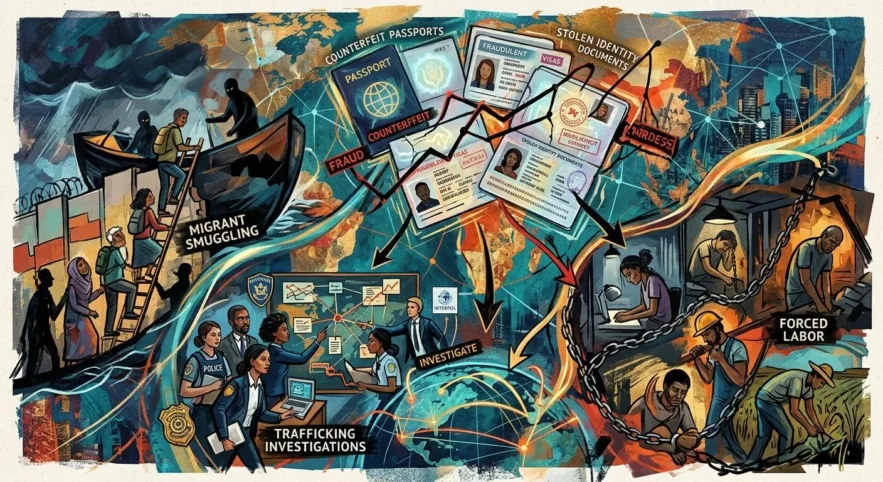
Counterfeit passports, fraudulent visas and stolen identity documents are increasingly linked to migrant smuggling, forced labor and international trafficking investigations, prompting authorities to examine criminal networks rather than isolated document offenses.
WASHINGTON, DC, November 14, 2026 — Counterfeit passports, fraudulent immigration documents, and confiscated identity papers continue to appear in investigations involving human smuggling and trafficking, showing how document-related offenses can support criminal activities that span international borders and domestic labor markets.
Federal investigators increasingly examine these documents as evidence of broader criminal schemes, recognizing that fraudulent identification may facilitate unauthorized travel while the confiscation of genuine passports can become a method of controlling vulnerable workers and trafficking victims.
The relationship between document fraud and organized exploitation has attracted renewed attention following American prosecutions and European investigations involving alleged migrant-smuggling networks, fraudulent employment arrangements, forced labor and the movement of vulnerable people between jurisdictions.
For authorities, the challenge extends beyond detecting counterfeit credentials because an apparently legitimate passport may become central to a criminal investigation when its holder is coerced, its contents are misrepresented or its possession is controlled by another individual.
Document Fraud Connects Different Forms of Organized Crime
Criminal organizations involved in human smuggling or trafficking may encounter identity documents at several stages of their operations, including recruitment, transportation, employment arrangements and efforts to control individuals after they reach their destinations.
Some networks allegedly supply counterfeit passports or other identification to facilitate unauthorized movement, while others exploit genuine travel documents by withholding them from vulnerable people who depend on criminal intermediaries for transportation or employment.
These practices differ significantly in their legal circumstances, but both show why investigators examine document-related activity alongside evidence of financial payments, recruitment promises, transportation arrangements, and the exercise of coercive control.
The broader investigative objective is to establish whether suspicious documents reflect isolated violations or form part of coordinated criminal activity, while identifying victims and distinguishing their circumstances from those of suspected organizers.
Human Smuggling and Human Trafficking Are Different Offenses
Human smuggling generally involves facilitating someone’s unlawful entry into a country, frequently for financial gain, while human trafficking involves exploitation through legally defined forms of coercion, fraud or other prohibited conduct.
Trafficking does not necessarily require international transportation because exploitation can occur within a person’s home country, including when the individual originally entered employment or traveled through entirely lawful arrangements.
A person who voluntarily pays a smuggler may subsequently experience coercion or exploitation, but the existence of an unauthorized border crossing does not automatically establish that human trafficking has occurred.
These distinctions matter because investigators must evaluate criminal responsibility and potential victimization separately, avoiding assumptions that every person carrying fraudulent documentation willingly participated in the operation that supplied or controlled it.
U.S. Farmworker Case Highlights Passport Confiscation
A federal prosecution announced in February 2026 demonstrated how genuine passports and immigration documents can become instruments of alleged labor exploitation rather than merely evidence of unauthorized travel or document counterfeiting.
According to the U.S. Department of Justice’s February 23, 2026, announcement, three Mexican citizens were charged in a 35-count indictment involving allegations of trafficking agricultural workers into forced labor on farms in Virginia, North Carolina and Florida.
Prosecutors alleged that recruiters charged workers substantial fees before their arrival and that the defendants subsequently confiscated passports, visas and identification documents to restrict their ability to leave exploitative employment conditions.
The indictment also alleged inadequate housing, withheld wages and other abusive treatment, illustrating how possession of another person’s travel documents can become part of a broader coercive arrangement rather than an ordinary administrative dispute.
The charges remain allegations unless proven in court, and the defendants are presumed innocent, but the case demonstrates why labor trafficking investigations frequently examine control over identity documents alongside recruitment, compensation and working conditions.
Spanish Investigation Connects Forgery With Child Trafficking Allegations
European investigators have also documented cases involving alleged trafficking networks and fraudulent identity documents, including a Spanish investigation into the suspected movement of unaccompanied minors from the Canary Islands toward France.
As Reuters reported on Nov. 13, 2025, Spanish police arrested 11 suspects during operations connected to an alleged trafficking network that investigators believed supplied forged documents and arranged the movement of vulnerable children.
The investigation followed the disappearance of 14 minors from reception facilities between late 2024 and mid-2025, raising concerns about possible exploitation and the criminal use of misleading identification during international transportation.
Authorities examined suspected connections involving Spain, Morocco, Ivory Coast, and France, showing the difficulties of investigating vulnerable individuals’ movements when different jurisdictions, immigration procedures, and identification records are involved.
The allegations highlight why child protection and document authentication must operate together, since investigators need to establish both the legitimacy of travel arrangements and whether accompanying adults possess lawful authority over minors.
Migrant-Smuggling Networks Use Fraudulent Identification
Investigations into organized migrant smuggling have identified criminal groups suspected of supplying false documents alongside transportation arrangements, creating opportunities for individuals to move through immigration systems using misleading identity or residence information.
In September 2026, Europol announced an international operation involving authorities from 17 countries that targeted a suspected network facilitating irregular migrant movement through European airports using fraudulent identity documents.
Investigators identified suspected distribution arrangements involving more than 1,000 counterfeit identity documents and reported indications that the wider criminal enterprise generated more than 2 million euros in unlawful proceeds.
The investigation also revealed suspected links between document suppliers and financial facilitators, showing how identity fraud can become an organized commercial service that supports criminal activities beyond a single border crossing.
Genuine Passports Can Become Instruments of Coercion
Human trafficking investigations frequently distinguish between forged documents used to misrepresent identity and authentic passports confiscated to restrict a person’s independence, since the latter can be especially relevant to allegations of forced labor.
Workers whose employers retain their passports without lawful justification may face practical obstacles to leaving exploitative conditions, particularly when they lack financial resources, language assistance or reliable information about their legal rights.
Confiscation can also accompany threats involving immigration status, debt, housing or family members, potentially creating a coercive environment in which victims believe that refusing demands will expose them to serious consequences.
However, investigators must examine the circumstances surrounding document possession rather than assume every temporary transfer of identification constitutes trafficking, because lawful administrative handling and coercive withholding are materially different situations.
Labor Recruitment Fraud Often Begins Before International Travel
Some labor exploitation schemes begin with deceptive recruitment arrangements that promise lawful employment, reasonable wages and appropriate accommodation, only for workers to encounter substantially different conditions after arriving in their destination country.
Recruitment fees can create financial pressure when workers borrow money to obtain promised positions, potentially increasing vulnerability if employers subsequently withhold identification, restrict movement or threaten consequences for leaving.
False statements concerning visa sponsorship, employment conditions or immigration eligibility may become relevant investigative evidence, especially when prosecutors seek to establish whether alleged deception began before workers entered the country.
These circumstances show why authorities increasingly consider recruitment records, employment agreements, and financial arrangements alongside identity documents, recognizing that the full course of alleged exploitation may span several jurisdictions.
Counterfeit Documents Can Conceal Criminal Identities
Fraudulent passports can also support criminal concealment when suspected offenders attempt to misrepresent personal information while arranging transportation, establishing commercial relationships or avoiding identification during encounters with authorities.
A forged document may appear credible at a casual glance while containing false biographical information, creating difficulties for organizations that rely on accurate government credentials to verify customers or identify individuals.
However, authentic passports can also be misused by impostors, meaning law enforcement agencies must distinguish counterfeit manufacturing from unauthorized possession, identity theft and genuine credentials obtained through fraudulent applications.
For investigators, these distinctions determine which evidence is relevant, because establishing physical counterfeiting is different from proving that someone knowingly impersonated another individual or supplied deceptive information during an official application.
Financial Investigations Reveal Connections Among Criminal Participants
The financial arrangements surrounding suspected smuggling and trafficking operations can provide important evidence when investigators examine recruitment payments, transportation expenses and other transactions potentially associated with organized criminal activity.
Authorities may investigate whether suspected organizers profited from unlawful services, whether victims incurred coercive debts or whether financial records establish relationships among individuals operating in different countries.
Such examinations require lawful access to relevant information and careful corroboration, since financial transactions alone do not establish criminal responsibility or demonstrate that every associated person knowingly participated in illegal conduct.
Financial investigations can nevertheless complement document examination by helping prosecutors understand the structure of suspected criminal enterprises and distinguish alleged organizers from intermediaries, exploited workers or unrelated commercial participants.
Border Security Technology Supports Identity Verification
Modern passports incorporate specialized physical security features and electronic authentication capabilities intended to help trained inspectors identify counterfeit documents and detect unauthorized changes to protected identity information.
As explained in Amicus International Consulting’s examination of passport security and counterfeit detection, effective document examination combines physical security features, electronic verification and identity assessment rather than relying solely on an apparently convincing photograph or passport booklet.
Electronic passport chips can contain digitally signed identity information, allowing compatible systems to verify whether protected data corresponds to an authorized issuing authority when the necessary trust information is available.
These safeguards can strengthen counterfeit detection but cannot independently determine whether a genuine passport has been confiscated, whether its holder is experiencing exploitation or whether travel arrangements involve coercion.
Biometric Screening Addresses Impostor Travel Risks
Facial recognition and other biometric technologies can support border inspections by comparing travelers with trusted identity records, helping authorities investigate situations where someone appears to be presenting another individual’s genuine travel document.
These comparisons address a different concern than physical counterfeiting because a passport may have valid security features and electronic information while still being used by someone other than its rightful holder.
Biometric results nevertheless require appropriate interpretation because image quality, appearance changes and technical limitations can produce uncertain comparisons, making additional examination necessary before authorities establish whether deliberate identity deception occurred.
For trafficking investigations, biometric verification may help clarify identity questions, but technology alone cannot establish whether a person consented to travel, experienced exploitation or was forced to surrender identification.
Victim Protection Must Remain Part of Enforcement
Investigations involving suspicious travel documents can encounter vulnerable people who were deceived, threatened or compelled to participate in arrangements they did not organize, requiring authorities to evaluate potential exploitation alongside immigration violations.
A trafficking victim may possess a counterfeit passport supplied by another person or may have been deprived of genuine identification, making document status alone insufficient to determine responsibility for criminal conduct.
Effective responses therefore require appropriate screening, trained personnel and access to support services, while investigators develop evidence concerning suspected organizers without assuming that every individual connected to fraudulent documentation is equally culpable.
These safeguards help distinguish criminal accountability from victim protection, supporting investigations that identify those directing exploitation while recognizing the different legal circumstances of workers, migrants and children.
International Cooperation Helps Identify Wider Criminal Networks
Passport-related investigations often cross borders because recruitment, transportation, document production, and suspected exploitation may occur in different countries, requiring cooperation among authorities with distinct legal responsibilities and evidentiary procedures.
Information sharing can help investigators establish relevant identities, examine travel records and connect suspected criminal activity, provided that disclosures comply with applicable privacy protections and recognized international cooperation arrangements.
The continuing challenge is ensuring that reliable intelligence supports appropriate enforcement decisions while preventing unsupported allegations or inconsistent records from creating additional difficulties for innocent travelers and potential trafficking victims.
Document Security and Human Protection Require a Combined Response
The overlap between document fraud, migrant smuggling and human trafficking demonstrates that travel credentials can serve very different roles, sometimes enabling identity deception and sometimes becoming instruments used to control vulnerable individuals.
For governments, effective investigations require more than detecting counterfeit passports because identifying criminal organizers, protecting victims and examining financial or recruitment arrangements can reveal the broader circumstances surrounding suspicious documentation.
Modern authentication technology can increase confidence in legitimate travel credentials, but its security benefits must work alongside trained investigators, lawful information sharing, and procedures designed to recognize exploitation.
Ultimately, the strongest response combines reliable identity verification with coordinated criminal investigations and victim protection, recognizing that the consequences of document-related crime extend beyond border checkpoints into workplaces, families and communities.