

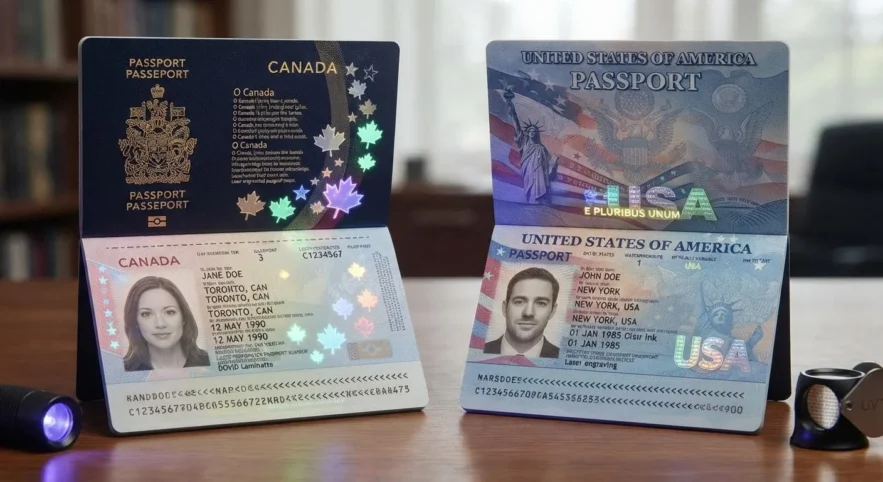
An examination of documented national features shows how countries combine materials, personalization and digital protections in different passport generations.
Washington, DC, October 19, 2026 — United States and Canadian passports illustrate how governments can follow common international travel-document standards while choosing different combinations of materials, personalization methods, artwork, optical effects and electronic protections to secure successive passport generations.
Both countries now use modern electronic passports with advanced identity pages and layered physical defenses, yet their documented features demonstrate that interoperability does not require identical designs, because each issuing authority can select technologies suited to its own security, production and national-design priorities.
International Standards Leave Room for National Design Choices
Modern passports operate within a common technical environment shaped by the International Civil Aviation Organization’s machine-readable travel document framework, but individual governments retain considerable freedom over the physical features and production techniques incorporated into their booklets.
ICAO guidance emphasizes combining materials, personalization and security techniques in ways that resist unauthorized reproduction, alteration and page substitution, while also recognizing that issuing states can choose among several technologies according to their document systems and operational requirements.
This flexibility allows one country to emphasize particular optical features, another to focus heavily on laser personalization and another to introduce specialized artwork or booklet construction while remaining compatible with standardized border inspection systems.
The United States and Canada provide useful examples because both have introduced newer passport generations that incorporate polycarbonate identity pages and modern electronic features while expressing security through visibly different national designs.
The United States Introduced Its Next Generation Passport in 2021
The United States began issuing its next-generation passport book in 2021, replacing earlier design elements with a document that incorporates more advanced materials and personalization technologies.
Official State Department information identifies a polycarbonate data page, laser engraving, updated artwork, security fibers in the passport paper and a perforated alphanumeric passport number appearing throughout the booklet among the features of the newer design.
Together, these features show how the United States has moved beyond conventional printed personalization toward a structure in which the holder’s identifying information is more closely integrated with the physical material of the identity page.
At the same time, the continued use of security fibers, perforation and booklet-wide features demonstrates that the American security strategy extends beyond the data page rather than treating the chip or portrait as the only meaningful protective components.
Polycarbonate Changes the U.S. Identity Page
A polycarbonate data page lets the issuing authority integrate personalized information more deeply into the material than conventional surface printing on paper would allow.
Laser engraving can place portraits, names, document numbers, and other identity information within the polycarbonate structure, making straightforward alteration more difficult without disturbing the surrounding material.
This approach also creates opportunities for secondary security features to interact with the engraved information, forcing a would-be alteration to remain consistent across several overlapping physical characteristics.
The resulting identity page therefore becomes a coordinated security structure rather than a simple photograph and collection of printed biographical fields.
U.S. Security Paper Protects the Wider Booklet
The next-generation American passport also uses security fibers within its paper, creating another physical layer of examination beyond the polycarbonate identity page.
These fibers can help distinguish authentic passport stock from ordinary commercial paper and add to the broader set of material characteristics inspectors can compare during close examination.
The booklet also incorporates perforated passport numbering across pages, creating a continuing relationship between the document number and the broader passport structure.
This design makes security a booklet-wide concept, because manipulation affecting individual pages must remain consistent with repeated numbering, materials and other features elsewhere in the document.
The U.S. Passport Card Uses a Different Security Format
The United States also issues a passport card, which demonstrates how the same government can adopt a different physical security architecture for another travel-document format.
According to the State Department, the wallet-sized polycarbonate card uses features including raised printing, microtext, color-shifting ink, textured artwork, and holographic elements.
The card lacks visa pages like a passport book, so its physical security is concentrated on a much smaller surface and must be engineered differently from the booklet format.
This comparison illustrates an important security principle: document design depends not only on national preference but also on the credential’s physical format and intended travel use.
Canada Introduced a Major Passport Redesign in 2023
Canada announced its newest passport design in 2023, introducing a polycarbonate personal information page alongside new optical, laser-generated, and artwork-based security features.
The Canadian government identifies multiple representations of the passport holder’s photograph, a visible chip and antenna, color-shifting elements, temperature-sensitive ink, and sophisticated optical features among the new booklet’s security characteristics.
Canada also replaced conventional ink-based personalization on the identity page with laser engraving, strengthening the integration between the holder’s information and the polycarbonate material.
This redesign shows a similar move toward layered material security, but expresses that strategy through features that differ visibly from those emphasized in the current American passport.
Canada Uses Multiple Representations of the Holder
One notable aspect of the Canadian design is that the personal information page includes several versions of the passport holder’s photograph.
Redundant portraits can strengthen identity protection because an unauthorized alteration must preserve consistency across several representations rather than changing only one primary image.
Canada’s newer passport also incorporates a Kinegram over the main portrait, creating optically variable effects that change as the page is viewed from different angles.
These moving, changing features give inspectors dynamic evidence that a single flat photograph or ordinary photocopy cannot fully capture.
The Canadian Data Page Uses Laser Engraving
Canada’s newest passport personal information page is made of polycarbonate and uses laser engraving, rather than ordinary ink, to personalize key identity information.
This approach improves durability while making the data page more resistant to straightforward removal or alteration of personalized fields.
The Canadian design also uses a custom see-through window containing another representation of the passport holder, creating additional interaction between transparent materials and individualized information.
These features show how one material choice can support several security techniques at once, rather than merely serving as a more durable replacement for paper.
Variable Laser Images Add Another Canadian Layer
Canada’s redesigned passport includes a variable laser image that changes with viewing angle, adding another dynamic feature to the personalized identity page.
These features can display different information or imagery through carefully controlled optical structures created within compatible document material.
An examiner can therefore tilt the page and observe whether the expected transitions occur, adding movement-based inspection to static checks involving engraved text and portraits.
This interaction between laser personalization and optical behavior shows how modern document design increasingly combines several technologies in the same physical area.
Temperature-Sensitive Ink Creates a Different Examination Method
Canada’s current design also includes a red maple leaf feature that changes when warmed by physical contact, offering an unusual example of a security characteristic that responds to temperature rather than light or viewing angle.
A feature like this adds another dimension to physical inspection because its behavior depends on material properties that ordinary printing cannot automatically reproduce.
The purpose is not to let one temperature-sensitive mark prove authenticity on its own, but to create another independently behaving feature within the broader design.
A sophisticated counterfeit must therefore reproduce not merely appearance but also material response across several unrelated technologies.
Canadian Visa Pages Extend Security Beyond the Identity Page
Canada’s newest passport incorporates seasonal artwork throughout the visa pages, and those designs change under ultraviolet illumination.
This feature demonstrates that booklet security continues beyond the holder’s personal information page and contactless chip.
Ultraviolet-responsive imagery creates a second visual layer that inspectors can compare against known genuine examples while also making page substitution more difficult.
The Canadian booklet therefore uses national artwork not merely for appearance but as part of a security strategy spanning the wider physical document.
Older Canadian Passports Remain Different but Legitimate
Canada has used ePassports since 2013, meaning more than one legitimate passport generation can remain in circulation during the transition to newer designs.
Earlier Canadian ePassports used digitally embedded identity information, holographic laminate, optically variable ink, a secondary photograph, see-through registration, and the standardized machine-readable zone.
Multiple valid generations show why document inspection must consider the exact passport series rather than assuming every genuine document from one country should display the newest security features.
A difference between two Canadian passports can therefore reflect normal generational change rather than counterfeiting or unauthorized alteration.
The Same Principle Applies to U.S. Passports
The State Department likewise recognizes that earlier American passport designs remain valid for international travel when they have not expired or become damaged.
This means border inspectors and travelers can encounter genuine U.S. passports with physical characteristics that differ substantially from the next-generation design introduced beginning in 2021.
Security evaluations must therefore account for issuance date, document series, and known production characteristics before interpreting a missing feature as suspicious.
National passport modernization creates overlapping generations, making reliable reference information essential for anyone comparing physical features.
Electronic Chips Add a Shared Digital Layer
Despite their different physical designs, both American and Canadian passport books operate within the broader electronic passport environment built around contactless integrated circuits and standardized digital data structures.
The chip can store biographical information and a government-enrolled facial image and support cryptographic mechanisms that let compatible inspection systems evaluate protected electronic data.
This electronic architecture creates a common technical foundation beneath otherwise distinct national booklet designs.
As a result, two passports can look dramatically different while still communicating with border systems through standardized electronic processes.
Physical Appearance and Digital Interoperability Serve Different Goals
The physical booklet lets national authorities build distinctive security features into materials, printing, portraits, optical effects, and national artwork.
By contrast, the electronic component follows internationally interoperable structures so foreign inspection systems can locate and authenticate standardized data.
These functions complement one another because physical examination helps identify tampering or counterfeit construction, while cryptographic checks help determine whether protected electronic information remains trustworthy.
Neither country relies upon one side of that equation alone because modern passport security depends upon the interaction between physical and digital evidence.
The MRZ Provides Another Shared Standard
Both U.S. and Canadian passport books also use the standardized machine-readable zone found on modern international travel documents.
The MRZ allows automated readers to capture names, passport numbers, dates, and other document information according to a predictable international format.
Its standardized structure helps border systems process documents from different issuing countries even when the visible page designs have little in common.
This feature demonstrates how international interoperability can coexist with significant differences in national visual and physical security design.

National Artwork Can Carry Security Value
Passport artwork often draws attention for its cultural or aesthetic meaning, but carefully designed imagery can also become a key part of document security.
Fine-line patterns, ultraviolet transformations, detailed backgrounds and artwork integrated with personalized information can create additional barriers against straightforward reproduction.
Canada’s seasonal designs and the United States’ updated next-generation artwork show how national imagery can support broader anti-counterfeiting strategies.
The security value emerges when artwork interacts with specialized materials and printing methods rather than functioning only as decorative illustration.
Material Choices Influence the Available Security Features
Polycarbonate enables laser engraving, transparent windows, tactile effects, and certain variable optical techniques that are difficult to replicate identically on a conventional paper identity page.
Security paper supports embedded fibers, watermarks and ultraviolet-responsive characteristics that provide different forms of protection across the remainder of the passport booklet.
Issuing authorities therefore select materials not only for durability but also based on the security technologies they intend to integrate.
The documented U.S. and Canadian designs show how similar materials can support different combinations of protective features, depending on each government’s design priorities.
No One National Feature Provides Complete Verification
A U.S. passport containing the expected polycarbonate page or a Canadian document displaying the correct Kinegram should not be declared authentic solely because that one feature appears convincing.
Professional examination considers whether multiple physical elements, electronic data, cryptographic signatures, and document-status information all remain consistent.
A counterfeit may imitate selected visible features while failing material, electronic or database checks elsewhere in the inspection process.
The strongest security therefore comes from the interaction between independently designed protective mechanisms rather than dependence upon one spectacular technology.
Generational Knowledge Is Essential for Inspection
Passport designs change periodically as governments introduce new materials, respond to emerging fraud techniques and adopt improved production technologies.
A physical feature documented for the newest American or Canadian passport may therefore be an inappropriate reference for a legitimately issued older booklet.
Inspectors need to identify the document generation before determining which holograms, portraits, materials or ultraviolet characteristics should be present.
This requirement explains why reliable passport examination depends upon current reference information rather than generalized assumptions about how a country’s passport is supposed to look.
ICAO Guidance Encourages Layered Design
ICAO security guidance emphasizes protecting travel documents against counterfeiting, alteration, photo substitution and page replacement through appropriate combinations of materials, personalization and construction techniques.
The framework does not prescribe a single universal national design, because different issuing states may choose different systems while still meeting broader machine-readable and electronic interoperability requirements.
The United States and Canada illustrate this principle clearly because both incorporate modern polycarbonate personalization and electronic capabilities while choosing distinct secondary physical features.
Their passports therefore demonstrate how international standardization can strengthen global compatibility without eliminating national innovation in document security.
Physical and Electronic Checks Reinforce One Another
A modern inspection system can compare visible passport information with the machine-readable zone and electronically stored data while also evaluating physical features appropriate to the specific document generation.
If the portrait, document number, physical personalization, and authenticated chip information all agree, the inspector gains several independent forms of supporting evidence.
If those elements conflict, the disagreement can outweigh any single hologram or printed feature.
Travelers seeking a broader explanation of this layered approach can review the Amicus International Consulting guide to modern passport security and counterfeit detection, which examines how physical and digital defenses work together.
National Passport Designs Continue to Evolve
The United States and Canada will continue updating passport technology as materials, cryptography, biometric systems and counterfeiting methods evolve.
Future generations may preserve some existing features while replacing others with new techniques better suited to changing production and border-processing environments.
This continuous development means passport security should be understood as an evolving architecture rather than a fixed collection of permanent visual characteristics.
Each redesign gives governments an opportunity to strengthen resistance to alteration while maintaining compatibility with international systems that depend on standardized travel-document information.
U.S. and Canadian Passports Demonstrate Layered Security in Practice
The current American and Canadian passport generations share key technological themes, including electronic chips, advanced materials, and stronger personalization, yet each government implements those protections through a distinct combination of physical design choices.
The American next-generation passport emphasizes polycarbonate personalization, laser engraving, security fibers and perforated numbering, while Canada’s newest design adds multiple portraits, optical movement, transparent elements, temperature-responsive features, and ultraviolet-changing artwork.
These differences do not indicate competing definitions of passport security because both approaches fit within the broader principle that multiple independent defenses should reinforce the identity information carried by the document.
The comparison ultimately demonstrates how governments can achieve international interoperability while preserving distinctive national security designs, with materials, personalization, cryptography, and booklet construction working together to make modern passports substantially harder to alter or reproduce convincingly.